
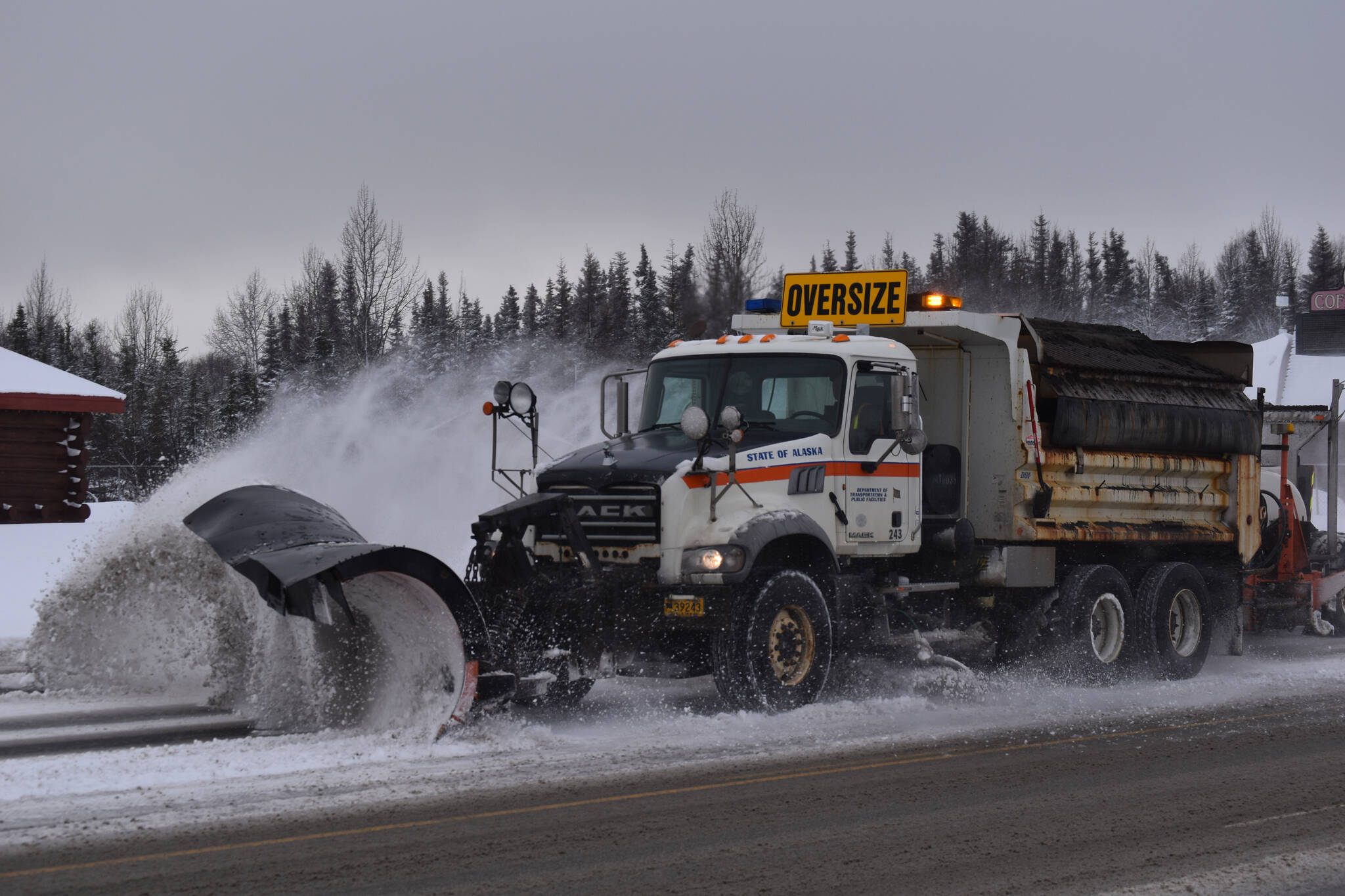
The Alaska Department of Transportation and Public Facilities is exploring maintenance strategies that could reduce the use of brine on state roads by about 40% this winter.
That’s what Ryan Anderson, commissioner of the department, told attendees during a community discussion on road brine held on Oct. 11 in Soldotna. The event, facilitated by Kenai Peninsula Borough Mayor Peter Micciche, drew roughly 200 in-person and online attendees, the borough estimates.
Everyone was there to talk about the department’s use of salt brine on roads during the winter, which many peninsula residents and automotive workers oppose. Public interest in the issue has largely been led by Mike Arnold, who has been circulating petitions calling for the end of bring use since last year. As of Oct. 11, Arnold’s petitions have garnered more than 5,000 signatures.
Members of the Kenai Peninsula Borough Assembly during their Oct. 10 meeting unanimously passed a resolution calling on DOT to stop using salt bring on Kenai Peninsula roads until more information is available. “The grassroots effort regarding the opposition to the use of salt brine includes concerned community leaders, individuals and business owners; a diverse group of individuals mostly rarely heard from before on other local issues, whose concerns range from accelerated corrosion, black ice formation, and concern for the effects on aquatic resources,” the resolution says.
Micciche kicked off the meeting by thanking Anderson and Special Assistant to the Commissioner Andy Mills for attending. A sitting commissioner attending a local meeting, Micciche said, “happens rarely.”
Anderson and Mills during their opening remarks acknowledged how important the use of salt brine is to residents of the Kenai Peninsula and dispelled misconceptions about the department’s use of the solution to treat winter roads.
“I want to acknowledge the petition that has been submitted by this community,” Anderson said. “We take that seriously. The latest I’ve heard is over 5,000 signatures. That’s people speaking loud and clear that ‘Hey there’s something going on here that needs to get addressed.’”
Mills said there are three levels of brine solutions that can be used for de-icing, which refers to treating roads on which ice has already accumulated, and for anti-icing, which refers to the pre-treatment of roads.
The brine used by the department is 23% sodium chloride, and is the least corrosive of the solutions available, as well as the cheapest and most commonly used. Calcium chloride, which Mills said is available for purchase at stores like Safeway, is a 28% concentration and works at lower temperatures. Magnesium chloride, he said, is even stronger.
“As you get to these steps where you get to something that is at a lower freezing point or operationally used to address lower temperatures, it gets more corrosive,” Mills said. “So, I did want to let folks know that sodium chloride is what is used in our brine and it is the least corrosive of those three options.”
Vehicle corrosion and associated costs, threats to public safety and environmental impacts were the top concerns voiced by the nearly 40 people who spoke during the Oct. 11 meeting. Only one person spoke in support of the use of salt brine, saying that they’d rather risk a rusty vehicle than dangerous roads.
Laura Maciariello spends a lot of time on the roads. She’s said she’s worked as a FedEx driver for 35 years and that their fleet of vehicles have experienced problems since brine use started. Those problems look like rusted off running boards and having to stop and wipe bring residue off of her windshield and mirrors.
“I don’t have a back window, of course — I’m completely dependent on my mirrors for what’s behind me,” Maciariello said. “I have to stop and clean my mirrors at least three times every shift or I can’t see out of them, especially when it’s dark.”
Anthony Pisa, the owner and operator of Anthony’s Transmission and Automotive Repair in Kenai, said he’s seen brakes on fire, minivan doors that won’t shut, leaf springs that have punched through a truck bed, broken shackles and “catastrophic brake line failure.” As a result, Pisa said customers are paying for thousands of dollars worth of repairs.
“Business is booming, and not in these people’s favor,” Pisa said. “Every day is another eye-opener — shocking — of what’s happening to these vehicles. It’s scary.”
Other attendees questioned the effect of brine use on roads to local wildlife and the Kenai River; multiple people reported seeing moose licking roads and vehicles. One speaker said brine attracts moose the same way mineral licks do during hunting season.
“You’ve got to see this — there’s a moose licking your F-150!” Kasilof’s Dave Hopkins remembers his wife telling him one winter.
Between vehicle corrosion and attracting more moose to roads, public safety and the high cost of repairs for residents was a key theme among those who spoke.
Also in attendance at Wednesday’s meeting were Rep. Justin Ruffridge, Rep. Ben Carpenter and assembly members Brent Johnson, Tyson Cox, Bill Elam and then-assembly member Richard Derkevorkian.
“I certainly can just say for myself, hearing from the folks in the room, as we go back to Juneau in January, I hope we continue this conversation from a budgetary perspective,” Ruffridge said. “Certainly we’ll have my support to use some of those tools at our disposal.”
At the close of the meeting, Anderson said the department ordered 3,000 more cubic yards of sand for use on Soldotna roads than is usually used. Additionally, the department is considering generally reducing brine use and only administering it on certain roads, which Anderson said the department estimates could reduce brine use by 40%.
Moving forward, Anderson said the department will need to balance public interests with funding availability, available data and trials and the level of road quality that motorists have come to expect on state roads.
“We do have these service levels that we really want to maintain for people,” Anderson said. “I’ve driven on bad roads in the wintertime and we don’t want that. I think if we can find new ways to manage this that are also effective so we’re all out there driving on safe roads, I think that’s a good thing for everybody.”
The Kenai Peninsula Borough’s full town hall on road brine use can be streamed on the borough’s YouTube channel.
Reach reporter Ashlyn O’Hara at ashlyn.ohara@peninsulaclarion.com.
