
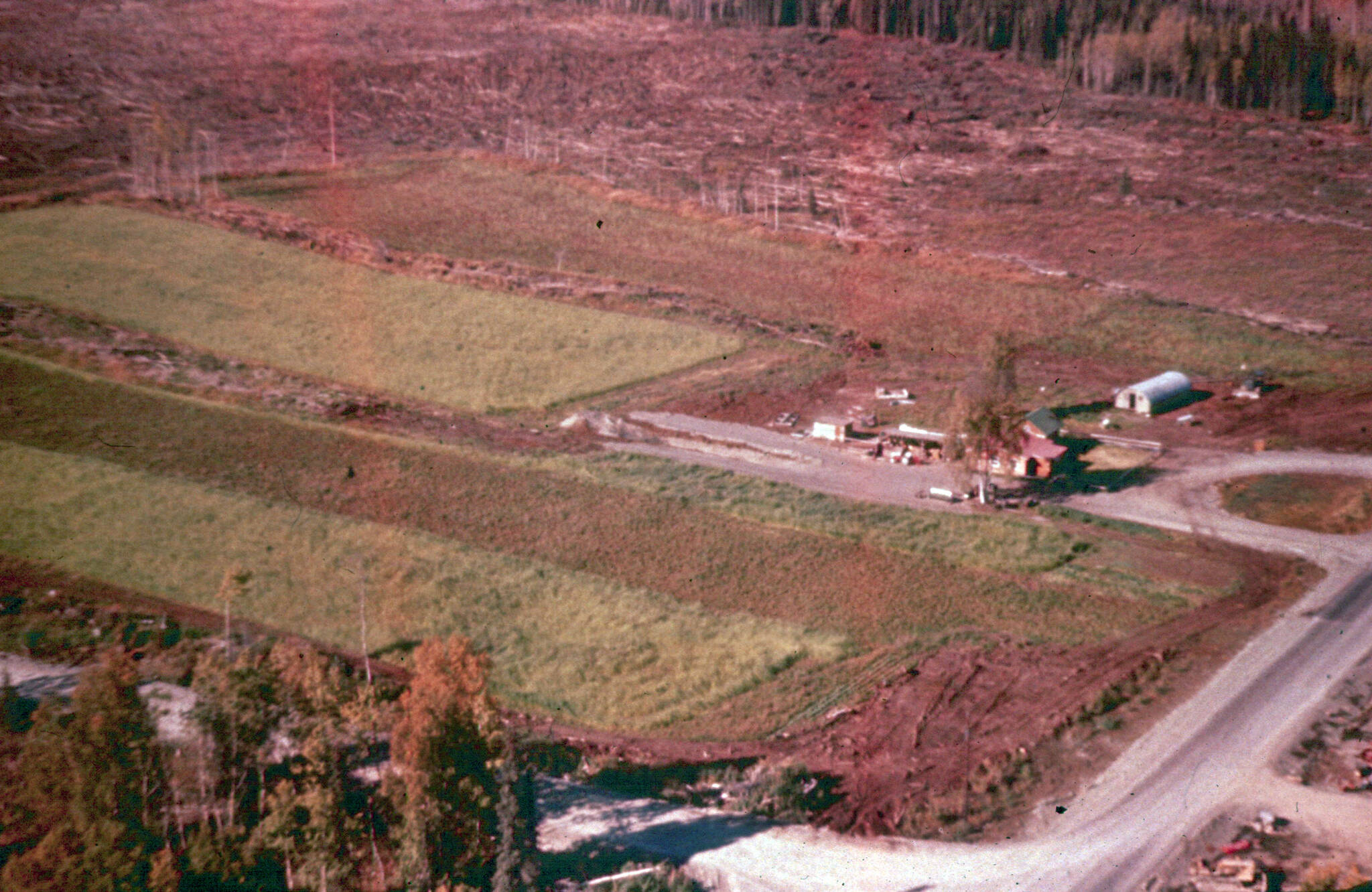
AUTHOR’S NOTE: This series of articles, in a somewhat different form, first appeared in the Redoubt Reporter in January and February 2012.
Binkley Street was just a gravel-covered Soldotna back road in November 1969. At 148 N. Binkley, construction on the new administration building for the five-year-old Kenai Peninsula Borough was moving forward again when another setback occurred.
On Nov. 29, a page-one headline in the Cheechako News alerted the public: “Borough Building Panels Lost in Storm at Sea.” Although this was certainly the most dramatic event in the borough’s multi-year effort to establish its sense of place, it was far from being the only twist or turn in a tale that begins in the late 1940s.
Scar on the City
Near Chicago in 1947, Howard and Maxine Lee — disenchanted with their regimented life in the Navy — read a Saturday Evening Post article about homesteading opportunities for military veterans willing to move to the Kenai Peninsula in Alaska.
It sounded simple enough: Go to the Anchorage Land Office, file on a suitable parcel of land, build a habitable abode and live there at least six months and one day out of the year, and clear one-tenth of the total acreage.
The Lees headed north in March of 1948. On the way to Alaska, Howard left Maxine and their 16-month-old daughter Karen in Seattle while he — accompanied by Maxine’s sister’s fiancé — continued by steamship to Seward and then to Kenai. During his first days there, Howard discovered that all the land abutting the newly constructed Sterling Highway had already been claimed.
Dispirited at first, he then learned of a couple named Peterson who had gone to the area the year before, homesteaded near the current home of Soldotna Elementary School, spent the winter, didn’t like it and wanted out. The Petersons had hauled a 60-by-30-foot Quonset hut over the frozen highway from Seward, and Howard was informed that for $1,000 they would relinquish their site and the Quonset to him.
Thus, when Maxine and Karen joined him at their new home in June, the Lees became residents of the fledgling community of Soldotna. Their homestead encompassed the current sites of the Borough Building, Soldotna Elementary School, Soldotna City Hall, Dr. Tom Kobylarz’s dental office and Cad-re Feed west of the Kenai Spur, plus a broad stretch of land east of the highway.
The Lees, like many homesteaders in those days, led a hardscrabble life early on but soon began to prosper. They added a son to their family, found new friends and adjusted to a very rural existence. In 1949, Maxine became Soldotna’s first postmaster and served in that capacity for two years when, abruptly — or so it seemed to many at the time — she decided she had had enough.
Maxine turned her postmaster duties over to Mickey Faa, and she then took her two children to the Lower 48 and filed for divorce. In the settlement, she and Howard split the homestead, with Howard retaining all of the property west of the Spur Highway.
By 1954, however, Howard, too, wanted a change. He left Alaska and returned to the Navy, where he had been a pilot during World War II. While he was gone, according to longtime Soldotna resident Al Hershberger, Howard sent a letter to his friend, Joe Faa (husband of the postmaster), announcing that he wanted to buy a new car — a four-door sedan called the Chrysler Royal. To make the purchase, he needed $4,000. Howard offered Faa his share of the homestead in exchange for the price of the car (approximately $32,000 in today’s money).
Faa brought the letter to Hershberger because he lacked the funds himself to make the deal. “I would have bought it,” said Hershberger, “except for the fact that at that time I had a hard time coming up with $40. It didn’t take long for Joe to come up with the money. It turned out to be a good investment.”
This was particularly true because the land contained a rich lode of gravel, necessary for road-building and, later, for paving.
In 1956, the Alaska Road Commission, which built the Sterling and Kenai Spur highways, was merged into the federal Bureau of Public Roads, an agency which, in those territorial days, was in charge of all the main byways in Alaska. Then, at some point prior to 1958, when the Sterling Highway was resurfaced and paved, the BPR acquired the gravel pit on Faa’s property.
After Alaska statehood in 1959, all BPR assets, as well as all road-building and maintenance responsibilities, were turned over to the state’s new Department of Highways (later renamed the Department of Transportation). For nearly another decade, the Department of Highways controlled the pit, which featured holes in some cases 20-25 feet lower than street level and was often viewed by residents as a sort of open wound in the center of the city.
In fact, when the borough administration began shopping in earnest for a piece of land on which to erect an administrative headquarters, Borough Chairman (the term used before “Mayor” was established in the 1970s) George Navarre made his disdain for its appearance plain, even as he sensed its potential: “The Soldotna Gravel Pit is an eyesore to the city,” he said, according to the minutes of the May 2, 1967, assembly meeting. “The site is in the middle of town and is not screened, and the land can be put to a better use as a borough office site or school site.”
The city administration concurred, and Department of Highways officials began to discuss the possibility of giving the land to the borough — with strings attached, of course. In exchange for the Soldotna pit, the department would eventually request unrestricted access to a new site for gravel on borough land either north or south of the city.
But that offer was not made right away. In fact, more than a year passed before the offer became official.
In the meantime, other properties were examined as potential building sites for borough headquarters.
On June 6, 1967, Soldotna businessman John Ingram attended the assembly meeting and made a presentation on behalf of a citizens committee interested in furthering the building efforts. Ingram said that he represented people willing to help find a suitable location; they were people with plenty of good ideas, he said. He told the assembly that the borough should seek a site no smaller than 5 acres “in order that ample space may be provided for the building, service driveways, vehicle parking and landscaping.”
Assembly president Earl Simonds responded by naming a four-person committee (Bob Ross, Dolly Farnsworth, Irwin Metcalf and Harold Jackson) “to discuss with Mr. Ingram and his committee the most feasible sites for the borough administration building,” according to the minutes of the meeting. Chairman Navarre also urged the two committees to consult with the Soldotna Planning Commission to be certain that the borough adhered to all relevant city planning and zoning regulations.
About two weeks later, Farnsworth reported that the City of Soldotna had offered eight possible sites, and the borough committee had reviewed them all. Committee members said that they favored an 80-acre site between the Catholic church and the Kenai River because the site offered nearby sewer and water services, mostly level topography, good drainage, and a solid gravel foundation, and it also seemed to comply with the city’s zoning laws. Furthermore, the committee believed that having so much land at the borough’s disposal would create numerous options for the area not directly affected by the construction of an administration building.
Farnsworth made a motion for Resolution 67-31, to accept the city’s proposal for the 80-acre site. Her motion was seconded by Ross. But then Navarre intervened because he believed that the resolution was too hasty a reaction to the offer. He said he wanted the borough planning commission to review the committee’s top three choices and make its own recommendation to the assembly. A vote to table the resolution until after this review occurred failed, and then a vote on Farnsworth’s original resolution failed, too.
In the end, all eight sites were sent to the borough planning commission.
Over the succeeding weeks, the borough assembly pressed ahead with an attempt to fund a borough administration building before it actually had an official place to put it, and in an October election borough voters readily slapped down that idea.
Then, even though no site had been chosen and no funding was available, the assembly focused on what type of building to construct.
While this new line of conjecture was taking place, a familiar possibility appeared again on Dec. 5, 1967: the Department of Highways’ offer to exchange the Soldotna Gravel Pit for a gravel site of equal value outside the city limits. The Soldotna pit lay within a 15.11-acre lot and was valued at $23,000.
Department officials knew that some of the lands being selected from the state by borough were rich in gravel reserves, and Navarre encouraged the assembly to consider selecting these lands so that the trade with the Department of Highways could be done. The assembly’s reaction was mixed, as some members were still pushing for the 80-acre parcel.
Seven months later, on July 2, 1968, Navarre arrived at the assembly meeting to speak about a letter he had received from Charles S. Matlock, a district highway engineer for the Department of Highways, concerning the department’s “immediate relinquishment” of the Soldotna Gravel Pit to the borough, in exchange for unrestricted gravel access from one of the previously mentioned sites. Navarre recommended that the assembly make the deal, and the members voted to do so — unanimously.
At long last, the administration for the borough government and its school district had a home, even if it was, at the moment, a wide and ugly gash in the heart of the city.
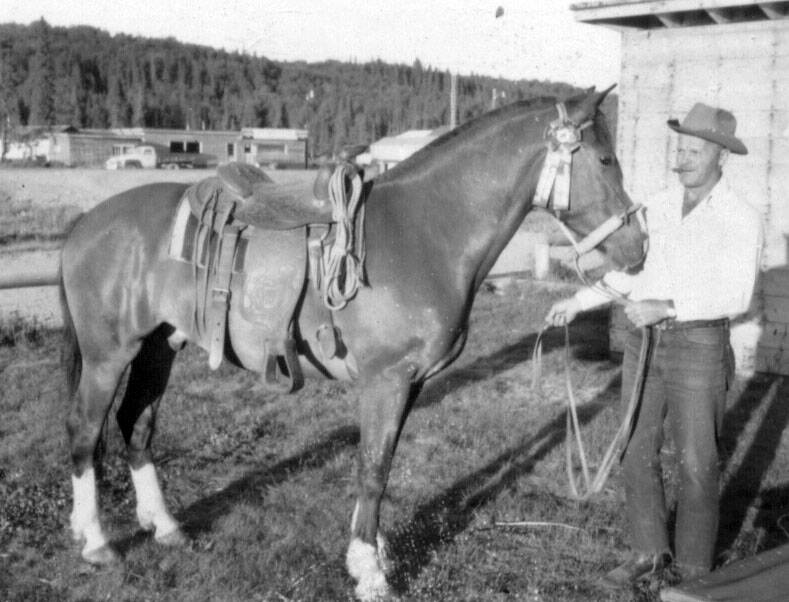
Joe Faa, with his horse circa the early 1960s, bought Soldotna homestead land from Howard Lee. That land included the large gravel pit at which the administration building for the Kenai Peninsula Borough was later built. (Photo courtesy of the KPC historical archive)
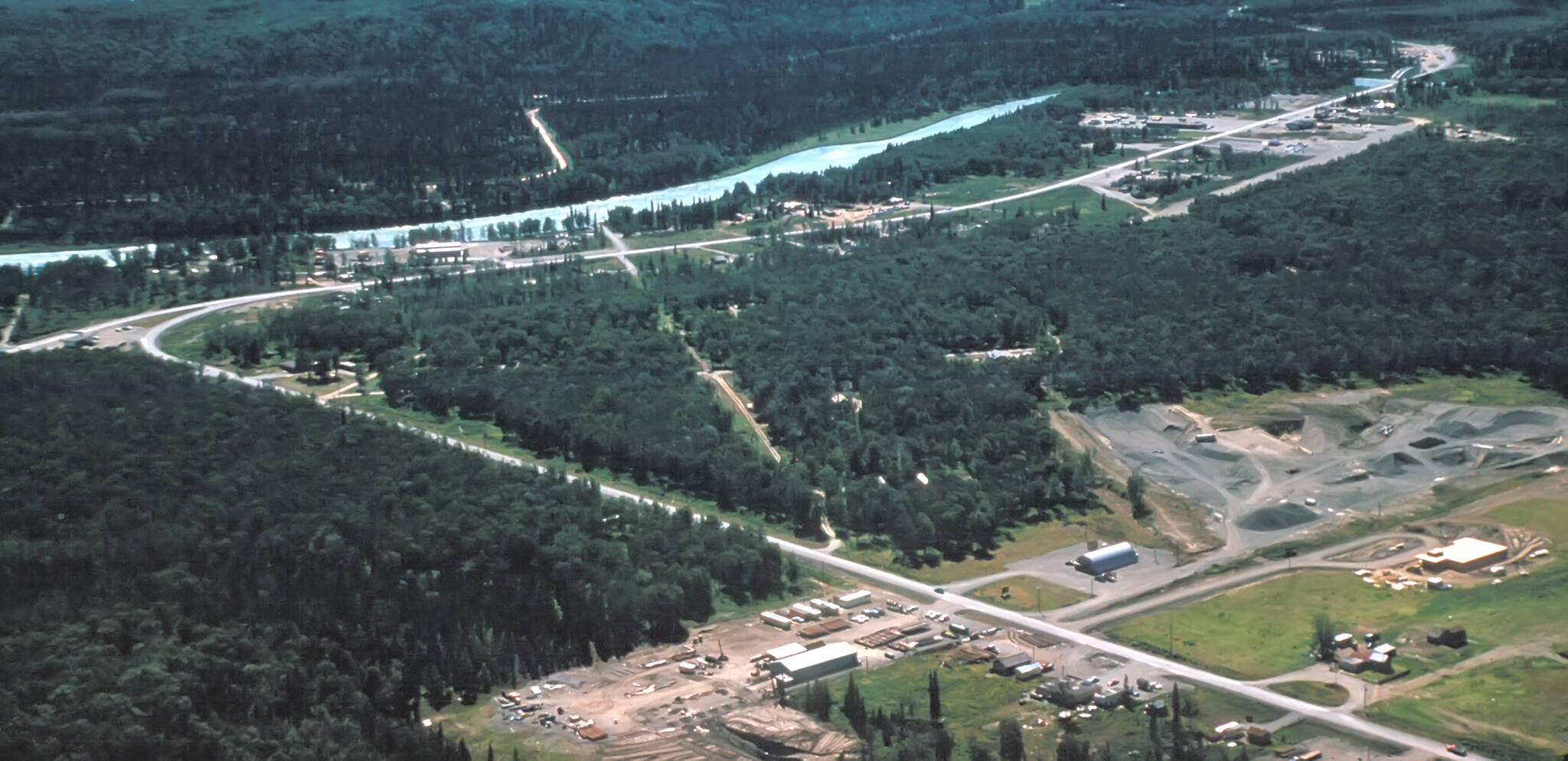
This 1960 aerial Soldotna shows the “scar” formed by the Soldotna Gravel Pit, where the Borough Administration Building now stands. Other interesting notes: To the left of the gravel pit is a large Quonset hut, which at this time was the Soldotna Theatre. In the lower right corner of the photo are Soldotna Elementary School’s first four classes under construction — the school would open to students in the fall — and, nearby, the barn that once comprised part of Joe Faa’s corral, for which Corral Street was later named. (Photo courtesy of Al Hershberger)
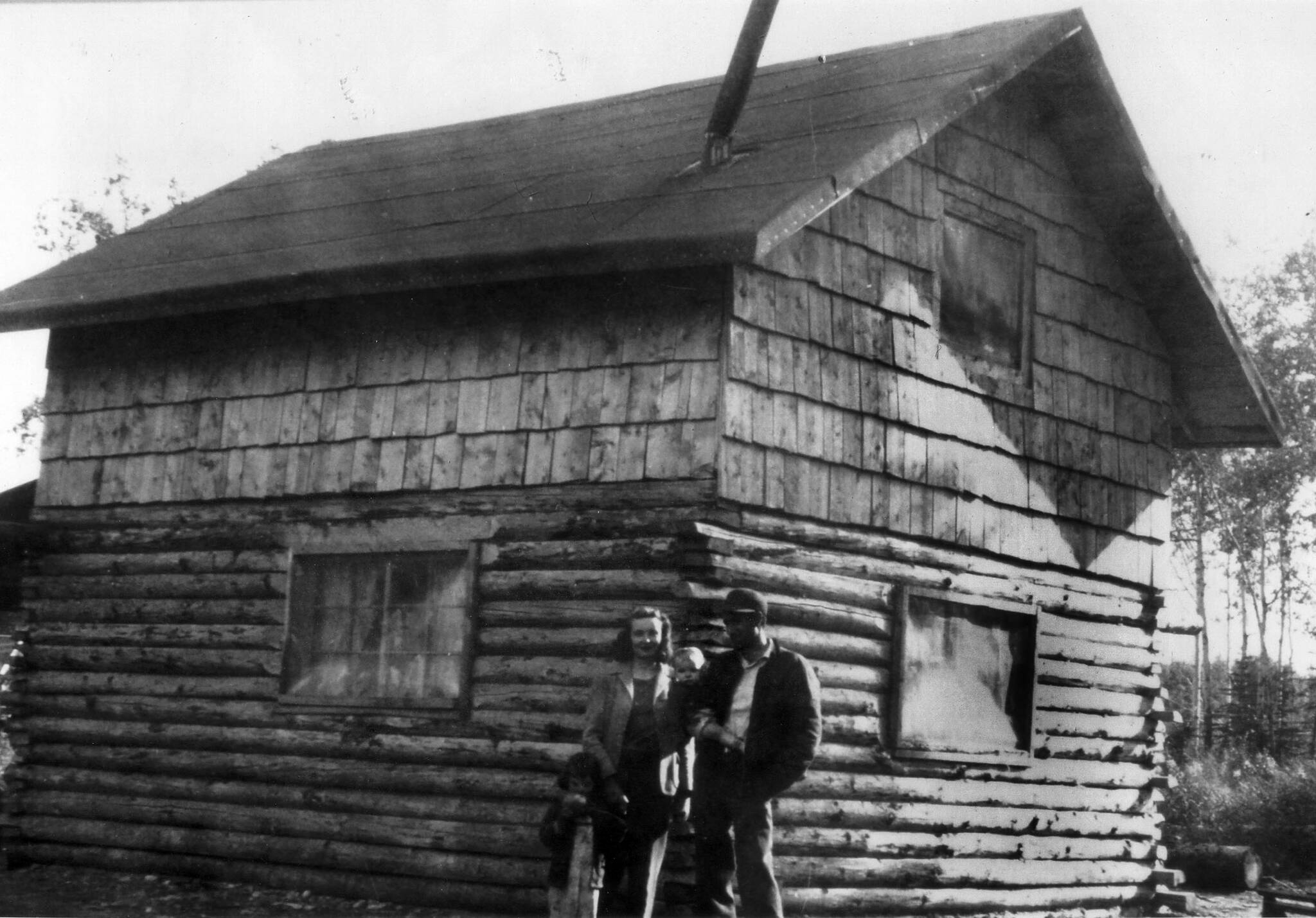
Howard and Maxine Lee, with their two children, pose behind their newly completed home in Soldotna in 1950. This structure, which became Soldotna’s first post office, stood on part of the homestead that contained a large gravel pit that is now home to the Kenai Peninsula Borough’s administration building. (Photo Soldotna Historical Society)
