
By Victoria Petersen
For the Peninsula Clarion
Snow is falling in the Anchorage hillsides today, but I’m going to bring up ice cream just one more time. In the last column, I talked about different fall ice cream flavors you could create. Well, my boyfriend and I experimented with a new, more complex base. We decided to try newer, more complex flavors by adding in snickerdoodle cookie crumbles and lemon curd. The ice cream was great, in case you’re wondering. It was as good as Wild Scoop’s Sunshine Club. But this column isn’t going to be about ice cream (I know, bummer). This column is about the simple snickerdoodle cookie.
I had a very slow weekend. Slow enough that I caught myself pondering snickerdoodles — where they come from and what my experience with them is. That pondering brought up a very weird memory for me, a school project I haven’t thought about for maybe 15 years? I don’t remember how old I was, but I was definitely in elementary school. We had a family tree project due. I remember my cardboard presentation board, folded into thirds, and decorated with printed-out family photos and colorful card stock. I spent a lot of time making it look really nice. I was really an overachiever. So much so, that I asked my mom if we could make a family recipe to give to my class to accompany the presentation. Make it an immersive experience. While pondering snickerdoodles this weekend, I remember my mom said that snickerdoodles were a family recipe. We made them and brought them to class. They were a crowd-pleaser and I got 100%.
The more I was thinking about this, the more I was wondering how snickerdoodles would even be a family recipe. It’s a very basic cookie. I faintly remember my mom telling me that her grandma made them all the time. So, I called my grandma to ask if her mom did indeed make snickerdoodle cookies. Apparently, she did. All the time. She had a jar of cookies always at the ready. My grandma said it was her favorite thing to make. As we were talking, I began to remember visiting my great-grandma’s house in Southern California, and eating cookies out of a jar. I asked my sister if she remembered and she had a very clear memory of it too.
The “Joy of Cooking” says snickerdoodles’ name is probably German in origin, a corruption of the German word Schneckennudel, a variety of “schnecken,” a sweet bun. But Oxford Dictionary says the name could just be a nonsense word. According to the cookie magazine, Biscuit People, the snickerdoodle came out of New England, at the hands of Dutch immigrants. Wherever the cookie got its name, it became popular in the late 1800s. My great-grandma grew up in Washington state and was the daughter of a Danish immigrant and an American from Iowa, who married right before the 1918 Spanish Flu captured the country’s attention. I’m really lucky in that I actually got to know my great-grandma. She died in 2012, just before I graduated high school. But, when she was alive, we would visit her often. She lived close to Disneyland and would take us there sometimes. I only have really nice memories of my time with her. So while the snickerdoodles I made this weekend were for the ice cream, they were also for her.
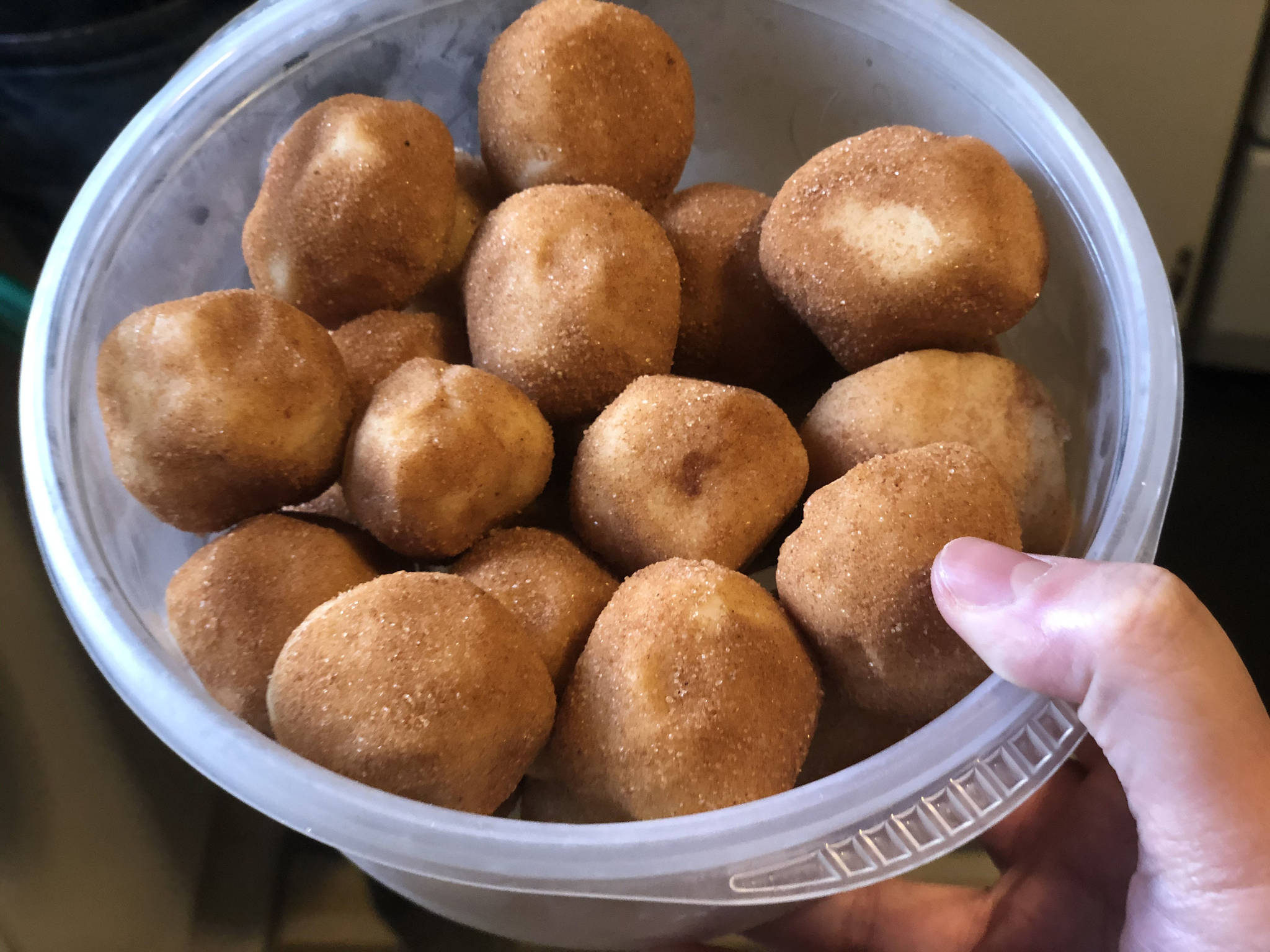
I asked my grandma if she had her mother’s snickerdoodle recipe. She said she didn’t, and that “it’s probably just whatever the normal recipe is.” So that’s what I have for you: a normal recipe. Most importantly, this recipe has you eating a fresh-baked cookie within about 30 minutes. It’s just me and my boyfriend, so we didn’t need a whole two dozen fresh-baked cookies. We rolled out the little balls of dough, rolled them around in a cinnamon sugar mix and placed them on a parchment paper-lined cookie sheet. We just stuck them all close together, wrapped plastic wrap over the top and popped them in the freezer to help solidify them. Once they were solid, after at least 30 minutes, we took them out of the freezer and placed all the cookies we didn’t want to bake into a plastic container to put back in the freezer. These cookies are for Future Us. Whenever you want one or 10 fresh baked cookies, just take out the little dough balls, and bake them for about 10 minutes. They might take longer to bake when frozen.
Hazel’s Snickerdoodles
1 cup of softened butter
1½ cups sugar
2 eggs
1 tablespoon vanilla
2¾ cups flour
2 teaspoon of cream of tartar
1 teaspoon of baking soda
½ teaspoon salt
3 tablespoons of sugar
1 tablespoon of cinnamon
Preheat the oven to 350 degrees. Place butter and sugar into a mixing bowl. Using a stand mixer or hand mixer, beat the sugar and the eggs for several minutes, until the butter and sugar have creamed together, forming an almost-whipped like consistency.
While butter and sugar cream, sift the flour, salt, baking soda and cream of tartar into a small bowl.
Once the butter and sugar are creamed, stir in the vanilla and the eggs until incorporated.
Gradually add in the flour mixture and continue to mix until a consistent dough forms. The dough should handle similarly to Play-Doh.
Mix the cinnamon or sugar onto a small plate. Grab a ball of dough, or scoop some with a spoon, and toss in the cinnamon sugar mixture.
Bake for eight to 10 minutes. If freezing, place cinnamon and sugar-dusted balls of dough onto a cookie sheet. Place in the freezer until they solidify, about 30 minutes. Remove the dough balls from the cookie sheet and place in a plastic bag or container. Eat within three months.
• By Victoria Petersen, For the Peninsula Clarion
