
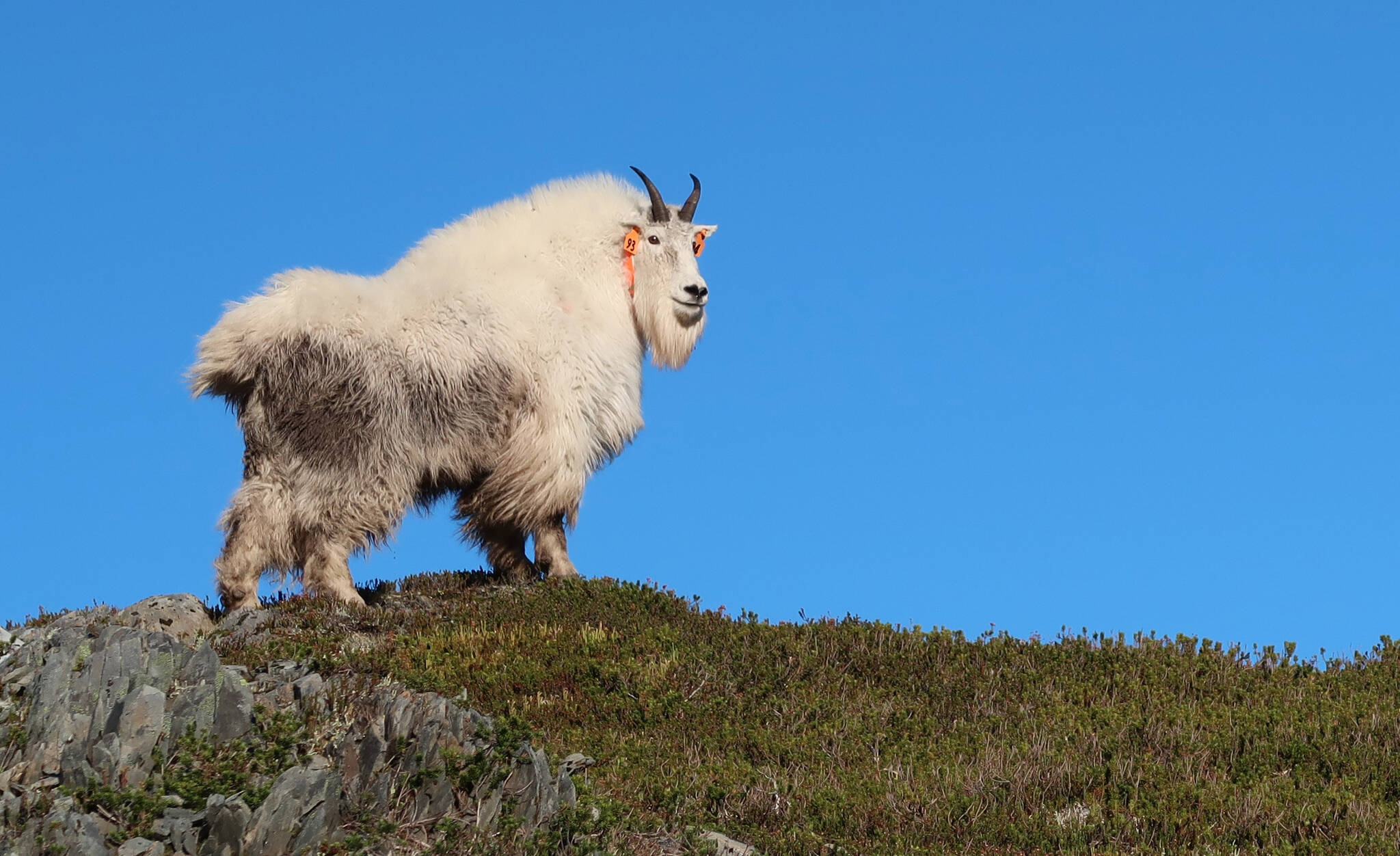
Earlier this winter, when looking out the window of the SuperCub at ridgelines covered in 4 feet of snow, it was difficult to imagine how any animal could possibly live out there in the subzero temperatures and 20 mph winds. However, the trails winding through the fresh snow along the cliffs suggest that something had certainly been moving around down there.
So I slowed the airplane down and followed the tracks for a short while, and there they were, just lying at the top of a south-facing rock face above the glacier, soaking up what little warmth the sun had to offer on a February morning.
It’s fascinating that mountain goats can not only survive in such conditions but that they can even thrive in them. To what my human brain perceives as a bleak, inhospitable and frozen landscape, mountain goats see their usual winter habitats and a place where they can find the food and shelter needed to survive the harsh Alaska winters.
However, it does beg the question as to what mountain goats could possibly find to eat on those snow-covered cliffs and why many of them spend their winter months up there.
That’s one of several questions the Kenai National Wildlife Refuge and its agency partners hope to answer. In 2017, the refuge partnered with Kenai Fjords National Park and Chugach National Forest to begin a study of mountain of goat ecology and habitat use on the Kenai Peninsula.
But, to collect the data needed, first, you must catch and radio collar mountain goats. Capturing mountain goats for studies presents biologists with some unique challenges.
Throughout their distribution, mountain goats live in some of North America’s most rugged and inhospitable mountain landscapes — such remote and rugged habitats limit capture options for biologists.
Chemical immobilization and aerial darting are commonly used to meet this challenge. These methods entail darting mountain goats from a helicopter with chemicals that immobilize the animal for a short period of time. Some studies also use net-gunning techniques, which entail shooting a net over the animal to physically restrain it.
Even using these methods, locating animals in suitable areas that do not pose too high a risk of falls or injury for both the animals and the biologists is challenging. The mountain goat’s affinity for steep cliffs and ledges, particularly when threatened, means that biologists must be very selective when choosing areas and animals for capture.
Once chemically immobilized, biologists work quickly to fit study animals with GPS radio collars, collect a variety of samples to monitor health and disease, and administer reversal agents to release captured individuals.
Radio collars deployed on study animals collect multiple daily GPS locations and transmit these data via satellites, allowing biologists to remotely download the data and monitor the animal’s locations and status throughout the year.
Since the project was initiated, 51 mountain goats have been radio collared throughout the Kenai Peninsula to collect location data to investigate mountain goat movements, seasonal habitat use and wintering strategies.
Capture operations during 2017–2018 deployed radio collars on male and female mountain goats near Tustumena Glacier, Dixon Glacier and Grant Lake. In addition, we captured 20 adult mountain goats in October 2022 to deploy radio collars within Kenai Fjords National Park and surrounding lands near Seward.
GPS location data from these mountain goats are used to monitor survival, track movements and investigate seasonal preferences for different habitats based on the animal’s frequency of use. The results of these analyses can also be used to develop predictive models that provide management agencies with insight into how mountain goat populations might respond to future habitat and climatic changes.
Mountain goats are susceptible to a variety of factors, including habitat degradation, harsh winters, diseases, parasites, hunting harvests, and disturbance from human development and recreational activities. Previous studies have shown that disturbances may alter foraging behavior, cause individuals to temporarily vacate preferred habitats or potentially lead to population declines in some cases.
Mountain goats are particularly susceptible to mortality from starvation during winter and early spring when fat reserves become depleted. Many mountain goats die from falls and avalanches each winter, which can also be important sources of mortality. Predators, like wolves and golden eagles, also take advantage of their prey’s diminished body condition and limited mobility in deep snow during winter.
Although winter is generally the toughest season for mountain goats, other seasons can be just as important to mountain goat survival and reproduction. Mountain goats rely on green vegetation during summer, and they feed intensively on this new growth to build up the fat reserves that see them through the harsh winters.
Mountain goats are a cold-adapted species, and unusually warm weather can also have adverse effects. Heat stress can restrict the amount of time mountain goats can spend feeding and may effectively limit access to feeding areas farther away from cooler areas near snow patches and glacial ice.
In addition, the nutritional demands of lactation and the need for females to remain near cliffs to protect kids from predators can also limit feeding opportunities and access to preferred habitats. Access to preferred habitats and high-quality forage during summer ultimately dictate mountain goat survival and reproduction the following winter.
Collectively, data from this study provides an improved understanding of mountain goat ecology and seasonal habitat needs during critical periods, which helps to ensure science-based management and long-term management and conservation strategies on the Kenai Peninsula.
Dom Watts is a pilot biologist at the Kenai National Wildlife Refuge. You can find more information on the refuge at http://kenai.fws.gov or http://www.facebook.com/kenainationalwildliferefuge. Also, look for Refuge Notebook Articles on the first and third Fridays of each month or find past Refuge Notebook articles (1999–present) at https://www.fws.gov/kenai-refuge-notebook.
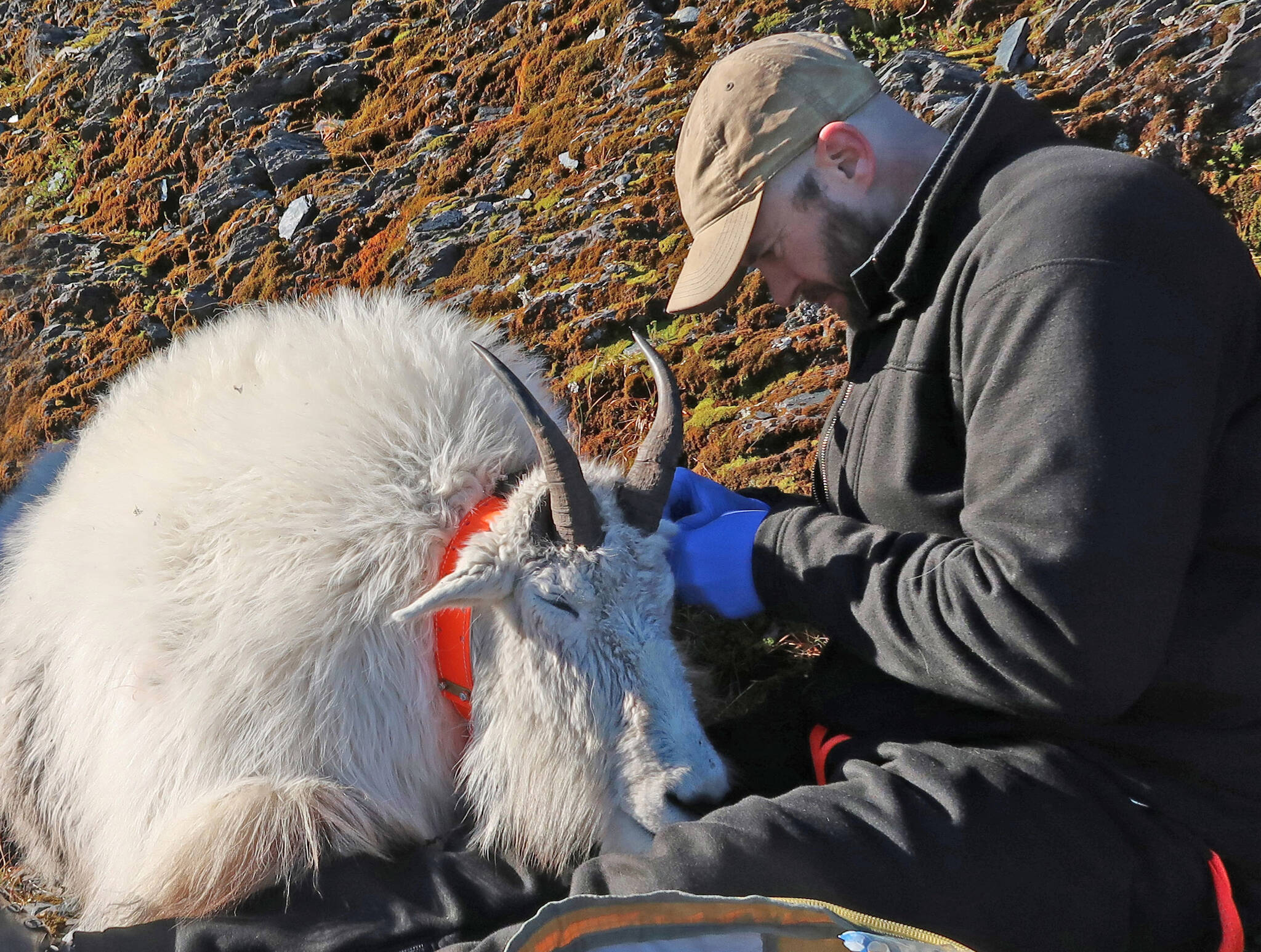
U.S. Fish & Wildlife Service pilot biologist Dom Watts fits a chemically immobilized mountain goat with a GPS radio collar near Seward. (Photo by K. White/ADF&G)
