
By Sen. Tom Begich
Given the opportunity to create a fair legislative map for Alaska, the chair and a majority of the Alaska Redistricting Board instead chose a radical direction in the last two days that silenced the Alaska Native voices on the Board and threw a carefully developed plan — and quite possibly their own lawyer’s advice — out the window. They did this contrary to the Constitution and the public process.
I have participated in four reapportionments since 1991 and witnessed what it takes to create maps that provide Alaskans fair legislative representation. You start from a blank map, create constitutional House districts reflecting our communities and shared interests, adhere to federal law, ensure nondiscrimination, equalize the population, and listen to the public.
The Board did a good job following these guidelines through much of their process, and their staff remained professional throughout deliberations. They heard extensive public testimony from every corner of the state, telephonically and in person. Following testimony and debate, they developed reasonable House districts that were, as the Constitutional Convention declared in 1956, “true, just, and fair …”. That is the standard we are held to.
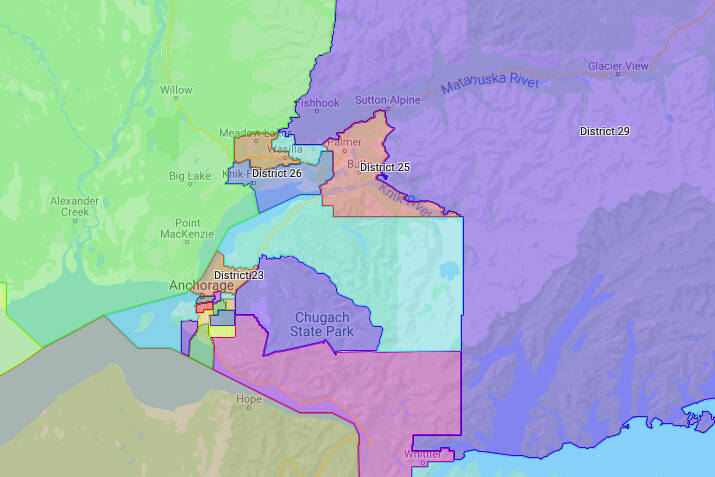
The Board started following this approach with Senate districts. In Southeast, Western and Northwestern, Fairbanks, the Kenai Peninsula, Kodiak, and Mat-Su, tough decisions were made generally based on Constitutional standards and public testimony. But in Anchorage, something very different happened. Debate was stifled, the public process and testimony were ignored, and the Republican majority on the Board, led by Bethany Marcum with active collaboration of the chair, John Binkley, jammed through a Senate map that was unsupported by the record and the Constitution. There were also alternatives that were more constitutional and reasonable.
Despite clear and convincing evidence that Eagle River/Chugiak is more tightly integrated with itself than with East Anchorage, Government Hill and Joint Base Elmendorf Richardson (JBER), Marcum insisted that splitting Eagle River, with combinations of Chugiak and Downtown Anchorage and Eagle River Road and South Muldoon, was somehow more reasonable. It’s baffling how the majority of the Board could possibly accept this argument. It was clearly less reasonable than maintaining one Senate district in Eagle River and one in East Anchorage — something put on the record by Members Nicole Boromeo and Melanie Bahnke.
What were the reasons given for splitting Eagle River? Said Marcum: to “provide Eagle River with more representation” substituting her own opinion for the vast majority of testimony the Board had received. She further cited a “military connection to Eagle River” without even pretending to acknowledge significantly greater interconnection between JBER and the rest of the North Anchorage bowl (Muldoon, Mt. View, Government Hill, and Downtown), where most of the off-base military live and shop.
But this is less relevant than the constitutional principle of contiguity, the connection of one area to another. Through contiguity, it’s hard to justify connecting one part of Eagle River/Chugiak with the North part of Muldoon and JBER, when the only road connection goes through the other Eagle River district, and where the population at the south end that District is separated by 8 miles from JBER, and 11 to the Muldoon interchange. The same is true for the other Eagle River district, paired with south Muldoon — only reachable by road through two other districts. Certainly not contiguous — unless you have a jet pack.
When pressed, Marcum could offer no factual contiguous relationship between these clearly unconnected parts of Anchorage — a far cry from what the Board did for the rest of the state.
Our Constitution outlines rules for a redistricting process designed to uphold public trust. Two contiguous, compact, and vastly more socioeconomically similar Eagle River districts which share an airport, schools, utilities, a business center, and watersheds (an important distinction at the Constitutional Convention), should be combined together. By voting for this unconstitutional Anchorage Senate map, the Board’s partisan majority rejected the public’s voice and the law. Eagle River and Muldoon residents’ testimony was disregarded. Marcum and Binkley violated their trust, the public process, and the Alaska Constitution by adopting Anchorage Senate districts that pair non-contiguous House districts. Further, Binkley cut off board debate during the final Senate pairing discussions to force a vote on a new map for which public comment was not allowed, subverting the public’s will.
Based on the data, evidence, and court history, this was not the most reasonable choice. What is reasonable is that the Redistricting Board will now face legal challenges with these final Senate maps.
Tom Begich is the Minority Leader in the Alaska Senate and represents Airport Heights, Downtown, Fairview, Government Hill, Mountain View, Russian Jack, and South Addition. His caucus presented a map that was adopted for consideration by the Alaska Redistricting Board. He has served as an expert in three prior redistricting processes.
