
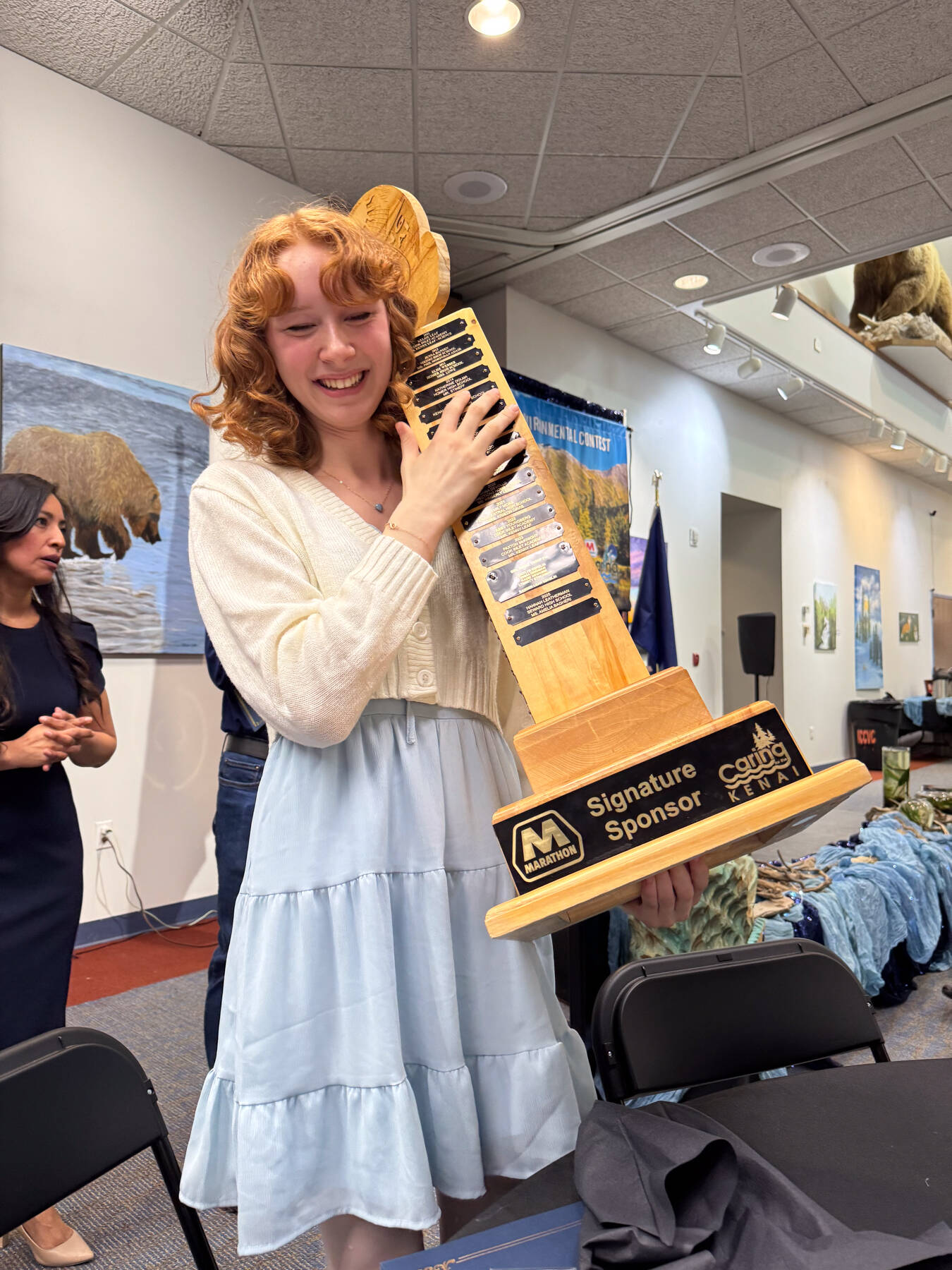
Hannah Leatherman, a senior at Seward High School, won the 35th annual Caring for the Kenai student competition last year by introducing an environmentally friendly alternative to the salt brine used on roads throughout the Kenai Peninsula. Next month, she’ll present her idea to the Senate Transportation Committee in Juneau.
Merrill Sikorski started Caring for the Kenai in 1991. He said last year was the first time a student from Seward has won.
“We select 12 finalists from all the entries, district-wide — which can be as many as 500 or 600,” Sikorski said. “Each finalist presents an oral presentation and is scored based on that.”
Sikorski said Caring for the Kenai is an idea-based competition, meaning there’s no requirement for the winner to take steps toward implementing their ideas. However, he added, many of the projects have won presidential or environmental youth awards, resulting in real-world impacts. He said it’s exciting to see ideas that were first presented at the competition come to fruition on both local and national levels.
“I’ve been very privileged to not only come up with the idea for the program, but to work with the young people every year,” Sikorski said.
The entire Seward High junior class was required to enter last year’s Caring for the Kenai contest through Amelia Bagheri’s science class. Leatherman said she had the idea to create a brine alternative when she learned animals like moose consume the salt in brine, drawing them closer to roads and greatly increasing the number of vehicle collisions each winter.
“So then I researched why we have the salt brine on the road, and it was because of the black ice,” Leatherman said. “Then I kind of fell down a rabbit hole about how black ice causes the majority of problems that we have on the Kenai Peninsula.”
While researching, Leatherman found articles about the use of graphene nanoplatelets, a molecular material that can be mixed directly into asphalt.
“Basically, the graphene nanoplatelets have these additives in them which help reduce the freezing rate of water molecules and increase the melting rate of ice and water molecules,” she said.
She read several studies about the material’s effectiveness on roads in China and began to wonder about the possibility of introducing the material to the Kenai Peninsula. While she was working on her project, a modified asphalt mix with graphene nanoplatelets was used successfully on a road in Teesside, England.
“I actually really want to go visit it,” she said. “It was really exciting, and a really cool coincidence that happened while I was doing my project.”
Leatherman and the rest of the junior class at Seward High began working on their projects early last year and presented at the contest in April. Judges announced Leatherman as the winner that evening, on April 17.
Last month, Leatherman received an email from Senator Jesse Bjorkman, R-Nikiski, about her project. Bjorkman asked her to travel to Juneau and present her idea to the Senate Transportation Committee. The next day, Leatherman created a GoFundMe to begin raising funds for her trip. She hit her goal two weeks later.
“I’m really appreciative of the people who donated to me, especially because I didn’t expect to get so many donations so quickly,” Leatherman said. “It just means a lot to me that the town cares so much about this project.”
Although she’s still working to pin down her trip’s exact date, Leatherman said she’s tentatively planning to travel to Juneau over spring break.
“I’m going to try my hardest to make sure we can make the Kenai Peninsula a lot safer,” Leatherman said.

Hannah Leatherman, a senior at Seward High School, is pictured with science teacher Amelia Bagheri during the 2025 Caring for the Kenai awards ceremony on April 26, 2025. Photo courtesy of Hannah Leatherman
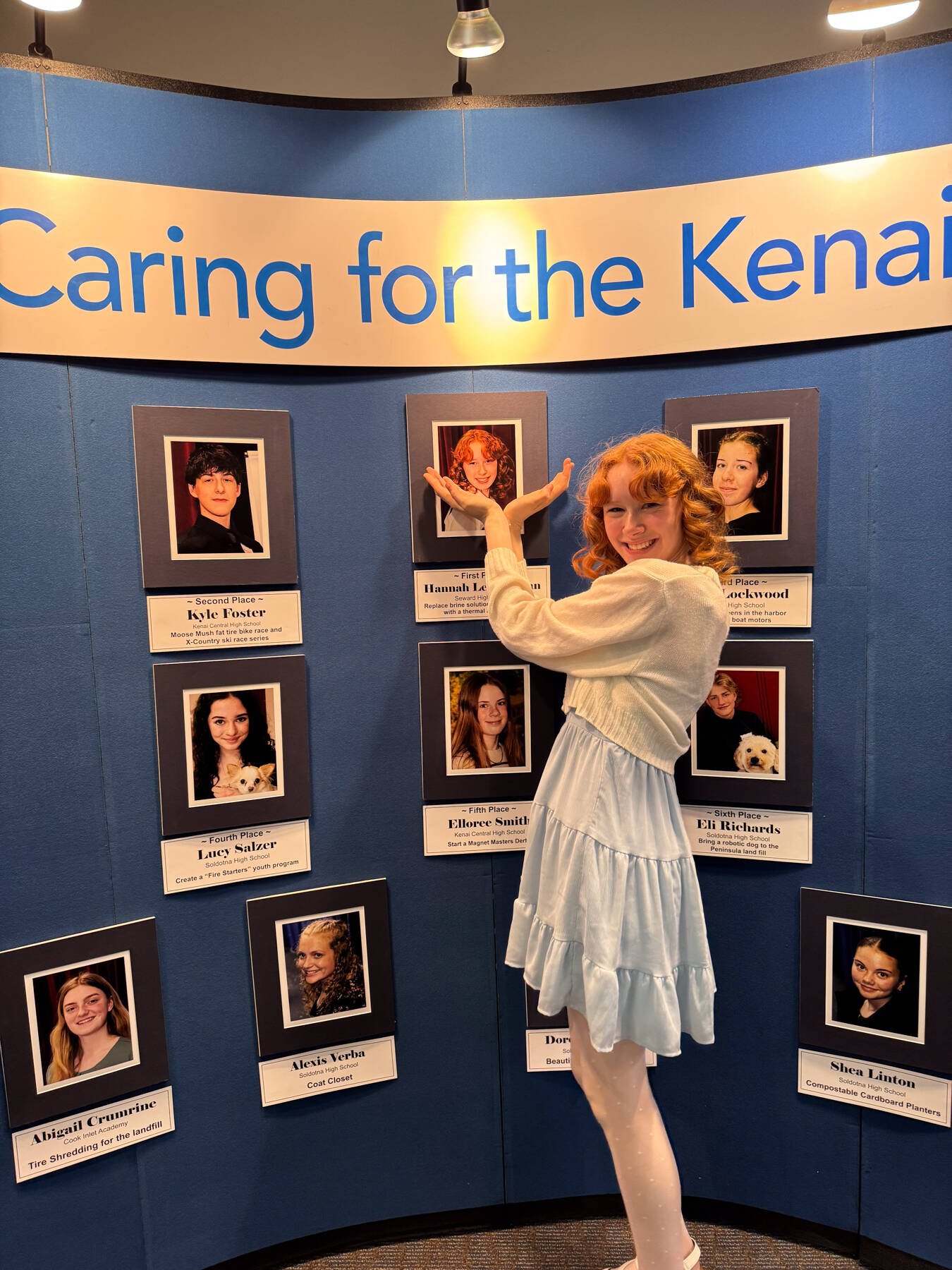
Hannah Leatherman, a senior at Seward High School, will present her environmentally-friendly alternative to salt brine to the Senate Transportation Committee in Juneau next month. Leatherman won the 2025 Caring for the Kenai student competition in April 2025. Photo courtesy of Hannah Leatherman
