Courtesy art / U.S. Navy
The Navy is proposing to considerably expand the maneuver space for warship and aircraft operations in the Gulf of Alaska while at the same time limiting the use of explosive munitions in the coastal waters in a proposal coming up for public comment in the spring of 2022.

Courtesy art / U.S. Navy The Navy is proposing to considerably expand the maneuver space for warship and aircraft operations in the Gulf of Alaska while at the same time limiting the use of explosive munitions in the coastal waters in a proposal coming up for public comment in the spring of 2022.

Navy proposes expanding Gulf of Alaska exercise area

The proposal would more than quadruple the sea room for ships and aircraft to manuever in

The Navy is issuing a proposal for expanding their Gulf of Alaska exercise area. The proposal will come up for public comment this spring.

The proposal includes more than quadrupling the area available for aircraft and warship to maneuver. The existing area has been in use in one form or the other since the 1990s, said environmental public affairs specialist Julianne Stanford.

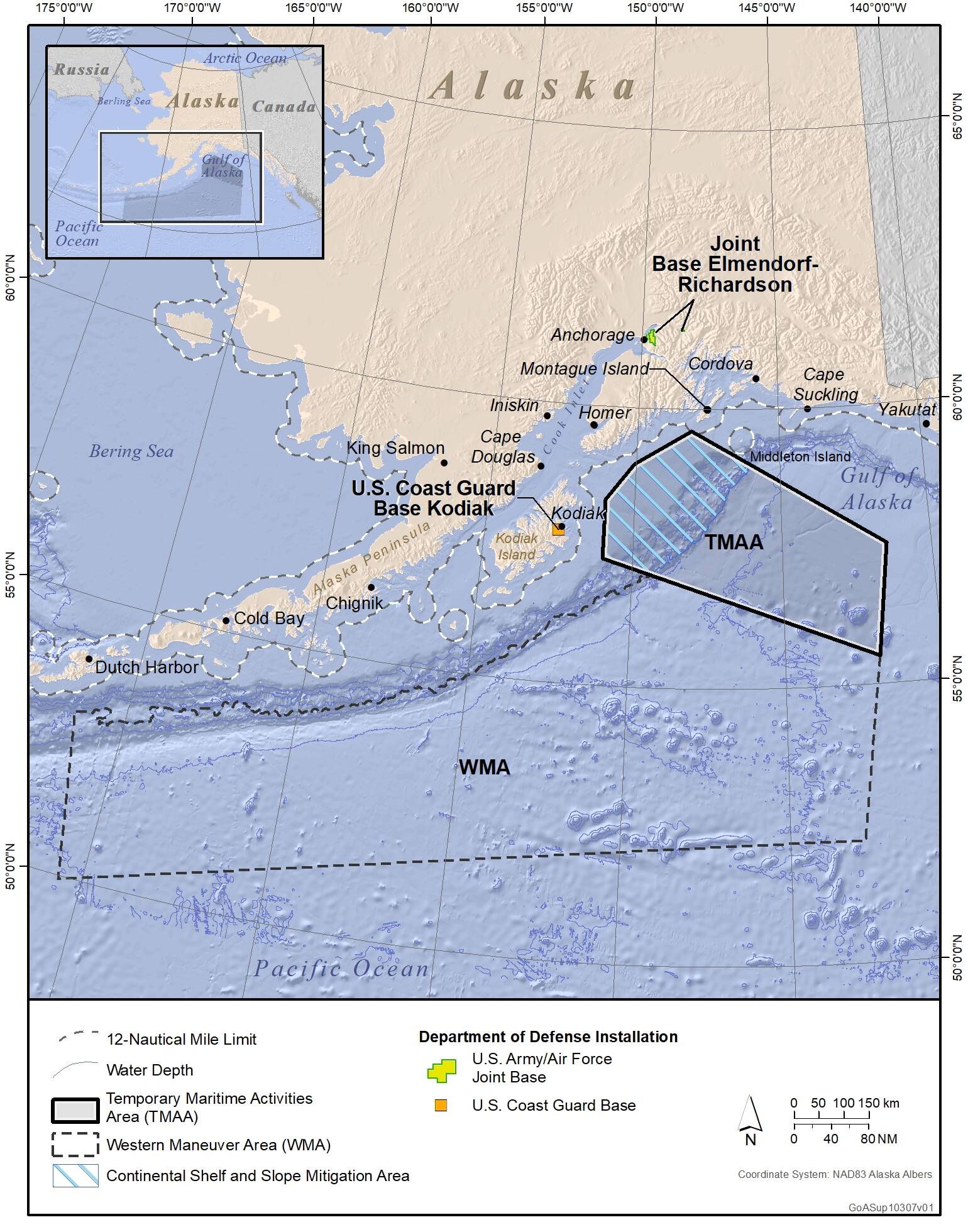
“The existing training area, known as the Temporary Maritime Activities Area (TMAA), is approximately 42,146 square nautical miles,” Stanford said in an email. “The Navy is proposing to add an additional area, known as the Western Maneuver Area (WMA), that would be approximately 185,806 square nautical miles.”

[Airport COVID testing ends as contract runs out]

Both the current training area and the proposed expansion are part of the Joint Pacific Alaska Range Complex, which also includes Army and Air Force ranges, allowing for service and joint exercises, according to the proposal website.
Courtesy art / U.S. Navy
The Navy is proposing to considerably expand the maneuver space for warship and aircraft operations in the Gulf of Alaska while at the same time limiting the use of explosive munitions in the coastal waters in a proposal coming up for public comment in the spring of 2022.

Courtesy art / U.S. Navy The Navy is proposing to considerably expand the maneuver space for warship and aircraft operations in the Gulf of Alaska while at the same time limiting the use of explosive munitions in the coastal waters in a proposal coming up for public comment in the spring of 2022.

The current area, the TMAA, has been in use in its current form since 2011, Stanford said, following a previous environmental impact study. Its boundaries stretch in a roughly rectangular region from east of Kodiak to south of Yakutat.

The new area, the WMA, will not be used for activities using active sonar or explosive munitions, Stanford said. The expanded training space would only be used for 21 days of exercises per year, Stanford said.

“To be clear, the WMA will only be used for vessel and aircraft maneuvering,” Stanford said. “All activities with sonar or explosives would only occur in the existing TMAA.”

The new proposed maneuver space would stretch from south of the TMAA’s eastern border south of Yakutat to west of Dutch Harbor, reaching far south into the Gulf of Alaska and the northern Pacific Ocean, according to the map.

The proposal also includes provision to restrict activities inshore, according to the news release, forming a new mitigation area on the continental shelf area that would apply to all regions of the TMAA that are shallower than 4,000 meters, according to the news release. Within that mitigation area, the Navy would curtail use of explosives below 10,000 feet to protect marine wildlife.

“The Navy anticipates the implementation of the proposed mitigation area would minimize impacts on marine mammals, fish, and marine birds and would be positive for marine species, fisheries, Alaska Native tribes, the regional economy, and the people of Alaska,” said the news release.
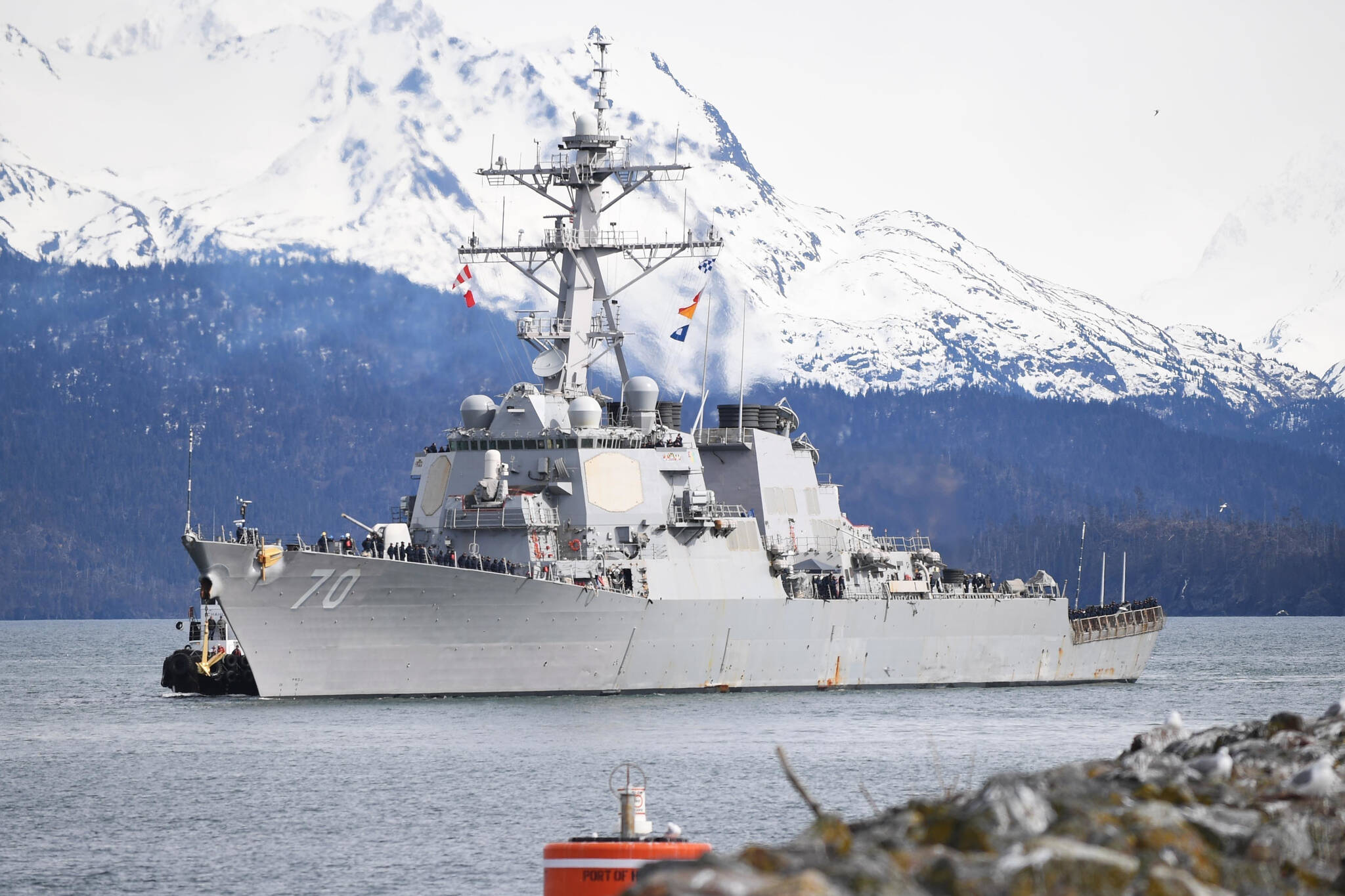
The USS Hopper (DDG 70) prepares to moor in Homer, Alaska, for a scheduled port visit in conjunction with its participation in Northern Edge 2017 in Homer, Alaska, April 29, 2017. The Navy is proposing to considerably expand its exercise area in the Gulf of Alaska. (U.S. Navy / Petty Officer 3rd Class Joseph Montemarano)

The USS Hopper (DDG 70) prepares to moor in Homer, Alaska, for a scheduled port visit in conjunction with its participation in Northern Edge 2017 in Homer, Alaska, April 29, 2017. The Navy is proposing to considerably expand its exercise area in the Gulf of Alaska. (U.S. Navy / Petty Officer 3rd Class Joseph Montemarano)

More in News

Goldenview Middle School student Luciana Liu's winning poster entry for the 2024 Alaska Radon Poster Contest. Photo provided by the Alaska Department of Natural Resources
Students invited to compete in statewide radon poster contest

The deadline to submit poster entries is Dec. 19.

The industrial area of Nikiski, featuring a refinery and currently mothballed LNG and fertilizer plants, was selected by the producer-led consortium of the Alaska LNG Project before the state took over in 2017. (Photo/File/AJOC)
The industrial area of Nikiski, featuring a refinery and currently mothballed LNG and fertilizer plants, was selected by the producer-led consortium of the Alaska LNG Project before the state took over in 2017. (File photo)
Harvest Midstream announces Kenai LNG terminal acquisition

The company is now seeking engagement from global LNG suppliers and potential offtake customers, a Nov. 11 press release says.

The aurora borealis is seen from Mendenhall Lake in Juneau on Nov. 12, 2025. A series of solar flares caused unusually bright displays of the northern lights across Alaska Tuesday and Wednesday nights. (Chloe Anderson/Peninsula Clarion)
Out of the Office: Aurora’s performance was worth the wait

A series of solar flares caused an unusually bright display of the northern lights Wednesday night.

The KBBI Public Radio office and studio is on Kachemak Way, as seen in this photo taken July 2, 2019, in Homer, Alaska. (Photo by Michael Armstrong/Homer News)
Kenai Peninsula public radio receives grant funding

The Alaska Community Foundation fund recently awarded $2.9 million in grants to public media stations statewide, including in Homer and Kenai.

Low clouds hang over Cook Inlet north of Anchor Point on Oct. 23, 2025. The Trump administration is planning an oil and gas lease sale in federal territory of the inlet. It is set to be the first of at six Cook Inlet lease sales that Congress has mandated by held between now and 2032. (Photo by Yereth Rosen/Alaska Beacon)
Trump administration sets terms for upcoming oil and gas lease sale in Alaska’s Cook Inlet

The ‘Big Beautiful Cook Inlet Oil and Gas Lease Sale,’ scheduled for March, would follow a series of federal and state inlet lease sales that drew little industry interest.

Volunteers gather around a captured salmon during one of Cook Inletkeeper’s Mapping Salmon Habitat Solution field days in August<ins> 2025</ins>. Every year, Cook Inletkeeper creates programs designed to get community members involved with mapping salmon habitat.
Cook Inletkeeper program promotes community engagement

Backyard Salmonscapes aims to map undocumented salmon habitat with the help of volunteers.

Central Peninsula Hospital is seen on June 24, 2018 in Soldotna, Alaska. (Ben Boettger/Peninsula Clarion)
Central Peninsula Hospital names new CEO

Angela Hinnegan will replace Shaun Keef as CEO following Keef’s retirement in January.

Grant Aviation’s Cessna 208B EX Grand Caravan is pictured at the Kenai Municipal Airport in Kenai, Alaska, on Monday, March 4, 2024. (Jake Dye/Peninsula Clarion)
Federal mandate orders Grant Aviation to cut flights

Grant Aviation will cut 10% of its flights between Kenai and Anchorage by Nov. 14.

The logo for the Kenai Peninsula Borough School District is displayed inside the George A. Navarre Borough Admin Building on Thursday, July 22, 2021 in Soldotna, Alaska. (Ashlyn O’Hara/Peninsula Clarion)
Board of Education moves to increase school meal prices

In January, the cost of adult meals and elementary student lunches will increase.

Most Read