KPBSD launches ‘Balancing Act’ software, calls for public to balance $17 million deficit
Published 9:30 pm Tuesday, February 4, 2025
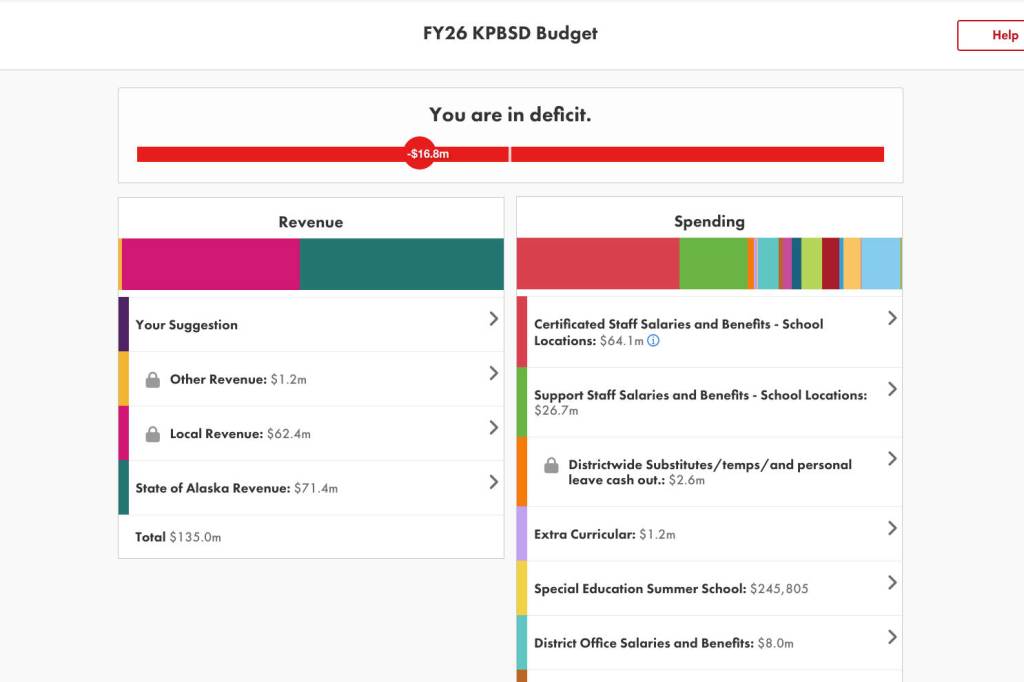
The Kenai Peninsula Borough School District on Wednesday launched its “Balancing Act” software, calling on parents, staff and other stakeholders to try their hand at overcoming the district’s $17 million deficit and then share their priorities directly with district leadership.
To start, visit go.kpbsd.org/fy26-balancingact, click the link on the district’s Facebook page or find it on the district website under “Departments” then “Finance.”
After entering their name, relationship to the district and postal code, a user will be greeted by a bright red bar and a simple message: “You are in deficit.”
Starting with the district’s projected deficit of over $16.9 million, Balancing Act offers two columns, Revenue and Spending.
Each of the district’s expenses are totaled on the right, at $151.8 million. Users can cut staff, increase classroom sizes, eliminate extracurriculars and sports, reduce operating budgets, and close pools and theaters, among other things.
Even when cutting sports, extracurriculars, operating expenses and others to the maximum amount possible, there’s no scenario in which a user can balance their $17 million deficit without cutting staff positions. With all other cuts maximized, the deficit still reads $13.7 million. After cutting pool and theater techs and managers, closing those facilities, a $12.3 million deficit remains.
The KPBSD Board of Education held a discussion this week about potentially closing schools, evaluating the projected savings that could be generated by closing nine district schools — those rough estimates altogether total $6.2 million, and those annual savings are projected to decline five years to only $1.9 million.
The district and other education advocates have said this year that the base student allocation — the amount of money districts receive per student — has failed to keep up with inflation over the last 10 years.
Stagnant funding, they say, is the driver for significant deficits facing the KPBSD and many other Alaska districts. The district in Fairbanks this week announced school closures, Anchorage’s school district announced a deficit of over $100 million, and others are similarly weighing cuts to programs and staffing to overcome funding shortfalls.
During a meeting of the KPBSD Board of Education’s Finance Committee this week, members asked KPBSD Finance Director Liz Hayes to add options to increase revenue.
Finance Chair and Board President Zen Kelly said that asking people to balance the $17 million deficit without revenue increases did little besides illustrate how dire the district’s situation is. Balancing Act as published allows users to budget for increases of $680, $750 or $1,000 to the BSA.
The first option, a $680 increase, matches the amount the district received in one-time funding last year, allowing it to reverse cuts made to programs and staffing in the face of a $13.7 million deficit. Without making any cuts in Balancing Act, that increase reduces the deficit to $5.4 million.
In reversing the cuts last year, Kelly said this week, the district spent $4.6 million of its unassigned fund balance and now has only around $285,000 left in accessible savings. KPBSD Superintendent Clayton Holland said in January that amount is less than a day’s operating expenses.
The maximum increase available in Balancing Act, of $1,000, resembles the increase proposed by House Bill 69, which is presently being considered by the Alaska Legislature’s House Education Committee. That bill would increase the amount of money each school district receives per student by the average rate of inflation of the last three years plus $1,000 in the coming fiscal year before then providing for two more increases of $404 plus inflation in 2026 and 2027.
That total of $1,808, besides the inflation increases, matches the reported inflation since 2011, when the BSA was set at $5,680. In the 13 years since, the BSA has increased by only $280 — to $5,960 for the current fiscal year. The education bills introduced and supported by Gov. Mike Dunleavy last week include no increase in funding through the BSA.
Inputting the $1,000 increase, without any cuts to spending in Balancing Act, still leaves a $44,000 deficit.
Balancing Act, Holland said, lays all the district’s finances out and showcasing the way a funding increase or a cut would impact the district’s finances.
“That’s the strength of this, for the public to see,” he said. “We’re not hiding a thing.”
Kelly said the board is interested in public feedback generated from the tool. Users can submitted their budgets, whether balanced or unbalanced, to voice their preferences for what should or shouldn’t be cut. Each revenue or spending item, too, can be individually commented on in written feedback to the district.
“The purpose of this is to have meaningful feedback to guide the board in what cuts they would have to make if we don’t get that dollar amount,” Hayes said.
A full recording of multiple school board finance committee meetings and the discussion of school closures can all be found at the KPBSD BoardDocs website.
Reach reporter Jake Dye at jacob.dye@cmg-northwest2.go-vip.net/peninsulaclarion.