
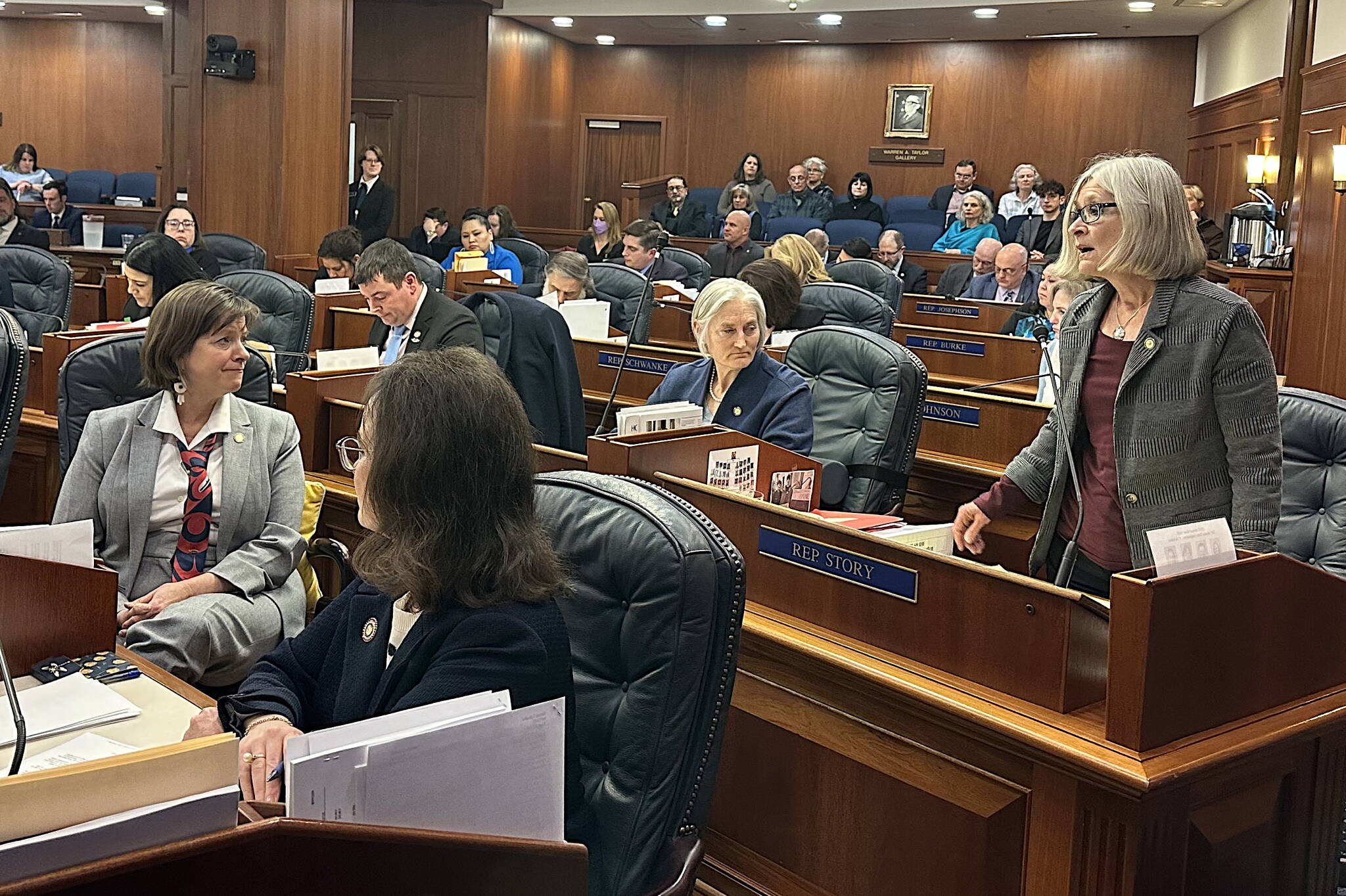
Lawmakers have been debating education issues since the second session of the 34th Alaska State Legislature began on Jan. 20. House Bill 261, filed ahead of session by Rep. Andi Story, D-Juneau, seeks to stabilize the state’s education funding process by changing it to rely on student counts from either the previous year or an average of the three previous years.
The bill would allow districts to create budget estimates for an upcoming school year by using the previous year’s count or the three-year average — whichever is greater. Story said this solution is common in many other states and that while it’s “one step forward,” it’s clear that the state still needs to find a long-term solution to fund education.
“It’s also clear that it’s time to fix the education funding process and better address student enrollment changes so we can focus on student achievement,” Story said during a presentation to the House Education Committee on Feb. 2. “ Education funding needs still must be resolved, and we’ll still wrestle with what should be the base student allocation number. But there are things we can do to stabilize our budget process by looking at how we can change student enrollment and how we do student counts in the state of Alaska.”
Districts currently create a rough budget projection with estimated student counts and make adjustments with Alaska’s October count. Story says using counts from previous years would give districts a more accurate budget estimate and result in earlier teacher recruitment and staff retention, shifting attention back to students rather than focusing on staff cuts and school closures or consolidations before finalizing the budget.
“We won’t have to spend so much time redoing budgets, and we can spend more time on student achievement,” she said. She said the bill would also help districts offer contracts earlier in the year and increase staff retention rates.
The bill would also change how alternative schools are counted and would require districts to report the number of students in need of special education services. Right now, alternative schools with less than 175 students are included in the count of the largest school in the district. Chris Brown, principal of Homer Flex High School, said the 40 students who attend the alternative school are grouped in with Homer High School rather than being considered its own district site, resulting in a lack of funding.
“We are not just an extra classroom at the end of the hallway,” Brown said in a Feb. 4 press release from the Alaska House Majority Coalition. “We are a separate facility, with separate operational costs, distinct administrative needs, and a student body that requires more support, not less.”
The bill also provides an outline for funding school construction projects, boarding schools and early education programs. Additionally, HB 261 would recognize that intensive needs students typically require more staff who can provide for their complex needs and give districts the freedom to adjust the intensive student count during the middle of the school year to accommodate new students. Brown said the bill would allow Homer Flex to hire paraprofessionals, a mental health clinician and special education teachers to provide crucial support in classrooms.
Brittney Cioni-Haywood, president of the Juneau School Board, joined Brown in supporting the bill, saying it would alleviate the risks that come with the year-to-year funding process.
“It’s not about increasing funding,” she said. “It’s about stabilizing that funding so we can adjust responsibly over time.”
The presentation was recorded and is available to watch at www.akleg.gov/basis/Meeting/Detail. To find all prefiled bills, visit www.akleg.gov/basis/Bill/Prefile/34.
