
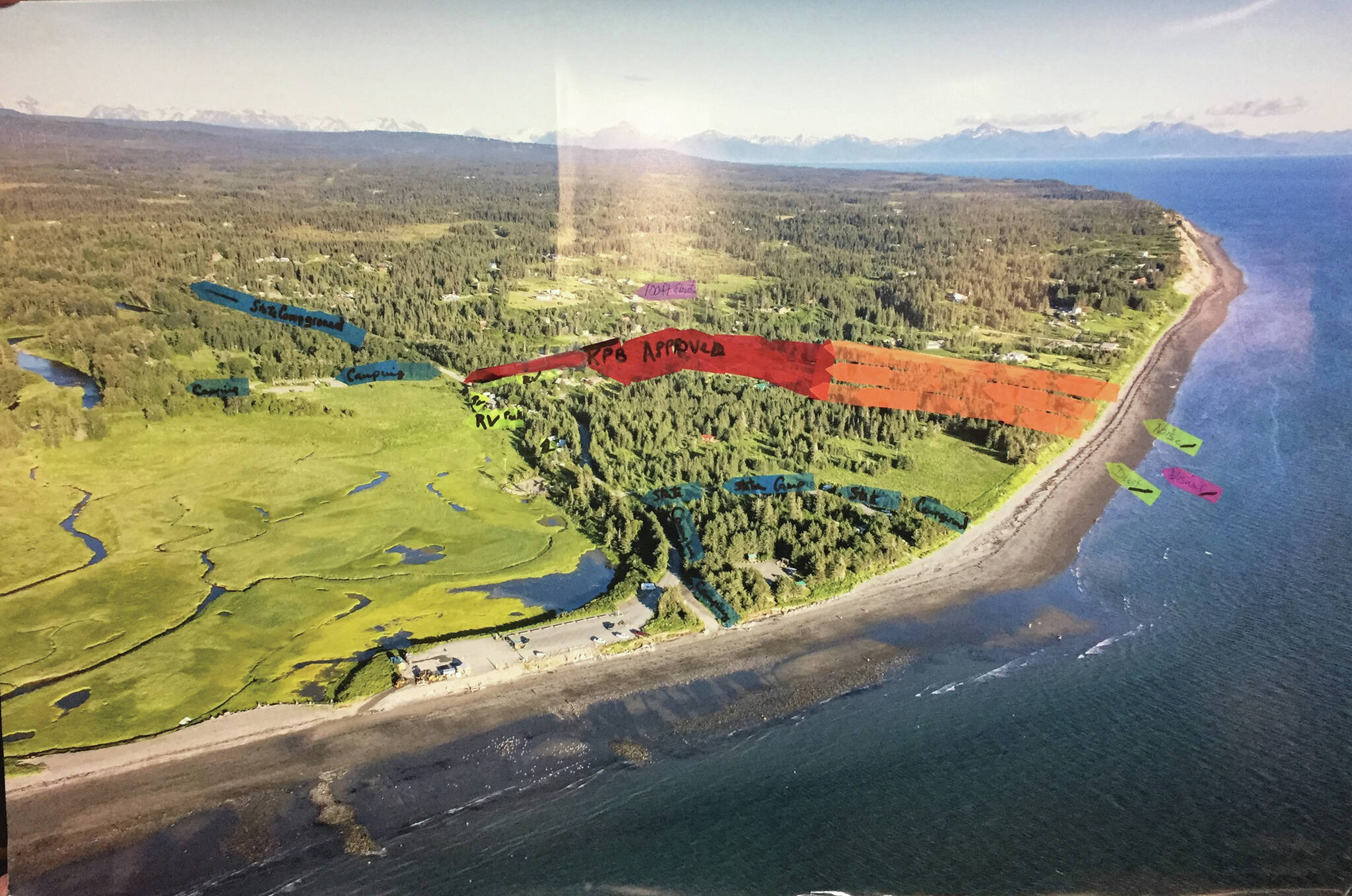
In a back-again, forward-again four-year saga of a proposed 27.3-acre gravel pit on the beach in Anchor Point, an administrative law judge last week may have put the final nail in the coffin of the project.
Judge Lisa M. Toussaint ruled on Dec. 6 that the commission could follow a 2021 Kenai Superior Court decision by Judge Jason Gist affirming the commission’s authority to apply standards to conditional land use permits, or CLUPs — the approach it had taken in July 2018 when the commission had first denied a CLUP by Beachcomber LLC to operate a gravel pit between a residential area on Danver Road and the beach near the Halibut Campground in the Anchor Point State Recreation Area.
Hans Bilben, one of a group of 30 property owners who challenged the gravel pit, and the lead appellant in the case, said this would be the first time in 100 applications a gravel pit CLUP had been denied in the borough.
“There’s never been a denial in the history of the borough that’s stood up on appeal,” he said in a phone interview on Tuesday. “… That would be the landmark case there.”
The decision comes with a caveat: In response to the Beachcomber LLC issue, the KPB Assembly currently is attempting to write new regulations regarding gravel pits that may undo the planning commission’s authority to apply standards. That rewrite may not come back to the assembly until March 2023.
“The majority of the assembly members seems intent to produce an ordinance that’s more protective of property owners,” Bilben said.
Toussaint’s decision denied an appeal by Beachcomber LLC owners Emmitt and Mary Trimble seeking to overturn an April 11, 2022, vote by the planning commission disapproving the CLUP. The issue had gone back to the commission after being bounced back and forth on appeals by the Trimbles and counter-appeals by Bilben et al. seeking to stop the gravel pit. The Trimbles sought to run the gravel pit all the way up to the Anchor Point beach — mining that could make the area wells vulnerable to salt water intrusion in the event of a tsunami, Bilben said.
Following the 2018 denial of their CLUP, the Trimbles made an appeal to a borough hearing officer, Holly Wells, who in December 2018 ruled that the commission had erred when it said Beachcomber LLC had to meet standards to protect against noise and visual impacts.
Neighbors argued that because the Danver Road neighborhood looked down on the gravel pit, the 12-foot high visual barrier proposed in the CLUP would be insufficient. Because the gravel pit in effect would be like an amphitheater, sound also would be amplified, the neighbors argued.
Wells sent the CLUP application back to the commission, with instructions that “the (borough) Code does not afford the Commission discretion to judge the effectiveness of the conditions identified in the Code. … the Commission may only apply conditions under KPB 21.29.050 when issuing a material site conditional use permit.”
The commission in March and June 2019 held public hearings and again considered the Trimbles’ CLUP. Following Wells’ instructions that it could only consider if the CLUP complied with mandatory conditions, the commission approved the 2018 resolution adopting the CLUP.
Bilben et al. then appealed the new planning commission vote to Hearing Officer L. Anmei Goldsmith, who also upheld approval of the Trimbles’ CLUP.
The group of about 30 neighbors took the issue to Kenai Superior Court, and ultimately won a judgment by Kenai Superior Court Judge Jason Grist remanding to the commission its 2019 approval. Grist said the commission could apply standards.
“Nothing in the Borough Code requires the Commission to approve a CLUP even where it finds that the conditions imposed cannot possibly minimize the visual and noise impacts to surrounding neighbors,” Grist wrote. “… The court finds that the Commission does have the authority under KPV 21.25.050(B) to deny a CLUP if it finds that the standards set forth in KPB 21.29.040 cannot be sufficiently satisfied.”
Grist remanded the CLUP application to the commission for further review and clarification on the issue of whether buffers could satisfy noise and visual standards in borough code. He wrote that if the commission found that no conditions “could adequately minimize visual and noise impacts to the standards set forth in KPB 21.29.040, then it may deny the CLUP.”
The commission then again considered the Beachcomber LLC CLUP application, and at its April 11, 2022, meeting denied the application. The Trimbles appealed that decision to Toussaint.
In their appeal, the Trimbles asserted that the commission had violated the Alaska Open Meetings Act by discussing legal advice about separation of powers in executive session and whether to hold an adjudicative session outside a March 21, 2022, public meeting. Toussaint ruled the commission did not violate the Open Meetings Act.
The Trimbles also asserted that the commission violated provisions in the Alaska Constitution protecting the right of Beachcomber LLC to equal protection under the law and enjoyment of the fruits of its own industry. The Trimbles said they did not receive equal protection because the commission granted a CLUP for another site with about the same acreage. Toussaint wrote that the Trimbles had not shown approval of a site that had Beachcomber LLC’s unique characteristics of a gravel pit at a lower elevation than a residential area.
On the “reward of industry” claim, Toussaint rejected the Trimbles’ claim that the commission incorrectly relied on Geographic Information System (GIS) and Light Detection and Ranging (LIDAR) maps, and that these maps only accounted for the ground topography and not the trees and vegetation.
Those maps showed that to protect line-of-sight from property owners to the gravel pit, berms would have to be from 24-feet tall to 52-feet tall. The commission used that evidence to conclude a 12-foot high berm would be insufficient.
“Substantial evidence exists to support the Commission’s reliance on the LIDAR maps for its findings of fact,” Toussaint wrote.
The Trimbles also disputed claims that the gravel pit had an “amphitheater-like” topography and that the commission erred in interpreting “minimize” to mean “eliminate” in rejecting the application.
“‘Minimize’ does not just mean that a party has taken steps to reduce impacts,” Toussaint wrote. “The applicant must show that the mitigating measures will actually keep the impacts to a minimum. That is the approach the Commission applied here.”
Considering the Trimbles’ arguments, Toussaint found insufficient grounds to overturn denial of the Beachcomber LLC CLUP application.
As Bilben et al. did when they appealed Goldsmith’s decision, the Trimbles can appeal Toussaint’s decision to Alaska Superior Court.
At press time, the Trimbles’ Anchorage attorney, Stacey Stone, had not returned a phone message or email seeking comment on the case or if the Trimbles would appeal to a higher court.
Reach Michael Armstrong at marmstrong@homernews.com.
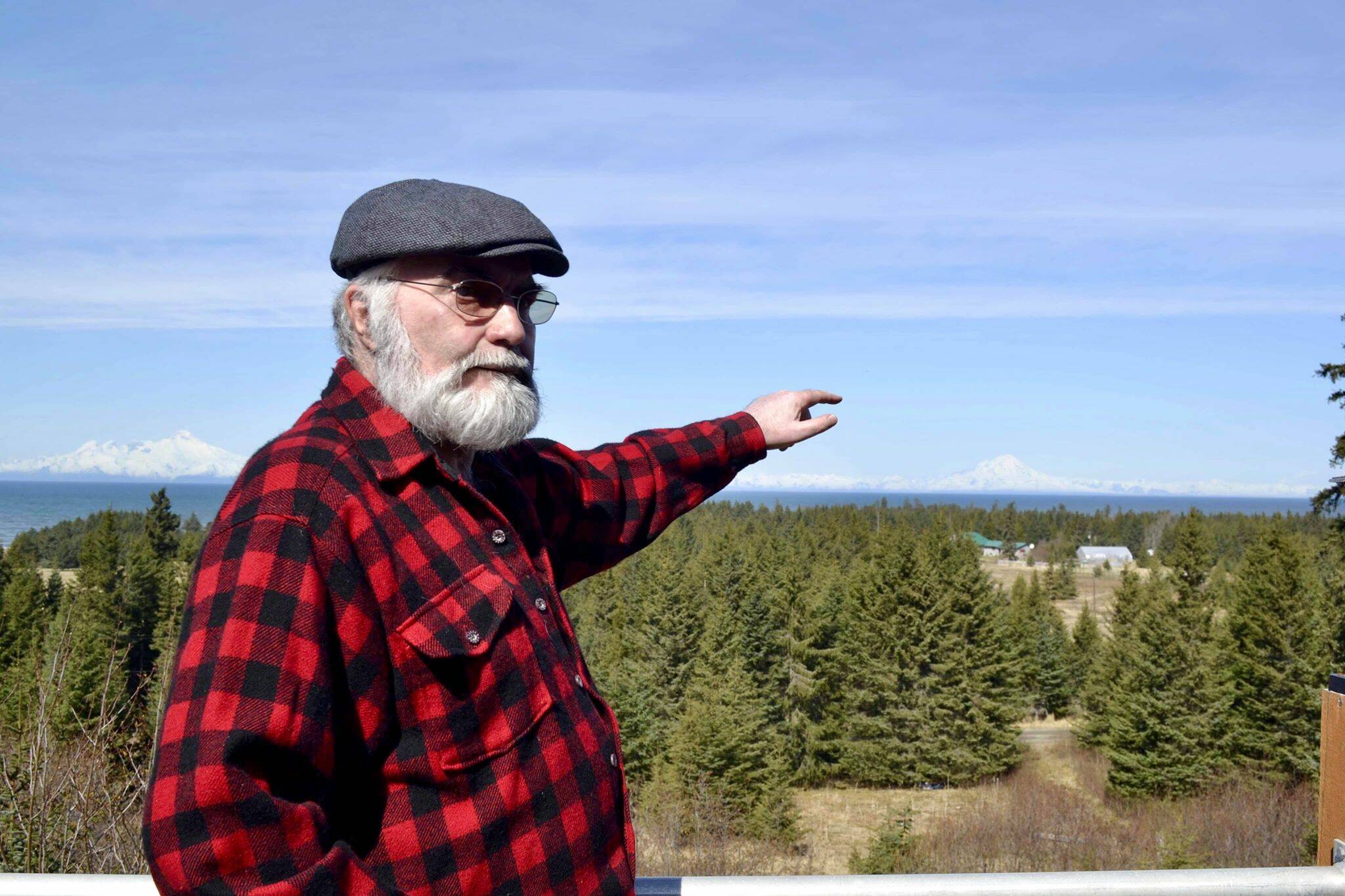
Pete Kineen, a neighbor of the proposed Beachcomber LLC gravel pit, stands on his deck and points to where the pit could be, on May 2, 2019, in Anchor Point, Alaska. (Photo by Victoria Petersen/Peninsula Clarion)
