
Just over a month remains before the Kenai Peninsula Borough administration plans to bring its proposed budget to the assembly on May 24.
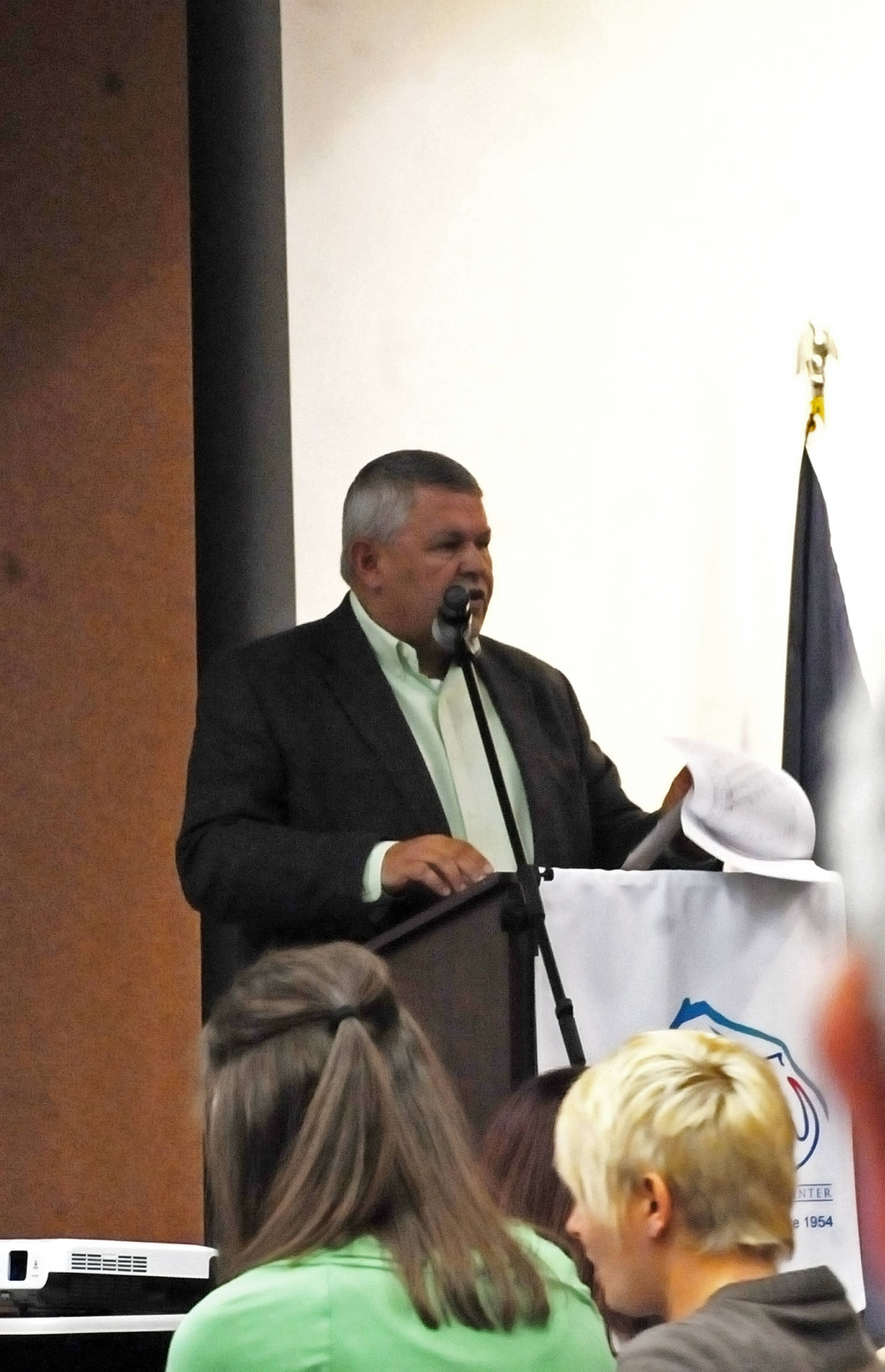
Borough Mayor Charlie Pierce is adjusting some pieces to balance the bottom line but is hinging his plan to bridge the borough’s approximately $4 million deficit around drawing about $3 million out of the borough’s land trust fund. The rest of the difference will come as a combination of budget cuts, efficiencies and an administrative fees applies to the service areas for borough support services.
The use of the land trust fund has been contested, both by assembly members and by members of the public, but Pierce said it makes more sense to take advantage of that asset to get the borough through fiscal year 2019 and then sell a longer-term plan to balance the budget in the following year. He related the land trust fund to an asset like a car the borough can cash in in the absence of new revenue, with the plan of looking for new revenue. The borough could look at cutting more expenses, but those would likely translate to staff positions, he said.
“What I’m doing is selling the car,” he said. “I’m selling the car because there’s uncertainty about going out and getting new revenue. There’s a considerable amount of uncertainty about that. Anything we do in regards to new revenue, I would encourage the assembly to always go before the voters and ask the voters what their opinions are first. I don’t think we should arbitrarily throw a tax on the backs of the taxpayers without talking to them first.”
The borough has to maintain at least $15 million in its fund balance by policy, or it risks a drop in credit rating and thus drastically increasing the interest rate the borough has to pay on funds it borrows through bond issues. There’s about $18 million left in the borough’s fund balance at present, and if the assembly chooses to fund the government out of the fund balance again this year, it will press close on that fund balance limit, Pierce said. That’s something his administration wants to avoid on advice from the finance department.
Using the land trust fund is only a holdfast plan for this year, but after that, the borough either needs to cut millions more out of its operating budget or look to new revenue. The primary idea the administration is planning to bring to the assembly is to raise the borough-wide sales tax from the current 3 percent to 5 percent and cut the mill rate down from the current 4.5 mills to 2.25 in fiscal year 2020. Projections show that the weight of revenue would shift from property tax to sales tax in the borough — about $51 million would come from sales tax while $21 million would come from property taxes.
Part of the reasoning is to have more revenue in sales tax to support school district operations and defray some of the annual tug-of-war between the Kenai Peninsula Borough School District and the Kenai Peninsula Borough Assembly over funding. Sales tax revenue in the borough is dedicated to the Kenai Peninsula Borough School District, and current revenues aren’t enough to meet the borough’s usual contribution. Because sales tax doesn’t meet the needs of the school district, the borough has had to dig into its general fund to pay for the school district, Pierce said. Shifting the tax regime to rely primarily on sales tax would more accurately reflect the borough’s spending each year — about two-thirds of the borough’s general fund spending goes to the school district, while about a third goes to other borough operations.
“The other third is a challenge to come up with enough revenue to cover those costs,” he said. “Incremental increase, cost of doing business, inflationary measures have driven that model … the present economy that we’re in today, putting 5 cents on the dollar generates $51 million dollars. I’m going to be an optimist and say the ball is going to roll to the right, we’re going to get good news from the industry, we’re going to crank up a couple industries here on the peninsula, and we’re going to be able to roll these numbers back and generate tax relief if we can generate more tax revenue from new money.”
However, that plan would require voter approval. For the past two years, the assembly has sent propositions to voters to ask for new sources of revenue to support borough operations, but the voters have soundly rejected each one.
At the same time, the assembly has balked at raising taxes that don’t require voter approval. During the discussions on the fiscal year 2018 budget, the assembly declined to raise the mill rate from 4.5 mills to 5 mills but simultaneously raised the borough’s contribution to the school district under pressure from the public, leaving the borough to spend approximately $4 million out of its fund balance to make up the difference.
The assembly is currently debating a proposition that would ask voters to raise the sales tax from 3 percent to 3.5 percent, which would raise an estimated $5 million each year after fiscal year 2019. However, Pierce said that plan would not raise enough revenue to account for increases in future operating years and force the assembly to ask voters for more revenue against in the near future.
“We have negotiations coming up in the fall. That’s going to drive the budget, I suspect. There will be something in regards to that that will have some effect on spending. We’ll have an insurance policy that will need to be renewed … I haven’t seen any of them go down yet.”
Another option his administration is considering is to implement a 10-cent excise tax on motor fuel in fiscal year 2019 and to raise the mill rate from 4.5 mills to 4.85 mills 9 in fiscal year 2021. Neither measure would require voter approval. The property tax change would bring in another approximately $3 million in fiscal year 2021 and the excise tax would bring in approximately $3.5 million each year after fiscal year 2019, according to documents provided to the assembly.
Pierce campaigned on the platform of not implementing any new taxes, but rather “hunkering down” and waiting for Alaska’s economy to recover and to see if any new economic development projects come to fruition on the Kenai Peninsula to help bolster the economy. The administration has high hopes for two of them in particular, Pierce said — the possibility of international fertilizer company Nutrien reopening its Nikiski fertilizer plant and the Alaska Gasline Development Corporation building its natural gas liquefaction plant in Nikiski as part of the North Slope gas pipeline project. The mayor’s office is also planning to draft a letter to send out to the Fortune 1000 companies presenting the Kenai Peninsula as a place to do business in the hopes of attracting more companies to operate here, Pierce said.
The borough administration has been talking with executives from both corporations to try to incentivize both projects, Pierce said. Before it closed in 2007, the Nutrien plant — then run by Agrium, as the company was called before its January 2018 merger with PotashCorp — employed about 230 people, and the proposed LNG plant is estimated to employ about 5,000 people on the peninsula during construction and about 1,000 permanent jobs statewide.
Pierce said the administration is proud of the budget going to the assembly and has taken input from the borough department heads as well as the school district. In the future, the mayor’s office is working on longer-range plans to assess the borough employee and department organizations as well as emphasize safety to cut down on worker’s compensation expenses. He said he hopes the assembly will approve the budget unanimously, which will help the administration sell the sales tax and property tax change plan in the future.
“It’s a good plan. It’s not robbing Peter to pay Paul. It’s not voodoo economics or simple math. But at the same time, it’s very thoughtful, very mindful, and very careful thinking and very careful preparation, and I give a lot of credit to everybody in this building who’s worked very hard over the last six months to bring us to the decisions where we’re at today.”
Reach Elizabeth Earl at eearl@peninsulaclarion.com.
