
One of the men accused of illegally placing gravel in the Kenai River says he did so because he believed it to be an emergency, while the Kenai Peninsula Borough argues that he should have consulted the permitting agencies first.
In a hearing Wednesday, representatives of the borough, defendant Steve Flick and his two lawyers discussed the incident before a hearing officer to determine whether he violated the terms of his borough permit. There are simultaneous charges pending in state court, though the court pushed the hearings back until the borough could go through its process.
Two people were charged with violations related to the incident, which occurred in June — Flick and Jason Foster of North Star Paving, the subcontractor Flick hired who actually placed the rock. However, Foster did not appear at the hearing nor file an answer to the borough’s complaint. Brittany Barrientos, Flick’s attorney based in Missouri, said Flick planned to take responsibility for the case as he was the contractor for the project and hired North Star Paving to do the work.
The borough did not agree and said the charges should be maintained separately, and failure to file a response was tantamount to admitting to the charges, said deputy borough attorney Holly Montague.
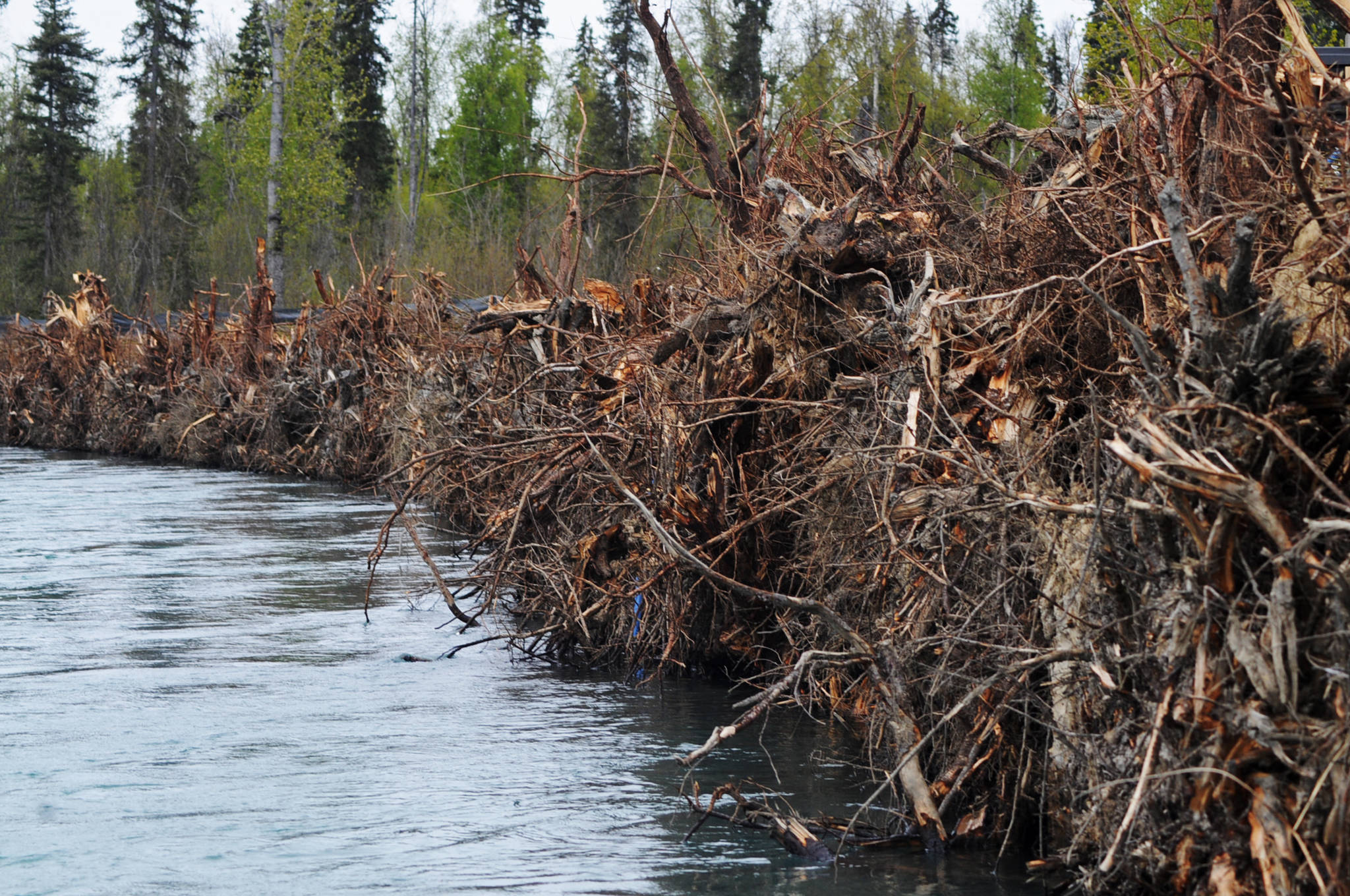
The charges date back to a bank restoration project the neighbors on Dow Island, an island in the Kenai River near Sterling, completed this spring. Flick served as the main contractor on the project, which was completed in May and armored the bank with rootwad and spruce cabling to protect it from future erosion. The staff at the Donald E. Gilman River Center supervised the project and coordinated with the neighbors about its progress.
The situation changed in June, when one of the neighbors reported that the rootwad project had been damaged and some of it was floating down the river, leading to further bank erosion. Flick, who lives in Missouri, was trying to coordinate a response via phone and judged it to be an emergency, based on the situation, Barrientos said.
“It was a major emergency that was going on … and he was trying to direct traffic from Missouri,” she said.
She said he understood the conditions of his permit to include maintenance, so he didn’t think he had to reach out to the River Center to deal with the problem. He called North Star Paving and asked Foster to send a crew out to place some gravel in the river to shore up the project. North Star employees drove equipment across the slough separating the island from the Funny River Road side of the Kenai River — which is also illegal — to complete the task, at first using the small gravel stored on the site but then switching to riprap when the smaller gravel didn’t work.
The borough doesn’t believe that the situation was an emergency, Montague said. River Center Manager Tom Dearlove said Flick didn’t indicate in his initial call that he thought it was an emergency, and judging from the photographs and other documents, the borough doesn’t believe the situation was an emergency. Bank erosion isn’t unusual there, either, Montague said.
“This is Dow Island,” she said. “Erosion is the norm.”
Since the investigation, Flick has filed permits to repair the project using the riprap placed in the river, but the state’s policies for fish habitat construction and floodway construction don’t allow for the use of riprap in bank protection projects, Dearlove said at the hearing. For one, riprap doesn’t allow for enough hiding space for juvenile salmon to rear safely, so it’s not considered best practices for anadromous stream restoration. The borough does make exceptions on the use of riprap for some Alaska Department of Transportation and Public Facilities projects because the roads are critical infrastructure, he said.
The riprap also affects flood planning, said borough Floodplain Administration Bryr Harris. Part of it is concern from the Federal Emergency Management Agency in flood planning, which allows for some leeway for habitat friendly projects along the river.
“Dow Island is entirely in the floodway,” she said. “… The rootwad revetment is allowed as a project because it’s habitat friendly, because it protects the bank. Throwing a large amount of riprap on top of the root fans then becomes not part of a habitat friendly bank stabilization project. It becomes an illegal encroachment into the floodway that would require that level of engineering and analysis before it could be permitted by the floodplain management program.”
On top of that, Flick could have called the River Center for an emergency permit, which is verbal, Montague said. The riprap would never have been approved and the borough might not have judged it to be an emergency, but he should have asked for consultation before going ahead, she said.
“Staff makes that (emergency) determination, but staff was never asked,” she said. “… On June 9, the River Center was open. We’re in the business of making that determination.”
Barrientos said the borough should take into consideration that Flick believed it to be an emergency and that he thought the permit he had for the construction covered maintenance. Preventing further erosion was actually helping the environment, she said.
“There were other competing considerations, such as maintaining the structure and preventing the rootwad from going down the stream, which I think we can all agree would have been an emergency situation,” she said. “We now understand that the River Center wanted things to be done differently and we’ll make sure to take that into consideration moving forward.”
The hearing officer was set to make a decision in the case within 10 days of the hearing.
Reach Elizabeth Earl at elizabeth.earl@peninsulaclarion.com.
