
The Kenai Peninsula Borough will offer hundreds of thousands of dollars in grants for opioid remediation using funds it expects to receive through a federal settlement with pharmaceutical companies.
That’s following a vote by members of the borough assembly last week both to accept the first round of money and to set up the Opioid Settlement Fund Grant Program.
The fund will serve as a repository for money the borough expects to receive through a federal settlement with major pharmaceutical companies related to the opioid crisis. Through the grant program, eligible entities can apply for money to use for opioid remediation activities as outlined in the settlement agreement. Notification of grants will appear on the borough’s grants webpage.
The Alaska Department of Law announced earlier this year that the state is slated to receive $58 million from a $26 billion nationwide settlement with major pharmaceutical companies Cardinal Health Inc., McKesson Corporation and AmerisourceBergen, as well as Johnson & Johnson. About 70% of the $58 million coming to Alaska will go to Alaska’s Opioid Abatement Accounts Fund.
The three companies were the top three opioid distributors in Alaska between 2006 and 2014, according to a database maintained by the Drug Enforcement Administration, which was made public by The Washington Post and tracks shipments of oxycodone and hydrocodone pills.
About $8.7 million, representing about 15% of the $58 million, will go to nine political subdivisions that opted to participate in the settlement, including the Kenai Peninsula Borough. Of that $8.7 million, the borough will get about 9.5% — around $826,500, to be distributed to the borough over 18 years.
The borough initially expected to receive about $46,000 per year, but that is not a set figure. This year, for example, the borough received about $29,000. Kenai Peninsula Borough Community & Fiscal Projects Manager Rachel Chaffee told assembly members last week that the annual payment is “supposed to be caught up” in future years.
Citing limited program funds, the borough ordinance says a maximum of five grants will be awarded each year.
Per a memo from Kenai Peninsula Borough Attorney Sean Kelley and Chaffee to assembly members, eligible uses of funds are outlined in the settlement agreement. Generally, those uses include care, treatment and other programs designed to address the misuse of opioid products, treat or mitigate opioid use or mitigate other alleged effects of the opioid epidemic.
“After gathering information to determine community needs, a common theme that was heard was that there were gaps in federal and state funding and that this funding could be used to bridge gaps and assist in ways to support needs,” the memo reads. “The needs were of a wide variety ranging from support personnel to incentives to complete treatments.”
The borough ordinance says entities eligible to apply for money through the program include nonprofits, medical and mental health providers, businesses who employ medical or mental health providers and Native Tribes and Corporations that have not received opioid settlement funds before. Any services funded through the grant program need to service borough residents.
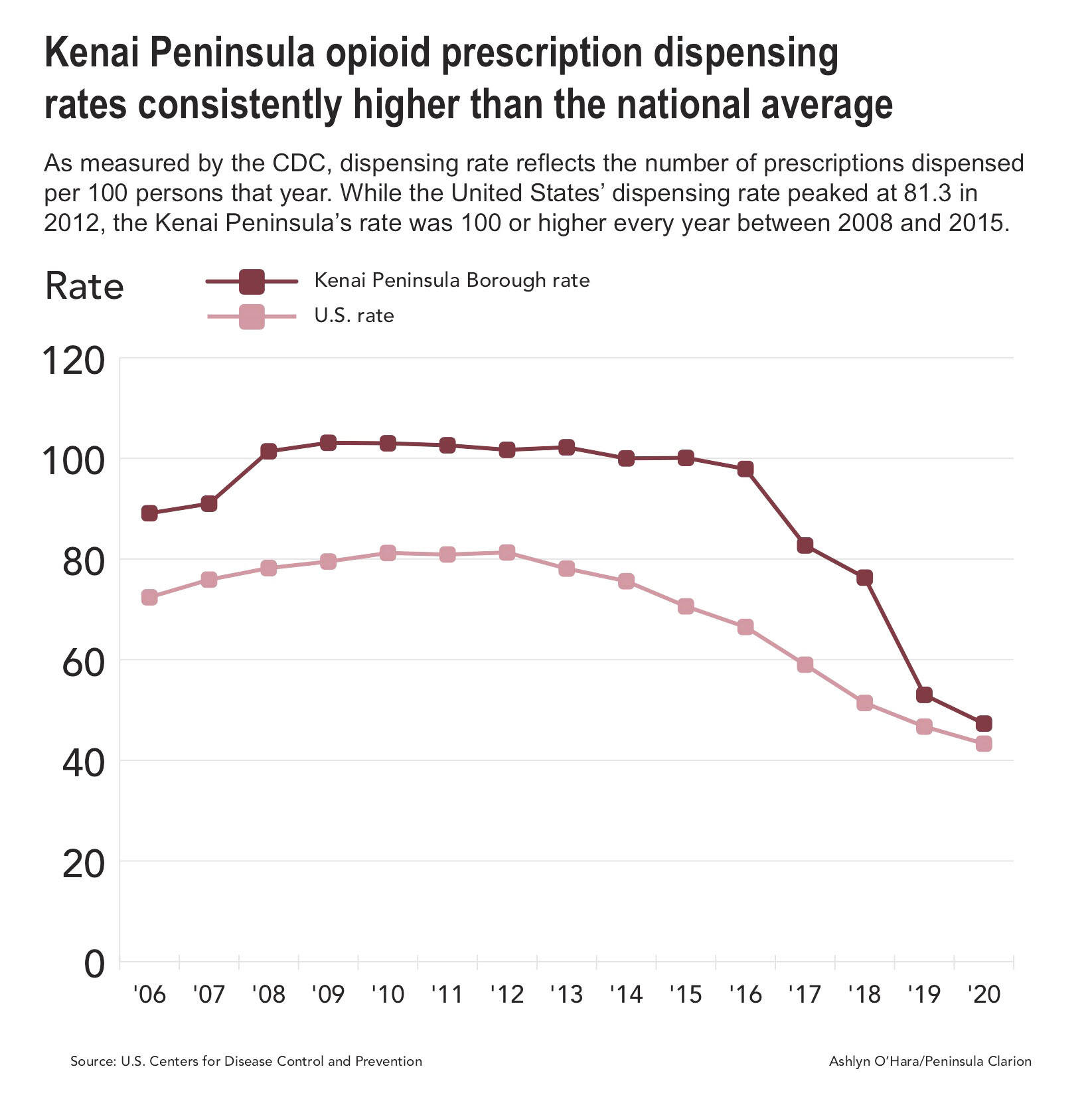
A Clarion survey of opioid dispensing rates on the Kenai Peninsula, conducted earlier this year, found that opioid prescription dispensing rates on the Kenai Peninsula were consistently higher than the rest of the country between 2006 and 2020. As measured by the CDC, dispensing rate reflects the number of prescriptions dispensed per 100 persons that year.
While the United States’ dispensing rate peaked at 81.3 prescriptions per 100 people in 2012, the Kenai Peninsula’s rate was 100 prescriptions or higher every year between 2008 and 2015. Nationwide, that rate never went above 100.
As part of the nationwide settlement agreement, Cardinal Health Inc., McKesson Corp. and AmerisourceBergen will, among other things, use data to detect suspicious opioid orders from customer pharmacies, prohibit the shipping of suspicious opioid orders and report suspicious opioid orders. It will also require senior officials to engage in regular oversight of anti-diversion efforts.
Additionally, Johnson & Johnson will not fund or provide grants to third parties for promoting opioids and not lobby related to opioids as part of the settlement. The company will also not resume selling opioids, which it stopped doing nationwide last year.
The companies will also be required to establish a central and independent clearinghouse that will provide all distributors with data and analytics about where drugs are going and how often. That effort will eliminate “blind spots” in the system currently used by distributors, the department said.
Reach reporter Ashlyn O’Hara at ashlyn.ohara@peninsulaclarion.com.
