
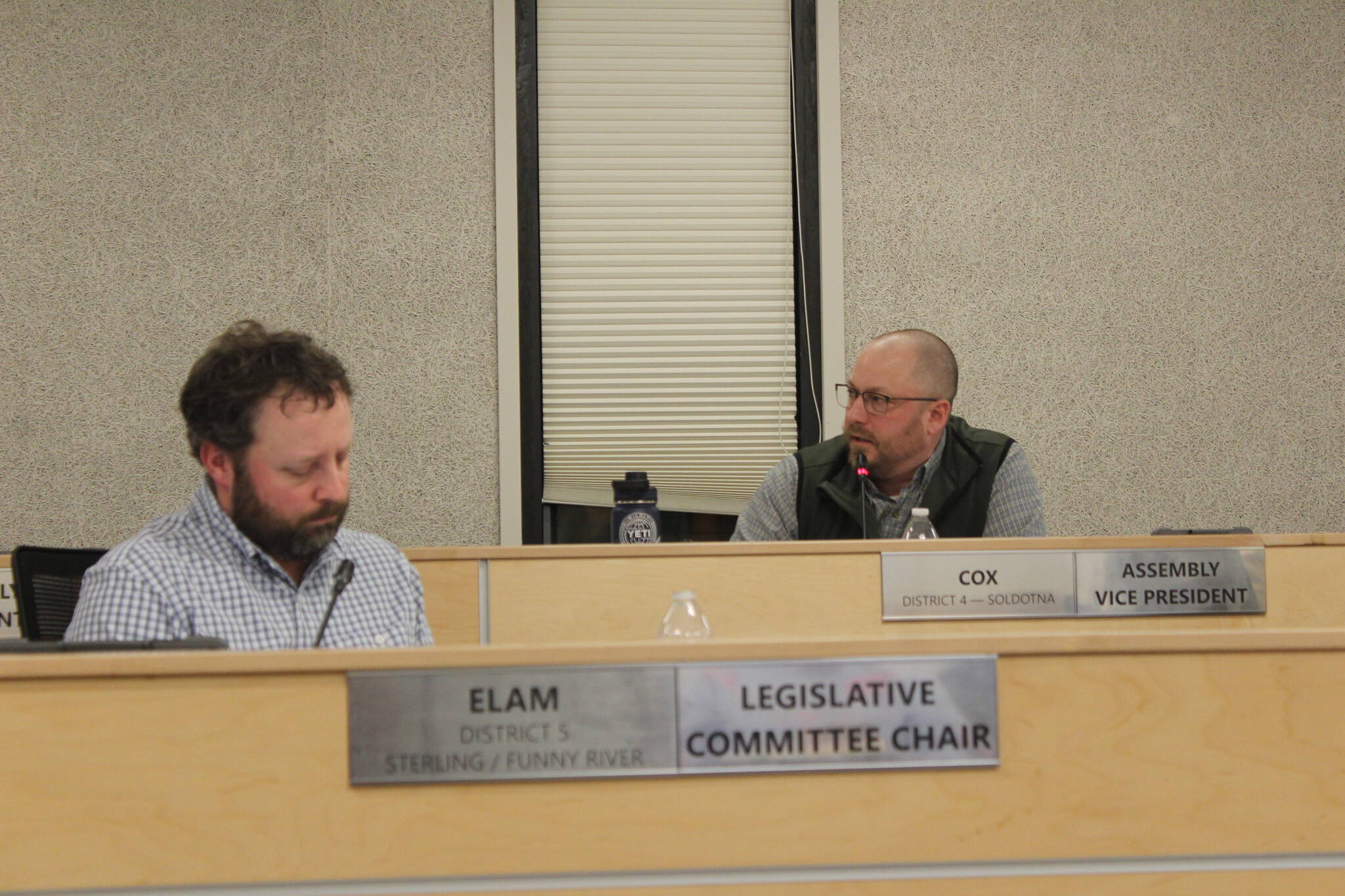
Members of the Kenai Peninsula Borough Assembly on Tuesday unanimously approved changes to the way invocations are given before the body’s regular meeting.
Effective Jan. 1, 2024, assembly invocations will be delivered exclusively by volunteer chaplains serving the borough’s fire and emergency medical service areas, as designated by the president of the borough assembly. Currently, the borough’s invocation policy says that the invocation may be given voluntarily by a borough resident. Invocations will also be limited to two minutes.
As defined by the resolution, invocations “will be limited to a short prayer or solemnizing message asking for help or support for the Assembly, decision making process, and/or Borough.” The borough’s previous language said an invocation “may include a short prayer or a solemnizing message.”
The resolution’s sponsors — Kenai Peninsula Borough Mayor Peter Micciche, Assembly Vice President Tyson Cox and assembly member Kelly Cooper — explained their reasons for bringing forward the changes during a Tuesday meeting of the assembly’s Policies and Procedures Committee.
Micciche said assembly invocations have become “unpredictable” and “relatively unproductive,” and have moved away from their objective of clearing assembly members’ minds. Cooper said invocations are political and divisive, on top of creating work for the borough clerk’s office. Cox said handing over the responsibility over to chaplains would bring more “professionalism” to the practice.
“We’ve seen more and more lectures, more and more, sort of, politically motivated speeches that seldom ask for any help or support for the assembly,” Micciche said during the assembly’s regular meeting. “This is a standardized way for a volunteer who is trained in exactly what an invocation represents to deliver a two-minute, or under, opening to our meeting.”
The resolution says a chaplain would bring abalanced approach.
“The Assembly believes a chaplain could more precisely execute a timely invocation specifically asking for help and support for the Assembly and Borough while remaining politically neutral and neutral with regard to religious affiliations,” it says.
The borough will most likely recruit the volunteer chaplains serving Central Emergency Services for invocations, for convenience, Micciche said. CES, located in Soldotna, is currently served by two volunteer chaplains: Frank Alioto and Tim Weekley.
“We were primarily focused on CES, who’s in the neighborhood,” Micciche said.
Tuesday’s adoption of changes to the borough invocation process came almost seven years after a trio of borough residents filed suit against the borough over the issue.
An invocation policy adopted by assembly members in 2016 limited invocation deliverance to religious associations with an “established presence” on the peninsula and to chaplains who serve “fire departments, law enforcement agencies, hospitals, or other similar organizations in the borough.”
Three peninsula residents represented by the Alaska Civil Liberties Union of Alaska sued the borough, alleging that the new policy impaired their constitutional rights. Plaintiffs Lance Hunt, who is atheist, and Iris Fontana, a member of The Satanic Temple, each said they were allowed to give an invocation before the 2016 policy was passed, but not after. Elise Boyer, who is Jewish, also said her request to give an invocation was denied under the updated policy.
“These restrictions impair the constitutional rights of Borough residents like Mr. Hunt, Ms. Fontana, and Ms. Boyer by controlling how residents may avail themselves of an honored opportunity to speak in public and by denying some residents the ability to share equally in the civic life of the Borough,” the initial legal complaint says.
The Alaska Superior Court in October 2018 ruled against the borough, saying that the 2016 invocation policy violated the Establishment Clause of the Alaska Constitution. That clause says “No law shall be made respecting an establishment of religion, or prohibiting the free exercise thereof.”
In the final decision and order, Superior Court Judge Andrew Peterson said that the borough’s 2016 policy “stemmed from intolerance for the controversial views expressed during two particular invocations” and “excludes minority faiths from participating in the invocation practice.”
“If KPB is opening the invocation opportunity to all borough residents, they cannot then put in place requirements that in effect exclude minority faiths or beliefs,” Peterson wrote. “Consistent with the establishment clause, an individual may only be prevented from giving an invocation where they have exploited the invocation opportunity to proselytize, advance, or disparage any faith or belief.”
The borough was ultimately ordered to pay $80,000 in legal fees to the American Civil Liberties Union of Alaska after losing the suit.
Kenai Peninsula Borough Attorney Sean Kelley told assembly members during Tuesday’s meeting of the Policies and Procedures Committee that, while the complete abolition of all invocations would make future litigation against the borough “very unlikely,” he thinks the proposed chaplain-led legislative prayer policy is defensible.
“The question posed to (the borough legal department) is whether a chaplain-led legislative prayer policy was defensible, in the light of feeling like the current policy was being exploited as an opportunity to proselytize or advance or disparage a faith or belief,” Kelley said. “In that context, we believe it is certainly defensible.”
Further, Kelley noted that the Alaska Superior Court’s ruling focused on violations of the establishment clause, stemming from the borough’s rule that religious associations giving invocations have an established presence in the borough.
Before convening for their regular meeting on Tuesday evening, assembly members had already received three comments opposing the proposed resolution.
The borough received a three-page letter opposing the resolution on Nov. 3 from the Freedom From Religion Foundation, a nonprofit organization with a stated goal of promoting the separation of church and state and to educate the public about nontheism. In the letter, that group said limiting who can give invocations to volunteer chaplains for borough service organizations, the assembly and the mayor would “ensure the borough has control over who delivers … the invocations and which religious views are allowed to be represented.”
“What the Assembly cannot do is alter its invocation policy in a transparent scheme to exclude religious views that it does not agree with or approve of,” the organization wrote. “If the Assembly wishes to avoid issues surrounding its invocation practice, the best solution would be to drop the practice altogether.”
Borough resident Bobby Henderson, who described themselves as a “concerned citizen” in a written public comment, said invocations should celebrate the “full spectrum of beliefs represented in our community.”
“By restricting who may deliver invocations, we risk alienating community members,” Henderson wrote.” The implicit message is that some beliefs are more valid or worthy of public acknowledgment than others, which does not align with the inclusive values the community must uphold.”
Of the seven people who testified during Tuesday night’s meeting, five opposed the resolution and two supported it. Those opposed expressed concerns about potential legal challenges and restrictions on residents who want to be part of the process, while those in favor said it offered a way for invocations to be given in a neutral and consistent way.
The resolution was pulled from the assembly’s consent agenda at the request of attendees, meaning assembly members were able to discuss the legislation before voting on it.
Adam Bertoldo, a former borough assembly candidate from Nikiski, spoke against the proposed changes. Chaplains already have the opportunity to give assembly invocations under the current policy, he said, and he supports allowing residents to continue participating.
“I don’t like all (of) the prayers that are given,” Bertoldo said. “Of course, there’s some I strongly disagree with, but I would lean toward the liberty on that.”
Rev. Dr. Keith Hamilton voiced his support for the work done by the volunteer chaplains that serve CES, who he said are trained in critical incident stress debriefing and have experience supporting the needs of their community.
“These are people who are trained in theology,” Hamilton said of the chaplains. “Each of our chaplains over the years have pastored local churches here in the community. They don’t come from any one denomination.”
Assembly member Bill Elam, who represents Sterling and Funny River, signed on as a co-sponsor to the legislation, which assembly members passed unanimously.
The new policies go into effect on Jan. 1, 2024. Scheduled to give the invocation at the assembly’s next meeting — the last under the current invocation policy — is Iris Fontana, of The Satanic Temple.
Tuesday’s assembly meeting can be streamed on the borough’s website at kpb.legistar.com.
Reach reporter Ashlyn O’Hara at ashlyn.ohara@peninsulaclarion.com.
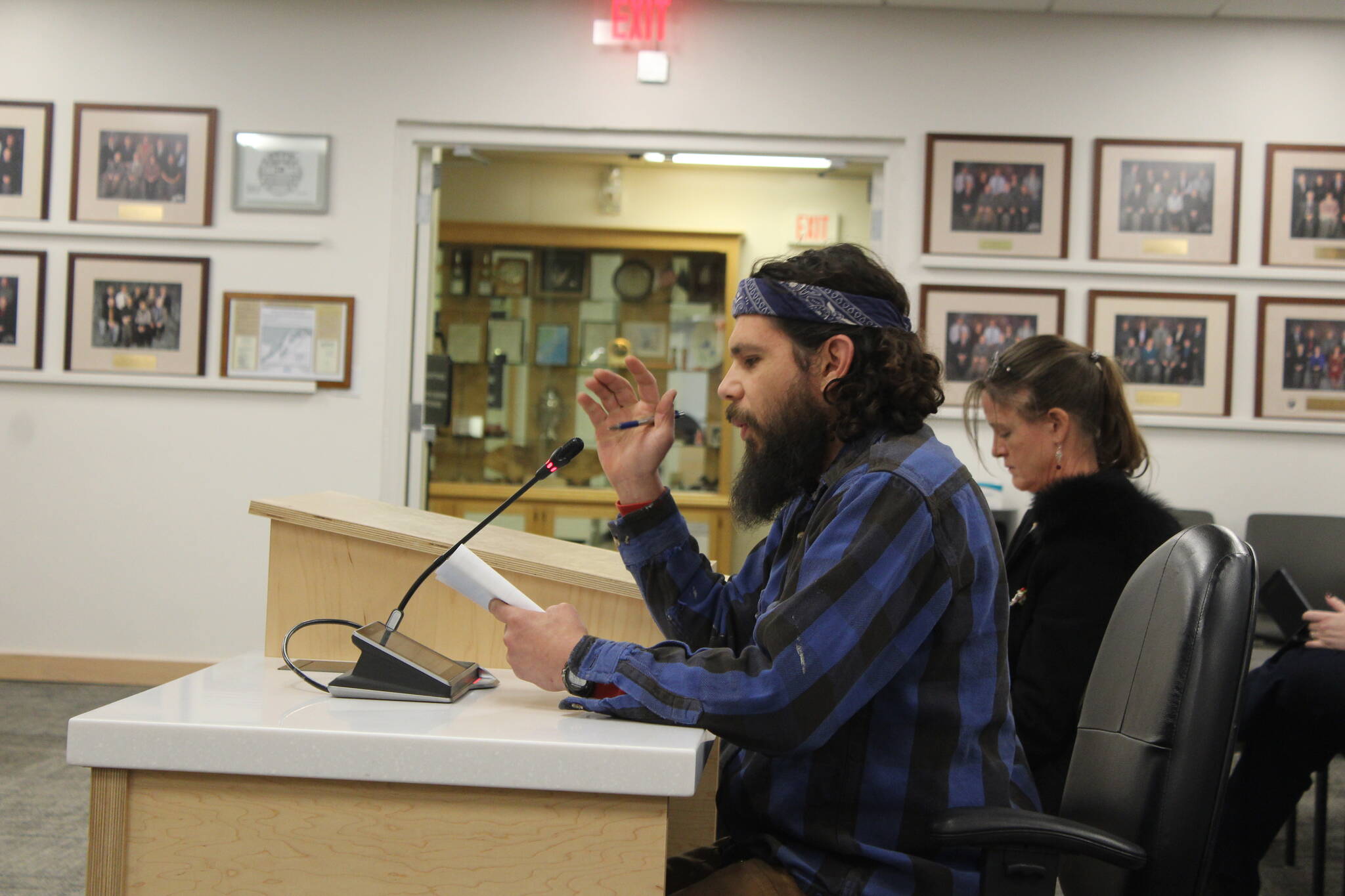
Adam Bertoldo testifies in opposition to a resolution only permitting certain chaplains to deliver invocations before Kenai Peninsula Borough Assembly meetings on Tuesday, Nov. 7, 2023, in Soldotna, Alaska. (Ashlyn O’Hara/Peninsula Clarion)
