
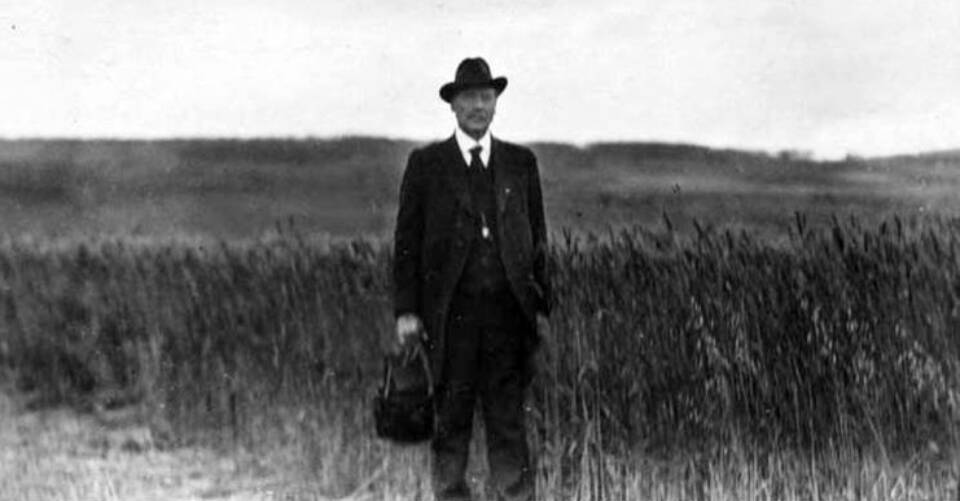
AUTHOR’S NOTE: A presidential executive order in January 1899 had set aside 320 acres of land near Russian Orthodox Church property in the village of Kenai for the creation of an agricultural experiment station. By 1902, the superintendent of this station, H.P. Nielsen, under the supervision of Sitka’s Prof. C.C. Georgeson, began changing the station’s focus to a dairy and beef farm.
Two more cows were added to the Kenai Station herd in 1903, bringing the total number of cattle to seven head. In a letter to the newspaper in his home county of Lincoln, Kansas, a few months earlier, station superintendent Hans Peter Nielsen had bragged about the mild summer climate on the Kenai Peninsula, the fine grain production of his fields and the vegetable production in his gardens.
In turn, the newspaper had offered this brief commentary on the accomplishments of its native son: “When we usually think of Alaska, icebergs and glaciers involuntarily come to mind. But from Mr. Nielsen’s letters, as well as from other sources, we are beginning to learn that Alaska has wonderful agricultural resources and will one day become the home of a vast population.”
Changes
Although 1903 was about to become Nielsen’s final season at the Kenai Station, he remained busy, including an important personal change: marriage.
On Oct. 17, 1902, Nielsen tied the knot with a local girl, whose name, according to the Alaska Prospector newspaper, was Aggrippina “Groonya” Yekaloff, “a young lady who has been brought up by the Rev. Ivan Bortnovsky.” The paper reported that the Kenai wedding ceremony had been followed by a dinner and enough drinking to cause a delay in honeymoon plans.
It is difficult to know the true nature of this relationship. Five years later, with the couple living in Kansas, a local newspaper reported that Nielsen had sued his wife for divorce on the grounds of abandonment and fraud. Nielsen would wait a decade to remarry.
A month after Nielsen married Groonya, a collegiate newspaper in Kansas reported that Nielsen would finally have a paid assistant at the Kenai Station—another product of Kansas State Agricultural College, Pontus “Patrick” Henry Ross, who was scheduled to start work in the spring of 1903.
Nielsen would earn a $1,500 salary for his final season of work, while Ross, would make just $60 per month. Their supervisor, Prof. Charles Christian Georgeson, stationed at Sitka, continued to pull in $3,000 per year.
By the end of that season, Ross would be announced as Nielsen’s full-time replacement, and his salary would be adjusted upward and made annual.
During the 1903 season, Nielsen and Ross raised the total land cleared, broken and fenced to 21 acres. The first five acres cleared at the station in 1899 had been along the station’s southern property boundary, closest to Cook Inlet and therefore nearest the source of sea winds that sometimes battered the crops.
By 1903, station personnel were clearing new ground farther inland in an effort to better protect future plantings. They planned to clear even farther from the inlet in future years.
Prof. Georgeson’s annual report on Alaska’s agricultural experiment stations noted that 1902 had had a late spring and a particularly cold summer, preventing the grain from maturing fully and casting a shadow over efforts to adequately provide for a growing herd of beef and dairy cattle.
That same year, Nielsen had received two more oxen to help with clearing work and other labor at the Kenai Station. Unfortunately, the oxen—which were old despite being new to the station—had arrived in poor condition due to rough passage on the bark Harvester. According to the Alaska Prospector, it was feared that only one of the oxen was likely to survive.
A short time later, those fears were realized. “Mr. Nielsen had to shoot one of the old oxen … as he was toothless and could not eat enough to sustain life,” said the newspaper. As a consequence, the station turned again for help to the Russian priest, Father John Bortnovsky, who allowed the use of his large bull. Soon, Nielsen was able to break the bull to harness and put him to work.
When Ross showed up in Kenai in 1903, he was given the job of working with the same bull, but Ross lacked Nielsen’s finesse with the animal. At one point, reported the Alaska Prospector, the bull decided to rest and simply lie in the middle of the field, refusing to budge. The polite, church-going Ross initially had no luck encouraging the bull with mild reproaches or even with a whip.
Finally, said the paper, he tried Nielsen’s cruder style of addressing the animal, and success came at last. “He sorrowfully turned to Nielsen,” the paper reported, “saying, ‘Well, I have found how to manage the brute, but I have lost my religion.’”
At the end of the 1903 season, Nielsen departed the Kenai Station for a final time and returned to Kansas. He would remain in agricultural pursuits, living to be almost 80 and dying in January 1954.
Ross, his replacement, had been born in Jewell County, Kansas, on June 24, 1879. He was almost 24 years old when he began his tenure at the Kenai Station. He would marry Esther Elizabeth Hanson in March 1905 while on vacation in Kansas and bring her with him to Kenai for that season, his last in Alaska.
By early 1904, Prof. Georgeson had decided convert the Kenai Station solely to a stock-raising and dairy unit. Besides vegetables grown for the use of station personnel, only grain for winter cattle feed would be produced. In the summer months, the cattle would have free range to fatten on native grasses.
When Georgeson summarized the 1903 season and considered the future of agriculture in Alaska, he offered good news and bad news. On one hand, the market for fresh produce in mostly roadless Alaska was strong, he said; on the other, those markets were “not always easily accessible.” Thus, transporting produce to the people who wanted it meant either a dismally low profit margin for farmers or very high prices for consumers.
While hardships were inherent in any type of pioneer lifestyle, a lack of adequate transportation systems, combined with an often harsh climate, meant even more difficult times for hungry Alaskans.
He hoped that the switch to livestock-centered production at Kenai would help provide at least part of the solution.
For the next several years, it seemed as though Georgeson’s optimism had been justified. And then the whole agricultural experiment in Kenai suddenly ended.
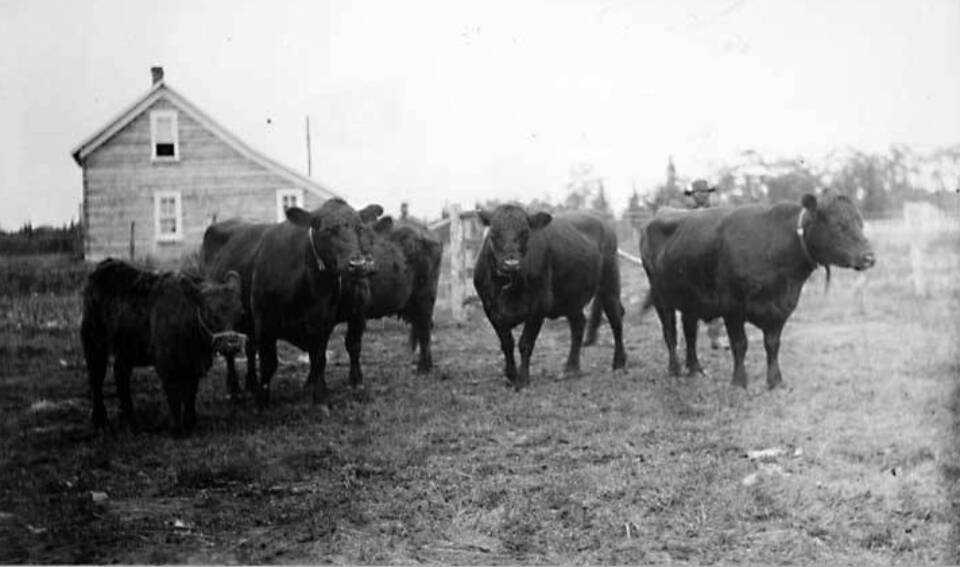
Photo from a circa 1906-07 U.S. Department of Agriculture report on Alaska’s agricultural experiment stations Hardy Galloway cattle, from Scotland, were transplanted to the agricultural experiment station at Kenai in 1906. The Kenai Station’s main quarters can be seen in the background.
