
AUTHOR’S NOTE: Presidential Executive Order #148, in January 1899, had set aside 320 acres of land near Russian Orthodox Church property in the village of Kenai for the creation of an agricultural experiment station. The superintendent of this new station was H.P. Nielsen, under the supervision of Sitka’s C.C. Georgeson, special agent in charge of all such stations in Alaska.
When Charles Christian Georgeson, a former professor at Kansas State Agricultural College, prepared to get Kenai’s agricultural experiment station up and running in 1899, he began by hiring KSAC graduate Hans Peter Nielsen as his Kenai Station superintendent. Then he set out to provide Nielsen with the tools and the laborers he would need to succeed.
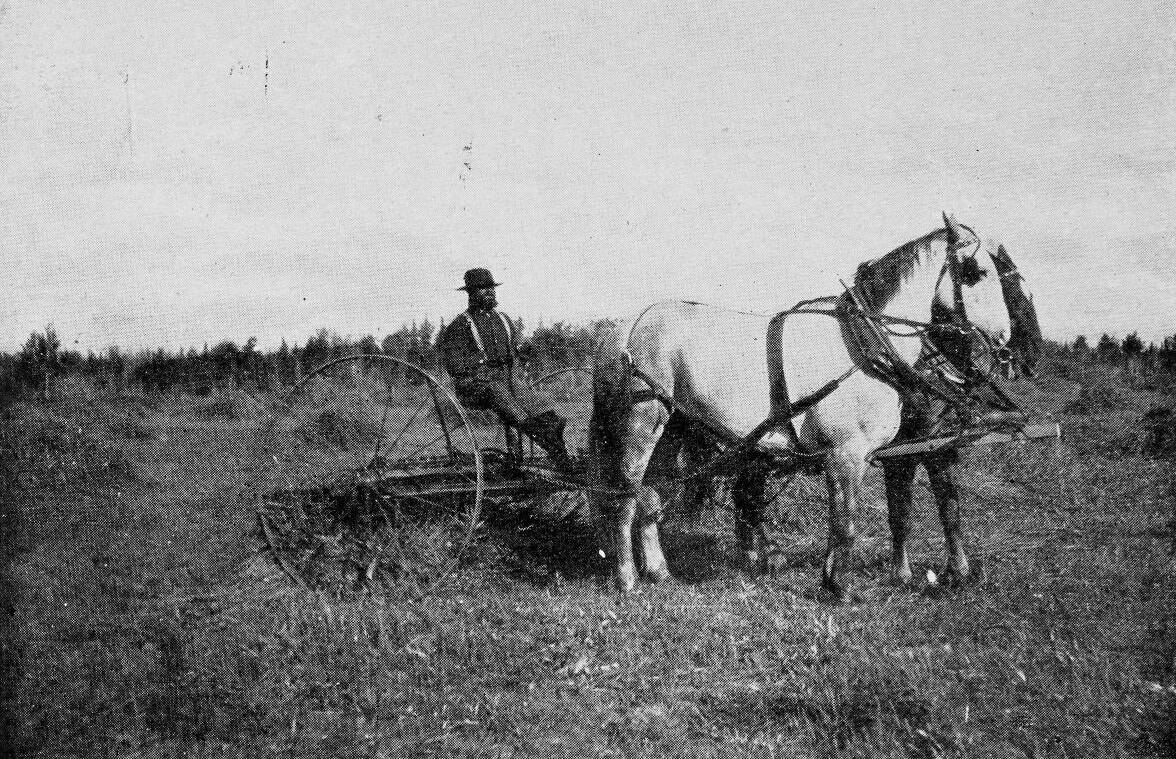
Georgeson arranged for Nielsen to have two oxen and equipment for turning and tilling the soil. He also provided hand tools and, later, stump-pulling equipment to aid in the land-clearing process.
After Nielsen’s first season in Kenai, Georgeson attempted to get him another Kansan as a full-time paid laborer to improve production. However, because weather and other factors could complicate spring trips from the Lower 48 to Alaska, arranging transportation sometimes caused hiring efforts to go awry.
In early January 1900, the U.S. Department of Agriculture offered KSAC grad James H. King a job as Nielsen’s assistant. His home newspaper, the Lincoln Republican, announced that King would be leaving Kansas in early March in order to reach Kenai in time for the beginning of spring work.
King, the paper added, had initially been dissatisfied with the government’s financial offer and had negotiated for a better salary. Within a week, he had the price he wanted, and the paper wished him “success and advancement in Uncle Sam’s service.”
Another area newspaper, at about this same time, seemed to find the very idea of agricultural experiment stations in Alaska ridiculous. Of King’s new job, the paper said, “He will help manage an experiment station, which will probably prove, theoretically, that oranges and bananas can be raised in the Klondike.”
Nevertheless, King continued to plan for his departure.
On Feb. 22, the Lincoln paper announced that the Department of Agriculture had notified King that he should expect to sail from Seattle to Alaska on March 12. By March 8, the departure date had been pushed back until early April. By March 22, his departure time had been extended about three more weeks. “He thinks this will be the last delay, however,” the newspaper assured its readers.
It is almost certain that King finally wearied of the delays and opted out of his “satisfactory proposition” in Alaska. He does not appear in the list of agricultural experiment station employees for 1900-01, but he does appear in Lincoln County newspapers in September.
In a letter home from Kenai on June 5, 1900, Hans P. Nielsen wrote that he had been working alone all summer thus far and was uncertain whether he could expect any help at all during that growing season.
The Farmer’s Life
Back in mid-August 1899, as he neared the end of his first season at the Kenai Station, Superintendent Nielsen had been instructed by his boss, Prof. Georgeson, to travel south to the village of Ninilchik, to learn how agriculture was being developed there, and then to make an official report on his observations. Later, in a letter to the editor of the Lincoln Republican, Nielsen also made an unofficial report of his discoveries.
“Ninilchik contains about sixty residents, most Russian,” began Nielsen’s letter, which was published Sept. 28. “The first thing I learned after a few minutes talk with a couple of men who could understand and speak a little English was a complete lack of systematic farming.”
Nielsen said that Ninilchik farmers were raising only potatoes and turnips for “home consumption” and never took any action to improve the productivity of their garden plots.
In fact, if a certain garden plot failed to produce in one year as well as it had the previous year, he said, Ninilchik farmers would abandon that site and create a new one some distance away. He also noted that their gardens were planted some two miles from their village and usually on hillsides subject to erosion.
In the more productive ground between gardens and village, he continued, Ninilchik farmers had planted only hay for their livestock. A farmer named “Mr. Koslikoff” informed Nielsen that they did not farm vegetables in this soil because doing so would “spoil [the] hay cut.” Nielsen tried to convince Ninilchik farmers that they could grow hay AND other crops on this good ground, but they were uninterested. They believed, he said, that doing so might not be good for village cattle.
“The cattle, of which there are about twenty head,” reported Nielsen, “are very small and scrubby. They are of Russian stock and have been inbred for so many years that the average cow weighs less than 600 pounds.”
“The people,” he concluded, “are a very ignorant, lazy set…. For an American to try to teach systematic farming to them would be like trying to break a colt to drive without ever hitching him up.”
The Kenai Station, meanwhile, had experienced “slight frosts” in mid-August that froze Nielsen’s tomato plants and the flowers on his buckwheat. Otherwise, his crops were undamaged, and he felt optimistic about the future of Kenai agriculture.
In mid-May of the following year (1900), Nielsen penned another letter to the newspaper and reported that he was just beginning to work the ground at the Kenai Station because the soil was finally drying out and warming up.
In the same letter, he noted that an influenza epidemic had hit the village and had killed perhaps 25 people, mostly Natives. At the same time, he said, “I never felt better—physically—in my life” than during the time so many other people were ill.
As the summer progressed, he continued to plant crops and clear more land. He pronounced himself delighted to receive a “fine new office desk and chair” from Prof. Georgeson, and he seemed happy with the production of his grains, which he hoped would be able to mature before any killing frosts occurred.
In contrast to the rigid, mostly ineffective agricultural scene in Ninilchik, Nielsen, at the Kenai Station, continued to experiment, expand and opt for variety—winter wheat and rye; buckwheat, oats and barley—as he took careful notes about his progress. Georgeson had sent him some block-and-tackle gear to improve his ability to pull down trees and uproot stumps, with his oxen doing the heavy work.
His first two seasons in Kenai had been highly productive, but the seasons and conditions in any farming enterprise are variable. Nielsen was about to earn another bump in annual salary, to $1,200, and to experience new challenges in 1901 as he broadened the operation and faced the capriciousness of the Kenai Peninsula’s climate.
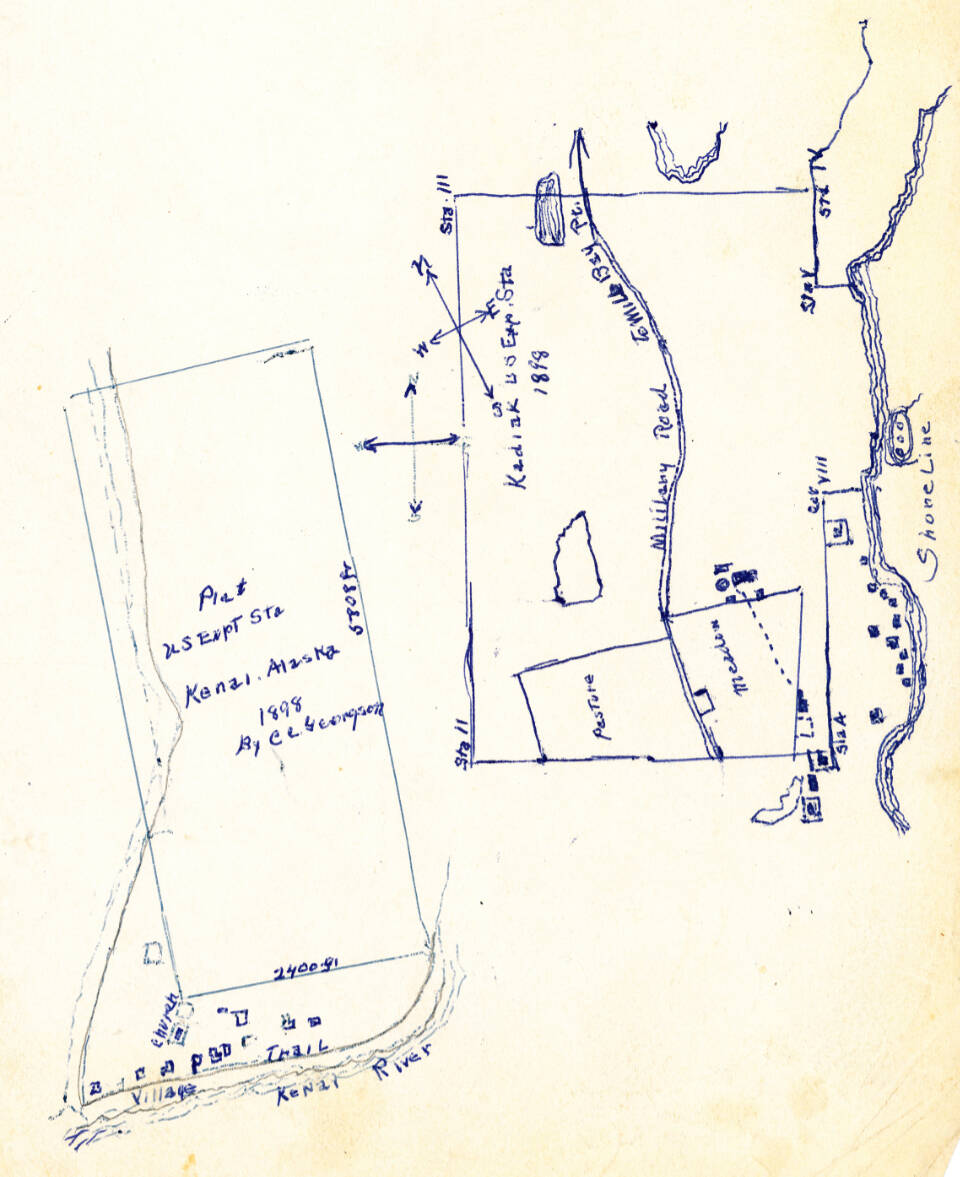
These two hand-drawn maps of the agricultural experiment stations at Kenai and Kodiak were either originals or copies made by Milton D. Snodgrass in 1907. For a citation, this is from Snodgrass, Milton and Roland Papers, Box 1, Folder 1, Archives, University of Alaska Fairbanks. (Image from the Rasmuson Library historical archives at the University of Alaska Fairbanks)
