
AUTHOR’S NOTE: Although I could not have written this series without the assistance of numerous individuals, I want to call particular attention to four of them: Gary Titus, who has for decades been gathering material on the denizens of the Kenai National Wildlife Refuge; Jonathan Streicher, from Germany, who in 2019 emailed the Resurrection Bay Historical Society to ask for any information it might have about his great-great-uncle; Hermann Melchior, also of Germany, a great-nephew of Steve Melchior and keeper of in-depth Melchior family history; and Susan Nielsen, of Philadelphia, the granddaughter of Steve Melchior’s middle son.
When 21-year-old George Beebe Roberts came to the middle Kenai River in the summer of 1922 to work for pioneer placer miner Steve Melchior on his Surprise Creek claims, he was led on foot to Melchior from the head of Kenai Lake by a man who offered Roberts a warning:
“My guide whiled away the long miles with an exhaustive dissertation on the less-endearing qualities and habits of the man for whom I was to work,” recalled Roberts in the May 1950 issue of the Alaska Sportsman Magazine. “I was told that, summing it up, I would find him stubborn, unreasonable, irascible, uncooperative and the biggest liar in the Territory.”
Roberts, in the end, failed to share that characterization of Melchior. “Set in his ways he was, perhaps, and dogmatic in speech at times,” he wrote of Melchior, “but a finer friend and more congenial wilderness companion I have never known.”
When Melchior died in Seward in 1933, the Seward Daily Gateway honored him with a full column of print on page one — topped with this headline: “Steve Melchior, Pioneer of Seward, Died Early Today.” A few days later, the newspaper offered a page-two description of Melchior’s well-attended Catholic funeral.
The de facto obituary described his final days, his early years, his love and knowledge of the outdoors, his efforts as a miner and his many technical skills.
Much of the Alaska material was true; however, many of the details comprising the fabric of Melchior’s first 40 years were falsehoods, bound together by the threads of mistruths Melchior himself had been weaving for decades.
Melchior had been lying about his age, his work history, his marriage, and his military experiences. He had deceived census takers, naturalization officials, his wife and family, and most of his friends and acquaintances.
Did anyone in Alaska know the real Steve Melchior? That is difficult to say.
Melchior was a hard worker and a skilled, innovative craftsman. He had traveled all over the Kenai Peninsula and knew its trails, its mountains and valleys, its animals and its people. He had constructed several cabins and boats. He had invented mining equipment. He had become a moose rancher and had even escorted one of his pet moose to a zoo in the Midwest.
By most standards of the time, he had led a remarkable, productive life.
It is unknown what prompted Roberts’s unnamed guide to label Melchior such a notorious liar. His proclamation is the only such contemporaneous damning yet discovered, and the number of people in Alaska who saw through all the falsehoods appears to have been precious few.
Besides, Melchior was hardly the only person to fabricate a past in order to suit dreams of the future.
The foundational lie
Most American sources place the year of Steve Melchior’s birth in 1848 in Germany. George Beebe Roberts, for instance, believed 1848 was correct because Melchior told him he was 74 in 1922.
To Roberts, an enthusiastic California native seeking an adventure before returning to college, Melchior must have seemed every bit the old sourdough he claimed to be.
“The years he had spent battling the rigors of the untamed North showed in the stoop of his back and the sprinkling of gray in his hair and beard,” Roberts wrote, “but his eyes behind the gold-rimmed spectacles still glowed with a zest for life and mirrored the restless and driving intellect that had led him into initiating a (moose-ranching) project a youngster would have considered long-range.”
How was Roberts to know that Melchior was actually 10 years younger than he said? What purpose could lie behind pretending to be a full decade older than he was?
To better understand Melchior’s reasoning, it is perhaps instructive to return to the beginning of his story.
Stephan Melchior was born in Ingendorf, in western Germany, on July 25, 1858, to parents Johann and Barbara (nee Mathes) Melchior. He was the seventh-born child. Another sibling would follow in 1861 and another in 1865. Stephan’s eldest sibling, Elisabeth, had been born 17 years before him. Stephan’s birth was recorded in the Dockendorf church register by Burgermeister (Mayor) Gabriel Weiß.
Stephan spent his childhood at his parents’ home in Ingendorf, where his father was a cooper (barrel maker) and a farmer. Under his father’s tutelage, Stephan learned the woodworking skills he would employ successfully throughout the remainder of his life.
From 1879 to 1882, Stephan performed his required military service with the 8th Rhineland Infantry Regiment No. 70 in Trier, 35 kilometers from his home. During this time, according to Hermann Melchior, he “encountered participants of the Franco-Prussian War of 1870-71, and his older brother Nikolaus (born 1847), who was probably also a veteran of the war, had likely shared stories with him. These tales seemed to have had a lasting impression on Stephan, as he later recounted the experiences of the war as his own while in the ‘New World,’ where these stories earned him admiration.”
Since Stephan had been only 12-13 years old during the war and had been still living at home, he began pretending as an adult that he was older — a strategy he would stick to for the rest of his life, even enhancing the falsehood with more details. According to one article in Alaska, Stephan claimed specifically to have fought in the 1870 Siege of Verdun and been wounded when a bullet pierced his right thigh during the battle.
As a consequence of the lies about his birth year and his military experience — plus his unwillingness to come clean and admit the truth — Melchior, in the United States, was forced to reshuffle his real past to fit the framework of his invented one.
According to his obituary, Melchior had worked as a millwright and a mechanic in Belgium and France after the war. This was true, but this employment did not occur immediately after the Franco-Prussian conflict had concluded, as he implied. Melchior actually worked in those countries in 1878-79, when he was 20-21 years old.
The obituary asserted that Melchior had been employed from about 1873 to 1875 as an engineer for a large German shipping company, and during this time, he had visited Africa, India and China. In reality, although he did apparently work for a large German shipping company, it was in 1883 when he was attempting emigrate to the United States. As a crew member on a large ship — while it would have taken him longer to reach his ultimate destination — he would have earned money and negated his need to pay for passage.
Working as an “engineer” was also stretching the truth. Hermann Melchior says Stephan worked on board as a fireman — one of the individuals who toiled belowdecks with a shovel in the intense heat in front of the ship’s furnaces, stoking them constantly with coal to heat the ship’s boilers and provide steam to power the vessel.
Whether his time onboard led him to Africa, India and China is unknown. What seems more certain is that his passage led him during that year to the West Coast of the United States.
Then, in U.S. District Court in Washington on Jan. 20, 1884, aided by two witnesses and having been in the United States only a few scant months, Stephan Melchior was naturalized as an American citizen. On his certificate of naturalization, he claimed to have resided in the United States for at least five years and within Washington for at least one year. During all that time, said the boilerplate language of the document, “he (had) behaved as a man of good moral character.”
It was an auspicious start to his life as an American, but it would be short-lived. This time.
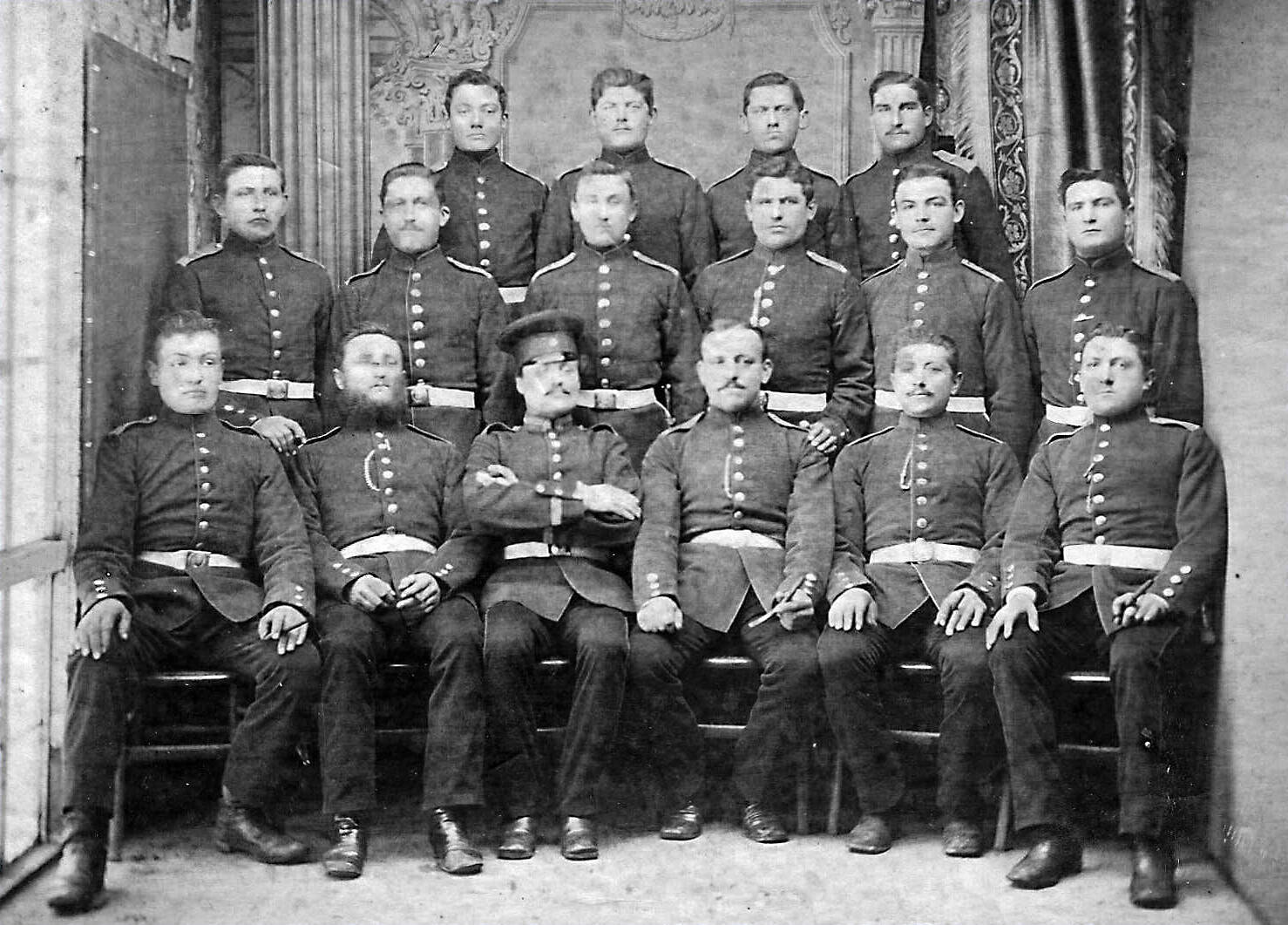
Between 1879 and 1892, Stephan Melchior (far left, middle row) performed his mandatory Prussian military service. He was a member of the Eighth Rhineland Infantry Regiment No. 70 in Trier, Germany. (Photo courtesy of the Melchior Family Collection)
