
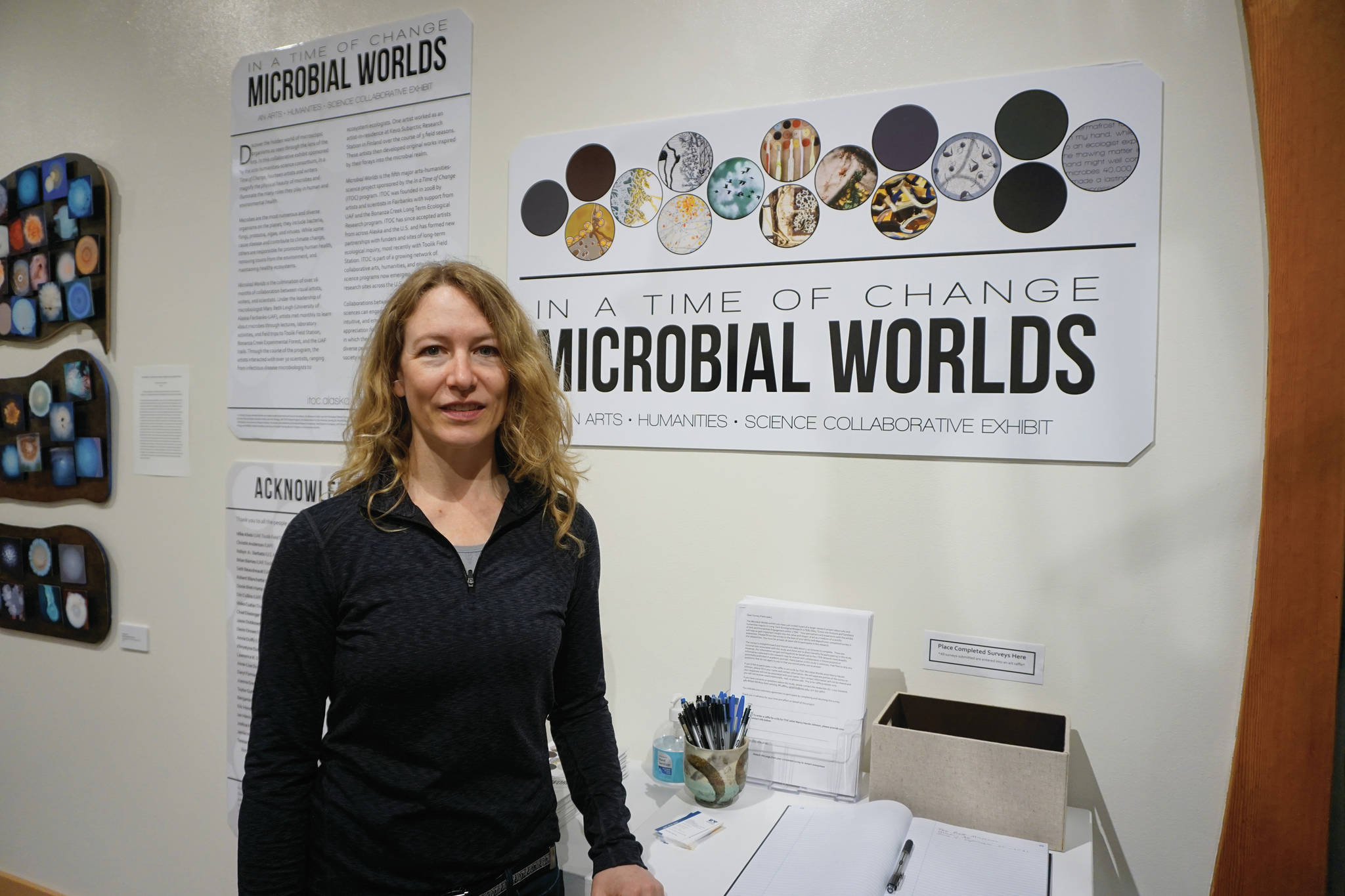
Though founded as a natural history museum, the Pratt Museum & Park’s mission also includes displaying and honoring visual and literary arts. While sometimes the gallery walls mark a line between art, history and science, periodically those walls come down.
That’s the focus this summer of a visiting exhibit, “In Time of Change: Microbial Worlds,” an art, science and humanities collaboration that invited artists of the north to learn about the world of microscopic organisms and then be inspired to create. Delayed from its planned 2020 opening because of the COVID-19 pandemic, “Microbial Worlds” opened last Friday and shows through Sept. 25. The Pratt recently expanded its summer hours to 11 a.m. to 4 p.m. Wednesday through Sunday.
For “Microbial Worlds,” in 2015 exhibit coordinator Mary Beth Leigh, a professor of microbiology and arts-humanities-science integration at the University of Alaska Fairbanks, recruited artists to join the project. Leigh herself combines a passion for dance with science. “Microbial Worlds” is the fifth “In Time of Change” collaboration, which started in 2008 with the founding exhibit of the same name.
Over 16 months, Leigh offered monthly meetings — “like a microbial course,” she said — and even provided the artists with their own microscopes to better view the world of bacteria, protozoa, algae, fungi and viruses. The artists also attended lectures, participated in laboratory workshops and visited scientists in the field.
“Then they all started on their own paths in whatever they were interested in,” Leigh said during a preview last Friday at the Pratt of the show.
A friend of Leigh’s from college, costume designer Stephanie Rae Dixon, visited the Kevo Subarctic Research Station in northern Finland as an artist-in-residence for a project studying the microbial decomposition of fabric and birch leaves. For that project, Dixon made dresses of burlap with lichen and other material woven in and then buried them. Later, they unburied the dresses, and Leigh wore them for a dance video performed in a boreal birch forest at Kevo. “The Microbial World” includes those dresses pressed between clear resin, and a running showing of the video.
As part of that project, scientists analyzed the DNA found in the decomposing material and found 73% came from bacteria and 19% couldn’t be identified. On a pie chart showing the DNA , next to the unknown material there’s an image of an evil Santa Claus.
“The hidden joke is that it’s from the Finnish Santa Claus,” Leigh said.
One artist, Margo Klass, made assemblages of found beach plastics and of dentures and dental devices to show how bacteria can degrade plastic in the ocean and how biofilms form on teeth. Leigh said Klass got her beach plastics inspiration from a visit to the Fairbanks wastewater treatment plant. There the workers had a display of plastic toys flushed down toilets.
“They had them all in this funny arrangement,” Leigh said. “Margo was, ‘I can do something with that.’”
Fiber artist Ree Nancarrow made a quilt after learning how methane gets trapped in vegetation under ponds and is released as gas bubbles — the same kind of bubbles seen in Beluga Lake when the ice freezes and traps them. Nancarrow’s quilt shows the abstract shapes of those bubbles and images of scientists studying them.
Nancy Hausle-Johnson’s metal tiles, “Emergence: The Warming Climate is Waking Up Sleeping Microbes,” shows microbial life that emerges when permafrost melts. According to a statement with her piece by Robyn A. Barbato, a research scientist with the U.S. Army Corps of Engineers Cole Regions Research and Engineering Laboratory, New Hampshire, Interior permafrost represents a time period of from 15,000 to 45,000 years ago. Those thawing ancient microbes could result in “an increased emission of carbon dioxide and methane, a depletion of soil carbon, and the release of potentially harmful microorganisms,” Barbato writes.
Some art becomes playful, like Jessie Hedden’s “Worship the All Mighty Microbes!” She notes that in our bodies, microbes outnumber our human cells 10 to 1. Hedden looked through her microscope and came up with images for wallpaper she designed and had made. Arranged in diamond shaped boxes, at first glance the pictures look like kitchen objects seen in wallpaper from the 1960s. Closer up, they’re amoebas and other weird creatures.
In another collaboration, between Klass and UAF associate professor of philosophy Eduardo Wilner, “New World,” the two consider the relationship between human bodies and our bacteria passengers.
Wilner writes that “The multitude that is you is spelled out in a recipe made by 10 million microbial genes and 23 thousand human ones. Six pounds of bacteria collaborate with 3 pounds of brain in the production of behavior-changing neurotransmitters. … You are a loosely tied, loosely defined, previously unimaginable assemblage. I is really we.”
Along with science writers, “The Microbial World” includes poetry and nonfiction by Susan Campbell and Debbie Clarke Moderow. Painting is represented by Hedden, Jennifer Moss, Gail Priday and the late Annie Duffy, who died last year. Eric Henderson and Maria Henderson collaborated on encaustic paintings on glass of microbes in permafrost melting. Sara Tabbert shows her carved wood and prints. Fiber artist Nancarrow is joined by another quilt artist, Charlotte Bird.
Leigh quoted the writer Robin Wall Kimmerer’s idea of how science and art can merge: “The data may change our minds, but we need poetry to change our hearts.”
“Among scientists there’s still this notion if people just knew the facts, they would change somehow,” Leigh said. “It turns out that’s not true. … What we hope is people also feel something. They will learn something, but they feel something.”
The exhibit’s cancellation at the Pratt last summer by the pandemic adds a bit of irony to “Microbial Worlds” showing in 2021.
“When we started this, people did not think about microbes, and then his became front-page headlines every day,” Leigh said.
Reach Michael Armstrong at marmstrong@homernews.com.
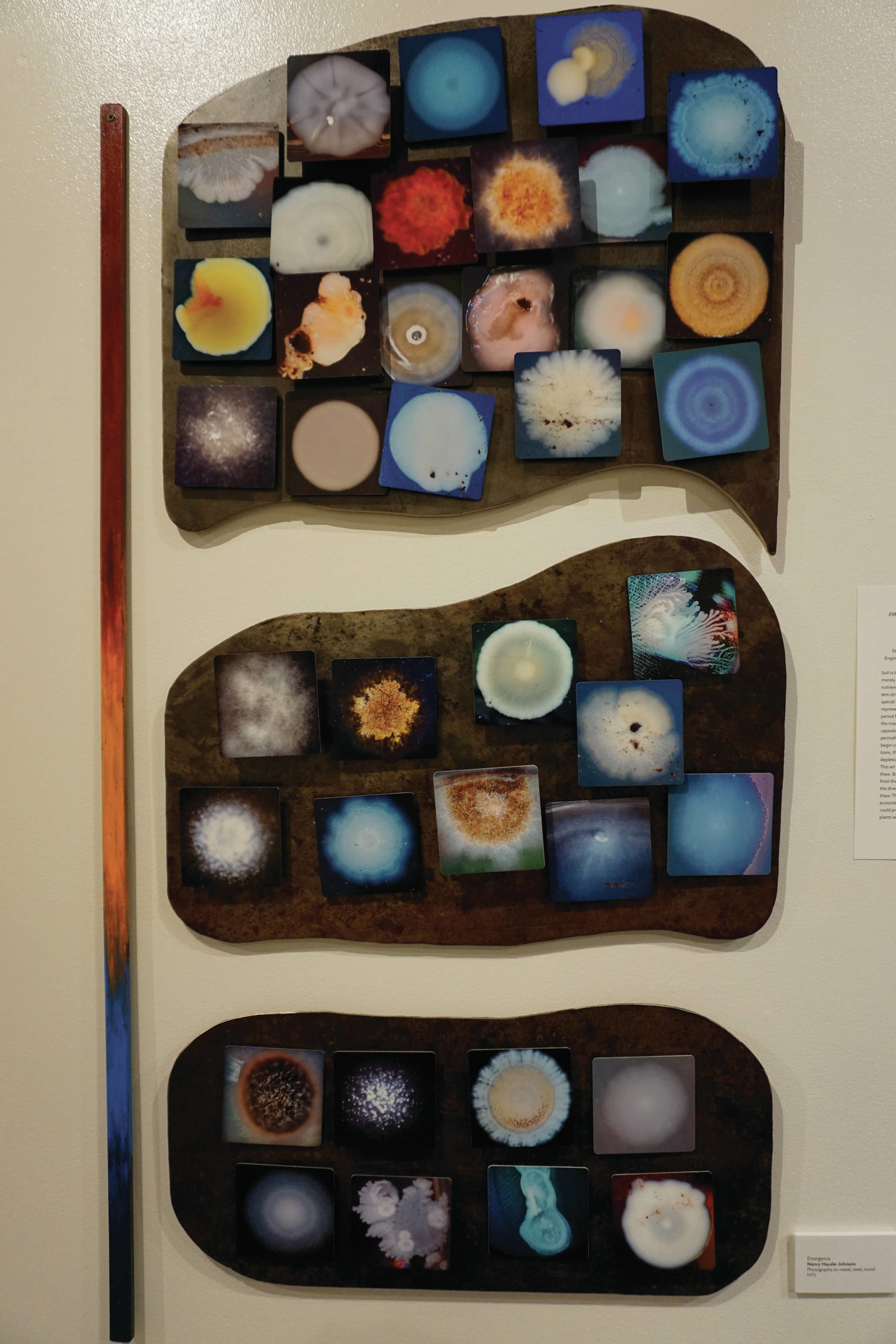
“Emergence,” by Nancy Hausle-Johnson is part of Microbial Worlds, an exhibit showing at the Pratt Museum & Park through the summer of 2021. (Photo by Michael Armstrong/Homer News)
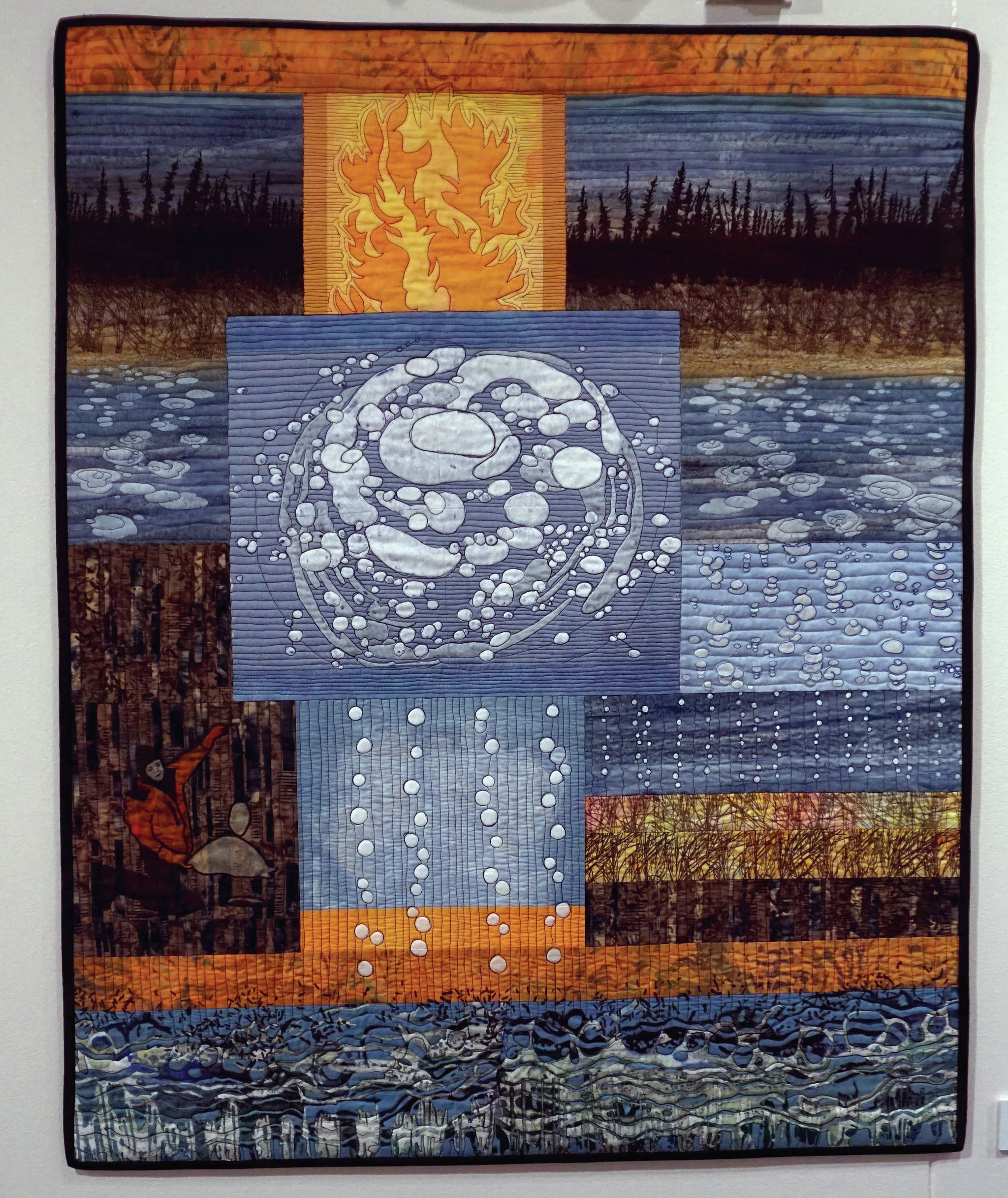
“Deceptive Beauty,” by Ree Nancarrow, is part of Microbial Worlds, an exhibit showing at the Pratt Museum & Park through the summer of 2021. (Photo by Michael Armstrong/Homer News)
