
AUTHOR’S NOTE: The first two parts of this three-part story about John Fenger, Homer’s first resident physician, provided some early personal background about Dr. Fenger and described many of his early medical experiences in Alaska. Part Two ended with the doctor and his family leaving Homer in 1965.
In early spring 1965, there were loose ends to tie up before Dr. John Fenger, his wife Grace, and their three children—Eric, Heidi and Peter—packed up a few of their belongings and headed for the doctor’s new medical gig on the Kwajalein Atoll in the South Pacific.
There was a goodbye ceremony for Grace Fenger, a registered nurse, to praise her for her work during the Fengers’ nine years in Homer.
There was John Fenger’s resignation from the first-ever Homer City Council, which had formed in 1964 after local residents voted to incorporate Homer as a first-class city. The council and a city mayor replaced the previous governing body, the Homer Public Utility District, and guaranteed Homer representation on the newly established Kenai Peninsula Borough Assembly.
John Pate was named to fill the final year of Dr. Fenger’s two-year term on the council.
And then there was John Fenger’s going-away party at the Waterfront Bar. A notice about the event in the Homer News mentioned that the party had featured live music, allowing Fenger to show his chops once again as a jazz musician.
Fenger had been a percussionist in his high school band back in New York. During this time, he began developing a passion for jazz and enjoyed playing drums with two of his boyhood musical friends. In Homer, he played often with jazz-loving doctor friends, and he continued his drum work after he left Alaska.
During many of the years he later lived in Arizona, he performed as a member of the Palm Canyon Jazz Lite Trio. He also amassed a large collection of jazz records and took his family to jazz parties, which often included side-men for Count Basie and Duke Ellington.
Margaret Pate of Homer recalled Dr. Fenger’s percussive prowess: “When he was not practicing medicine, he was playing down at the Waterfront Bar evenings,” she said in Beth Cumming’s Homer history collection “And Some Stayed On.”
Shoes to Fill
In the year or so prior to his departure, Dr. Fenger had become aware that some things needed to change. As the only physician in town, he was either working or on-call 24 hours a day, seven days a week, and he was burning out. He began advertising in medical journals to lure north another doctor with whom he could partner and share the load; barring that, he sought to find another doctor to take over his practice.
Eric Fenger recalled that his father paid the airfare for at least two other doctors to fly to Homer and assess the situation. One of them, he said, didn’t think long before declining. He got a standard tour and was winging his way home on the next flight out of town.
“Nobody took the bait,” Eric said. Dr. Fenger received no offers of partnership, and no offers to replace him.
The citizens of Homer, after nearly a decade with a single, steady resident doctor, found themselves suddenly with none. The result was a piecemeal medical situation.
About the time the Fengers left the Kenai, the Homer News reported that, although the community’s nurses would still be allowed to assist with some medical needs, they could not, by themselves, write prescriptions or perform surgeries.
Dr. Osric Armstrong of Seldovia and Drs. Paul Isaak and Elmer Gaede of Soldotna traveled to town when they could to provide temporary medical service.
Homer residents with pressing medical needs had to travel—across the water to Seldovia, up the road to Soldotna, Kenai or Seward, or even all the way to Anchorage or out of state.
Finally—nearly eight full months after the Fenger family had left town—a front-page banner headline in the Homer News on Nov. 25, 1965, proclaimed: “HOMER HAS DOCTOR.” Dr. George “Gussy” Leih had arrived, with his family, to live and work in Homer.
The community breathed a collective sigh of relief. However, Dr. Leih was not the long-term fix that Homer residents had been hoping for.
Dr. Paul Eneboe, who succeeded Leih, called his predecessor “a bit of a medical tramp,” known for his many brief doctoring sojourns—about a year in Gila County, Ariz., nearly four years in Fairbanks, a single week in Valdez, and so forth.
By the time Dr. Eneboe arrived in Homer in August 1968, Leih was already gone. Eneboe, in contrast to Leih’s short tenure, went on to practice medicine in Homer for more than 50 years.
Eventually, Dr. Fenger sold his clinic to Dr. William Jay “Bill” Marley, a dentist who added a second story to the structure and also provided dental service in Homer for many decades. His son, Dr. Jay Marley, practices there now.
In 1969, the people of the southern Kenai Peninsula, on a vote of 252-146, created a hospital service area, and in May 1977 the new South Peninsula Hospital opened its doors. Medical service in Homer has been expanding ever since.
On the Move
Despite not wanting to leave Homer, the Fenger children loved Kwajalein. Eric Fenger called it “a paradise for kids.” They soaked up the abundant sunshine. They swam and snorkeled. They traveled to nearby islands. They accompanied their father on deep-sea fishing trips. After years of beach life in Homer, the beaches of Kwajalein suited them just fine.
Interestingly, another Kenai Peninsula physician, Dr. Joseph Deisher also ended up in Kwajalein. After 13 years of serving Seward’s medical needs, Deisher and his family had left for the South Seas about a month and a half before the Fengers. The two doctors enjoyed each other’s company, and both looked back fondly on their time there together.
Dr. Fenger’s Kwajalein contract expired the following year, and the family departed the South Pacific. Their next stop was, once again, Homer.
For the next two or three months, the Fengers were in familiar territory. While Grace and the children reacquainted themselves with friends and began planning for what came next, Dr. Fenger made arrangements to rent a house in Bothell, Wash., and applied to the University of Washington medical school to train in physical rehabilitation. By necessity, he traveled back and forth to Washington and was absent from Homer frequently until it was time to move to Pacific Northwest.
During this final sojourn on the southern peninsula, the Fengers did not displace Reuben Call, who had been house-sitting for them. Instead, they set up temporary quarters in the back of the doctor’s office in town. Call continued to live in the Fenger house until it was later sold.
In July, they once again departed Alaska. They spent nearly two years in Washington, with Dr. Fenger commuting from Bothell to his studies at the medical school in Seattle. By 1968, he had been boarded in Physical Medicine and Rehabilitation and was ready to move again.
His family, meanwhile, was reluctant to leave. Although Dr. Fenger could have worked in Seattle, he disliked the long commute, often in darkness in both directions, and he also had become weary of the rain. He was ready for a drier climate, more sunshine and more heat.
His children, though, enjoyed the 20 acres of forest and hayfield surrounding their rented house in Bothell. Grace Fenger, who was born in Lynden, Wash., just south of the Canada border, liked being only 90 miles from her family.
But John Fenger was resolute, and in 1968 the family found itself in Phoenix, where the doctor joined the staff at Good Samaritan Hospital’s rehabilitation center and began directing its residency program. Dr. Fenger thrived in Arizona, and he remained there the rest of his life.
His children, despite their reluctance to leave Washington, also thrived in the Southwest. Eric Fenger recalled concerts, an abundance of arts, camping trips, and treks to explore old ghost towns with their father.
In 1974, John and Grace Fenger divorced. Dr. Fenger remarried later that year and also resumed his private practice in Phoenix. He continued to practice medicine until 2005, and he died the following year, a few days shy of his 83rd birthday. Grace died about a year and a half later.
From the Fenger five, only Eric returned to Homer to live. He moved back in 1990 and has been a resident of the southern peninsula ever since.
He recalled his father as a complex man who was meticulous, hard-working and generous, even though he occasionally had to be stern, even with his patients. Once a local woman named JoAnn Hanson told Eric about a visit to Dr. Fenger’s clinic when she got to witness his pricklier side.
“She was in the waiting room,” said Eric, “and my dad was with (another) patient who was not helping himself get well.” The doctor was growing frustrated at his failed attempts to get the patient to change his behavior. “He came out of the examination room and he was yelling at this guy. And when the patient left the clinic, my dad turned (to Hanson) and said, ‘And what can I do for YOU?’”
Despite this assertive display, Eric said, “people did love him. He was friendly. He was very social … and he tried to help other people out.” And in his later years, he looked back with fondness on his years in Alaska.
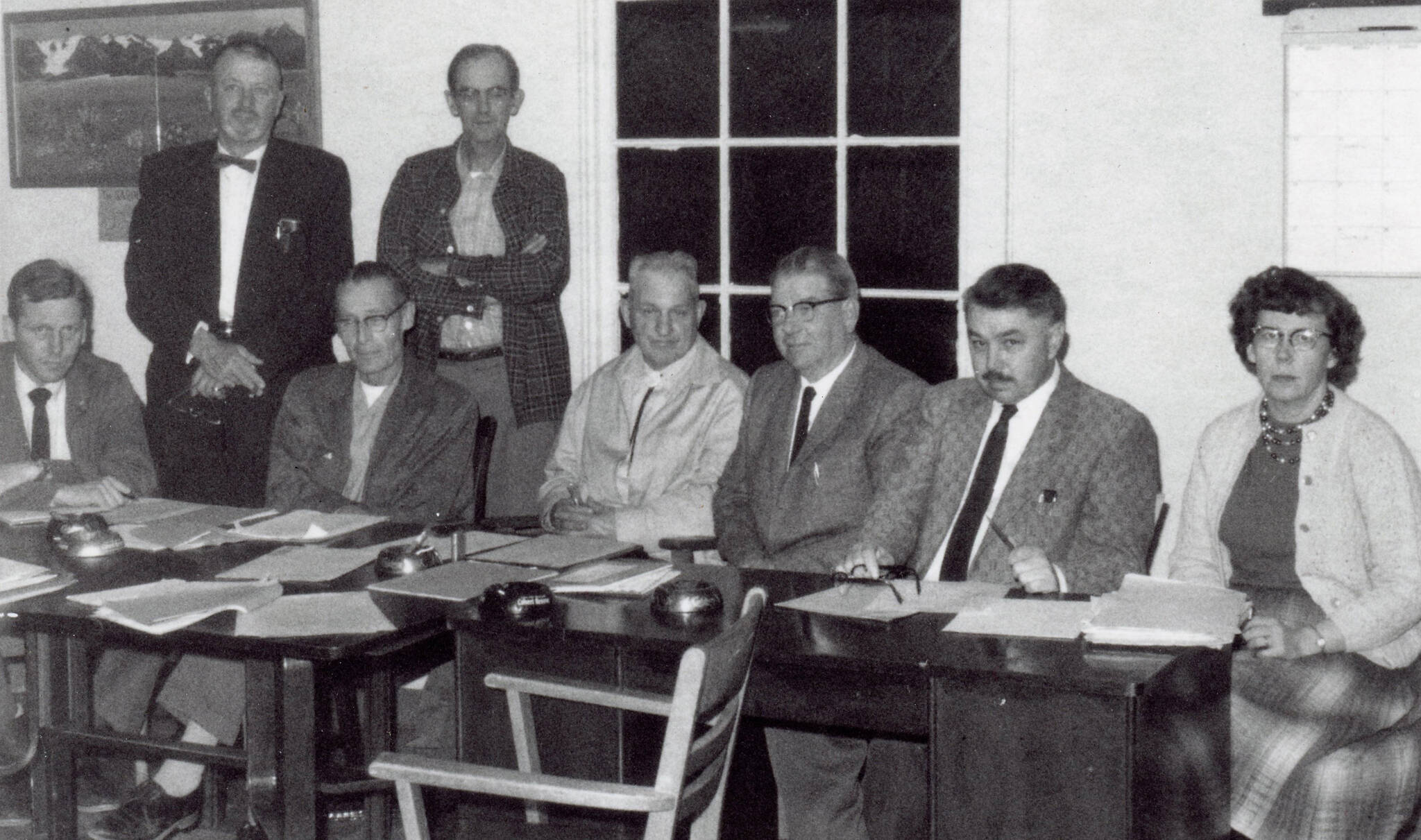
Photos courtesy of the Fenger Family Collection John Fenger (far left) served on Homer’s first city council, formed after Homer incorporated in 1964.
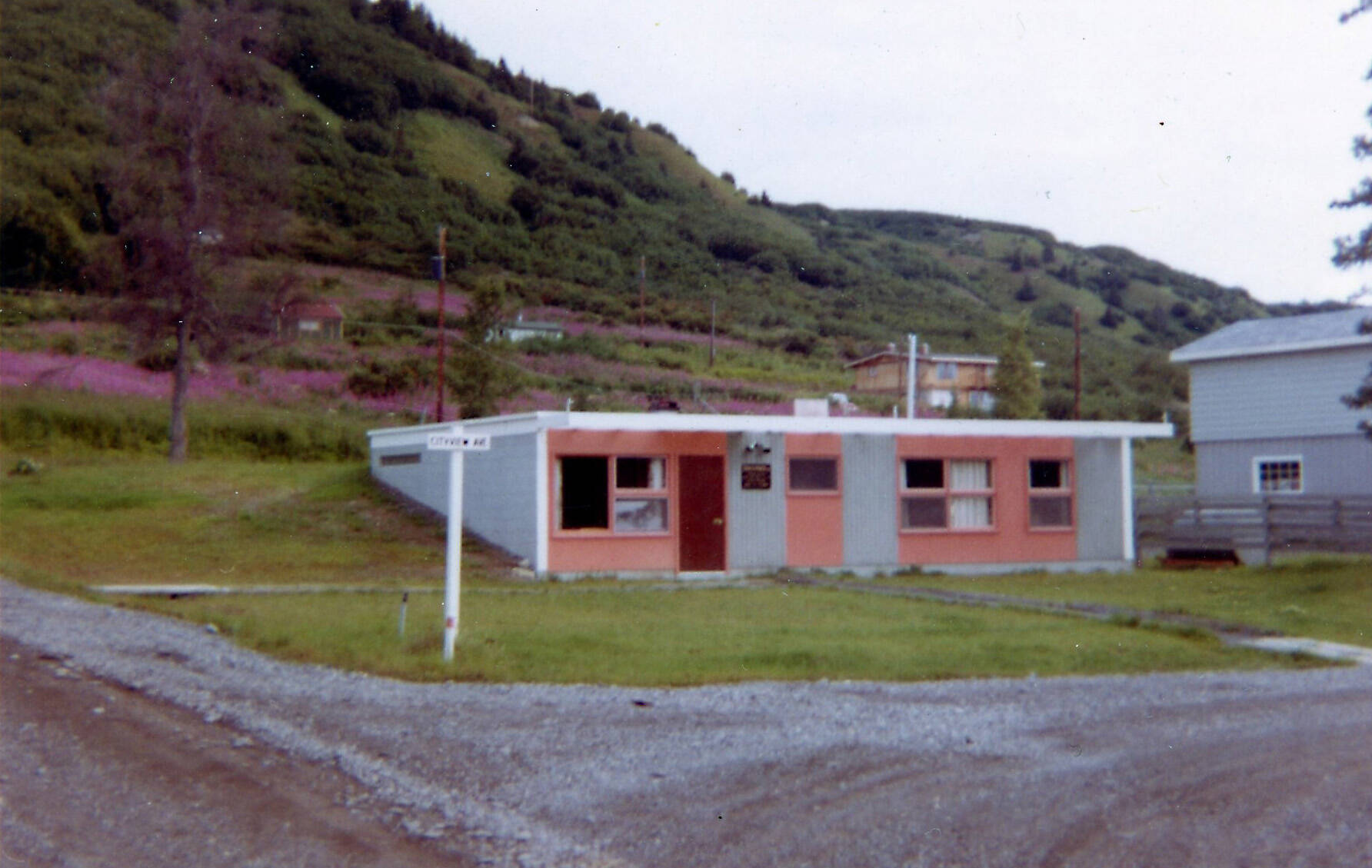
Photos courtesy of the Fenger Family Collection In 1962, Dr. John Fenger had this clinic built at the corner of Hohe and Cityview in Homer. Now a two-story building, the top floor is occupied by Dr. Jay Marley, a dentist whose father, Dr. Bill Marley (also a dentist) purchased the original structure in the late 1960s.
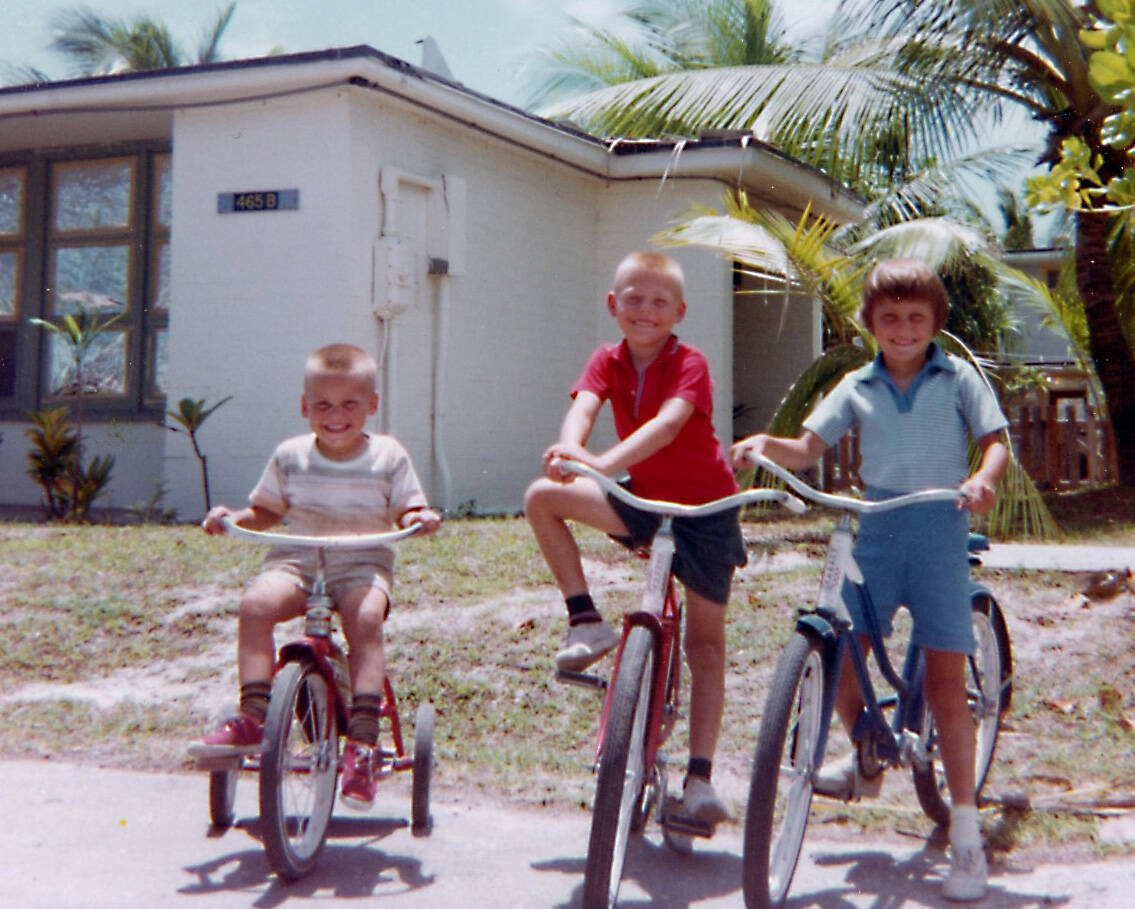
Eric Fenger (posed between brother Peter and sister Heidi) called Kwajalein Atoll “a paradise for kids.” The Fengers lived in this South Pacific locale for about a year, starting in mid-1965.
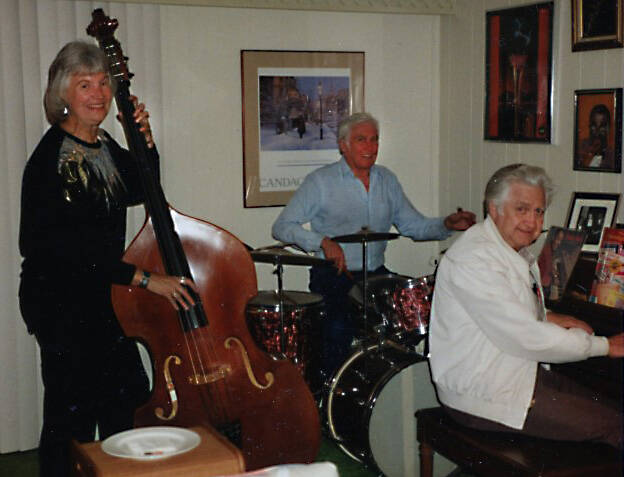
Dr. John Fenger (seated in back at the drums) was a passionate purveyor of jazz music. Here, circa 1990, he practices with the two other members of the Palm Canyon Jazz Lite Trio in Arizona.
