
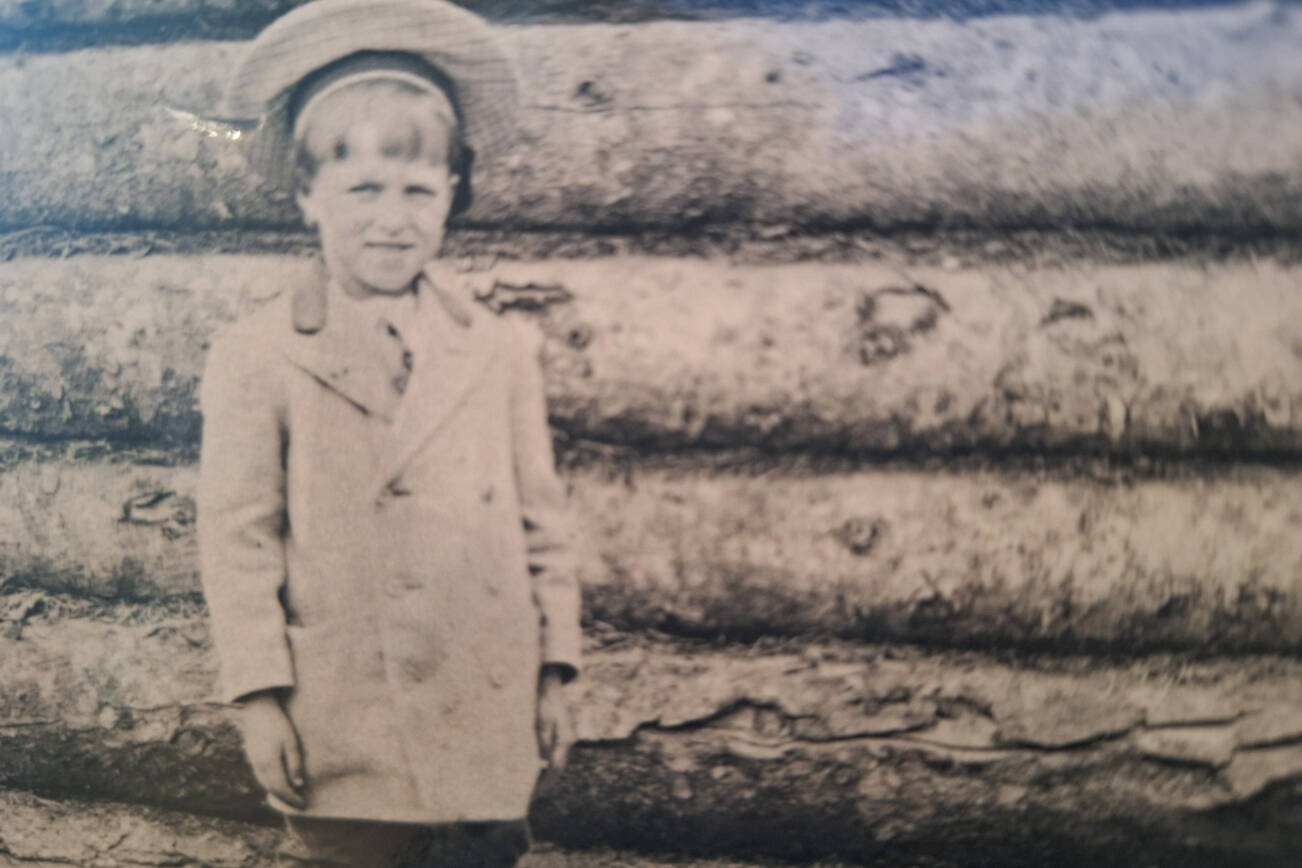
AUTHOR’S NOTE: In 1913, King David Thurman, a Cooper Landing-area resident who often seemed one step ahead of authorities, was finally convicted of violating game laws and served time in the Seward Jail. After his release, he busied himself in preparation for another season of trapping, hunting and mining.
After his 1913 conviction for violating the territorial game laws, King David Thurman served 50 days in the Seward Jail and was released on Aug. 27. While he was behind bars, he received daily visits from a young friend, 12-year-old Emmett Krefting, whom he had befriended in the summer of 1907 at Simon Wible’s gold-mining camp on Canyon Creek. Emmett’s mother, who had been the camp cook, supplied Thurman with hot meals each day during his incarceration.
In Krefting’s memoir about his youth in Alaska, he described their friendship and the many things Thurman had taught him about mining and trapping, hunting and foraging, and safety in the wilderness. In Chapter 14, Krefting revealed some advice from Thurman in 1908 that stuck with him for the rest of his life.
Whenever Thurman traveled along a noisy creek, he attempted to make his presence known to any bears that might be prowling around. “Bear! Bear! Weeza comin’ through!” he would yell, according to Krefting. “Don’t wanna startle a brownie,” he informed the boy, who was then just seven years old. “Iffin they hear us, they’ll be movin’ on outta the way, silent like.” A startled bear, on the other hand, could be very dangerous, he warned.
Busy Man on the Move
Although he generally eschewed paperwork — preferring to keep his mining and trapping activities on the down-low — King Thurman, in the afternoon of Nov. 9, 1912, walked into the Seward Recording Office to file a claim on a quartz vein he had discovered near Rat Creek, which flows into the Chickaloon River from Trout Lake, just off the Resurrection Pass Trail. The mining claim was witnessed by Kenai Lake resident Louis Bell and Thurman’s frequent trapping partner and occasional accomplice, John Erik Kulin.
He called this claim “West Extension No. 1” because it lay west of a previous location he referred to as “Seward Claim, the Discovery.”
Thurman was back in the recording office in mid-May 1913 to file on another nearby location, which he called the “Gold Bullion.” He described the site being situated, like West Extension No. 1, on the north side of Rat Creek, approximately two miles from the Trout Lake outlet and “about ½ mile from Rat Creek cabins,” which probably belonged to him.
Five days later, he filed on yet another location in the same area, this one called “East Extension of No. 1.” Again, John Kulin was one of his witnesses.
Finally, on July 15, Thurman — while still behind bars in the Seward Jail — managed to file a “Proof of Labor” with the Seward Recording Office, stating that he had made recent improvements to his “Seward Claim” out by Rat Creek.
Then, as the 1913-14 winter trapping season around Trout Lake and Cooper Landing was winding down, Thurman began ramping up for the mining season. A portion of his diary still exists from this time period and provides information about his activities leading up to his disappearance in July 1914.
Mostly, Thurman traveled back and forth between his Bean Creek home and the shelters at his mining claims near Rat Creek and Trout Lake. Occasionally, he broke this pattern — to buy supplies in Seward, to do some prospecting on Canyon Creek and other streams near Hope and Sunrise, or to visit friends and acquaintances along Kenai Lake and the upper Kenai River.
He planted a garden at one of his cabins. He shot and butchered a black bear near Trout Lake. He crafted a forge and an anvil. He made a pack board. He prospected, went fishing, cut firewood, sharpened picks and gathered water.
At home, he built a boat that he planned to haul up to Trout Lake; he sealed the boat with pitch and manufactured a sail for it. He bought 50 pounds of potatoes from a local gardener. He visited a friend named Jim—probably James Kalles, who would be made guardian of Thurman’s estate months after his disappearance. And he communed with his dog, which appears to have been called “Brownie,” the only hound he had after authorities had confiscated and sold the three work dogs he’d been using to illegally hunt moose in 1912-13.
His final departure — accompanied by his dog, for what was apparently a secret new mine — has left historians with several questions: When he left Bean Creek on July 23, 1914, is it true that he informed friends when he planned to return? Did he really have a conversation with big-game guide Ben Swesey and tell him about a bear he’d seen near his remote cabin. If so, did he really decide not to shoot that bear, hoping afterwards that he hadn’t erred in sparing its life? And when exactly did the ultimate disaster strike?
The final entry in Thurman’s diary, dated July 25, 1914, read: “Came to Flat Cabin,” a reference to a structure in the Chickaloon River watershed, of which Rat Creek is a part.
In neat script at the top of a separate page — the bottom of which contained information that would help authorities determine the final chapter of Thurman’s story — Thurman wrote: “July 26, 1914. To whom it may concern, this camp outfit belongs to the undersigned. Please do not take it and disappoint the owner….”
On Aug. 20, nearly one full month later, Thurman’s dog, alone and “half-starved,” according to a report in the Seward Gateway, returned home to Bean Creek. “Men who know the dog,” said the newspaper, “say that it would not desert its master as long as he was alive.”
The paper, relying on local information, added that in his Bean Creek home, Thurman had left a note explaining the general vicinity of his remote cabin and stating that he expected to be back in Cooper Landing in about two weeks. Visitors to the cabin saw the note and, even before the dog’s arrival there, had become concerned. A search party had been formed but had found no clues concerning Thurman’s disappearance.
After the dog came home, the searchers, alarmed, took the animal with them, hoping it would lead them to its master. Again, they had no luck.
The months marched by. Then winter arrived….
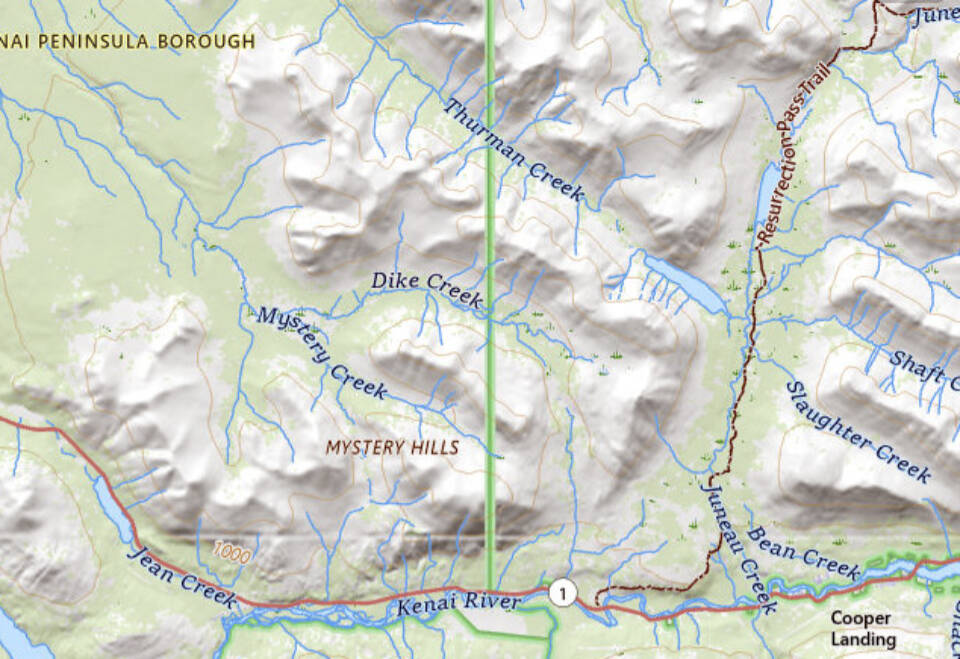
King David Thurman’s primary stomping grounds. Thurman had a home cabin on or near Bean Creek, by Cooper Landing. He frequently traveled back and forth to Trout Lake (unnamed on this map), the headwaters of Thurman Creek, which is a tributary of the Chickaloon River. In Thurman’s day, the now eponymous stream was known as Rat Creek.
