
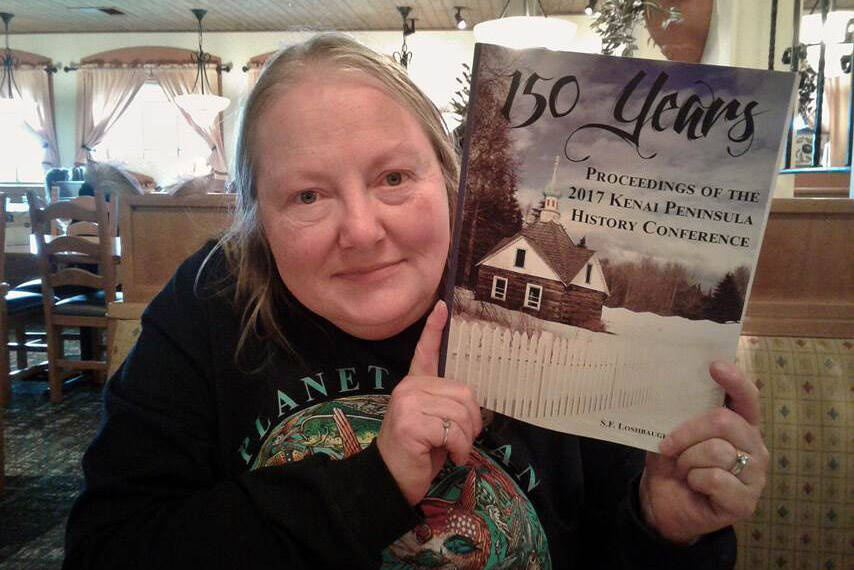
Next month, the Alaska Historical Society’s annual conference will be held on the central Kenai Peninsula for the first time, drawing members of the historical community from around the state for a weekend of panels, chats and stories.
The conference will run from Oct. 5 to 8, and registration is open to the public. Panels stretch over the four days, with Saturday, Oct. 7 dedicated as Kenai Peninsula Day and featuring topics relevant to the local area and its history. Each panel will also be available via a digital option.
Rachel Mason, a senior cultural anthropologist with the National Park Service, said Wednesday that the annual conference hosts professional historians, members of historical societies and the curious public. She said the event has been held in Homer and Seward before, but the central Kenai Peninsula has never had this spotlight.
This year’s conference is titled “Connections and Disconnections in Alaska History.” Mason said that a focus will be on examining the state’s history through different perspectives. The keynote speaker, Diane Hirschberg, will open the conference with a lecture about the impact of colonization on Alaska’s schools and students — interrogating the “boarding schools” that have seen national attention lately.
Mason said it’s important to face this history and understand how things that happened left different impacts on different stakeholders.
“We’re in this together,” she said. “We need to look at our history in a realistic and generous way.”
Most of the Alaska Historical Society’s conferences are hosted by one smaller historical society in the area where it’s being held. The Kenai Peninsula is unique in that it has several active groups as part of an umbrella Kenai Peninsula Historical Association. Shana Loshbaugh on Thursday described herself as a liaison between the varied historical societies of the Kenai Peninsula. Each will be a part of the conference.
The central peninsula, Loshbaugh said, is a “microcosm of Alaska,” a space with its own rich history and a significant role in the wider history of the state. She said it’s filled with interesting stories that even local folks don’t know.
Loshbaugh said the conference is a chance for the statewide historical community to come together and learn from one another. Even just among the peninsula groups, she said there are different missions and directions. The conference is a chance to catch up on what everyone’s involved and interested in.
The event isn’t just for members of the local historical societies or even the Alaska Historical Society, Mason said. It’s open to curious members of the public, with as many as three panels running at any one time during the weekend.
Kenai Peninsula Day features, according to a draft schedule available on the event website, conversations about transportation, energy, salmon, Indigenous cultures, ecology and the history of place names with roots in Russian and Dena’ina.
Loshbaugh said hearing about the experiences of real people, especially from other cultures, can help to build a more complex — “three-dimensional” — understanding of ideas and history.
She said that panels are hosted by skilled presenters and capable storytellers, and many will be accessible to folks who are coming in without much background knowledge of the topics. She said that some of the fun is in attending a session and being entirely surprised by what she can learn inside.
She said one such panel, which she doesn’t know much about yet but is excited to attend, is a conversation around a Haida woman named Agnes McAlpin who won her human rights in divorce court.
Mason said the panels that center on the experiences or story of a certain person — “colorful characters” — will be the most accessible. She said these will offer a look at real life through different eyes. She pointed to a talk about Benny Benson, an Alaska Native man who designed Alaska’s state flag at age 14, or a talk about a Filipino cannery worker.
Each panel will be held at Kenai Peninsula College, but this year there is also a digital option available, Loshbaugh said. Attendees can conference in and still ask questions and participate in discussion.
For folks with an interest in history, “this is the big party,” Loshbaugh said. People looking to get involved with local historical groups will be able to make those connections, as well as meet knowledgeable folks from around the state.
“On one level, it’s an academic conference,” she said. “On another level, it’s a broad offering of engaging historical information.”
Registration can be done online at alaskahistoricalsociety.org. Admission can be purchased just to the panels for any given day for $15, with access to all the panels digitally via Zoom running at $50. Full conference registration is $175, discounted to $125 for members of Kenai Peninsula historical societies.
Until Friday night, a $25 “early bird” discount is available for the full conference registration and the local member’s rate. Those prices are $150 and $100 until Friday at midnight.
The digital and one-day passes, Mason said, are great options especially for local folks to get the information and participate in the conversations.
For more information about the conference, and to view a draft schedule of the panels being offered, visit alaskahistoricalsociety.org.
Reach reporter Jake Dye at jacob.dye@peninsulaclarion.com.

 E-Wallet Purchase (Add Funds)
 Term Subscription