
AUTHOR’S NOTE: This is Part One of a two-part story about a physician/surgeon who came to Seward in the 1920s with some curious blank spots on his resume.
In October 1927 — a dozen years after R. J. Alcorn had applied to the Wisconsin State Board of Medical Examiners for a license to practice medicine there — the now 58-year-old physician began providing the residents of Seward, Alaska, with the first full-service hospital care they had had in three years.
That was the good news.
The bad news was that Dr. Alcorn had been less than candid in his 1915 application, not everyone was pleased to see him get a chance to practice medicine in the Badger State, and he had an intriguing gap in his employment history.
The Wisconsin board approved his application, anyway.
Reilly Jefferson Alcorn was born in Good Water, Iron County, Missouri, on Sept. 10, 1866, the third of eight children of Harmon and Elvira Alcorn. He said he left home at age 14.
By 1886, the year he turned 20, he was a rural school teacher in Iron County. He apparently taught school in various tiny settlements for about eight years before leaving the profession, either to seek new horizons or escape from a cloud of controversy — or both.
By the fall of 1894, Alcorn was married to another rural schoolteacher, Cora Elnora Hilton, and he had begun the coursework necessary to get him through medical school. He had also left behind some folks in rural Montana who were doubtlessly happy to see him go.
On Feb. 8, 1894, a short, opinionated article appeared in the Fergus County Argus (Lewistown, Montana), questioning the ethics of R. J. Alcorn, a teacher in nearby Utica. The article seeded doubts about his teaching qualifications, his possible association with gambling, his use of his wife’s earnings, and the debts he had left behind.
According to the story, the Utica school board had “disposed of (Alcorn’s) services” shortly after he left the county, accompanied by Cora “not altogether under favorable circumstances.”
On Feb. 19, writing from Big Elk, Montana, Alcorn defended himself. In a long letter to the editor of the Argus, he justified his qualifications, rebutted the claim that the Utica board had dismissed him, provided names of individuals who could vouch for his character, and said Cora had freely given him the money in question.
And he added: “I do not owe one dollar in Fergus County which I do not expect to pay.”
The Argus editor was unconvinced. In a brief statement tagged to the bottom of Alcorn’s letter, the editor wrote: “Since receiving the above communication we have further investigated the matter and find that we have no reason to retract any statement made in our issue of Feb. 8th.”
Shortly after this, Alcorn left teaching behind and devoted himself to medicine, as did Cora. Eventually, they both would become licensed physicians, and it was as a team that they would come to Seward in 1927, reopening Seward General Hospital that November. Two nurses joined his staff there in February of the following year.
But back in the States in the 1890s, Alcorn’s troubles were far from over. In fact, after a brief uptick, they worsened considerably.
In 1897, while living in Pearl, Idaho, R. J. and Cora welcomed the birth of their first child, a son they named Argie Frenoy Alcorn. In 1898, R. J. graduated from Central Medical College in St. Joseph, Missouri, although later that year he failed to earn a passing score on his medical-licensing exam for the State of Montana.
Perhaps as a result, he moved back to Idaho to begin his practice.
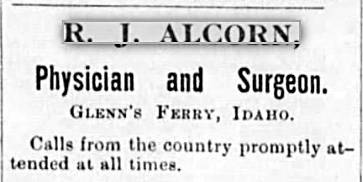
Oddly enough, however, Dr. R. J. Alcorn had already practiced medicine in Idaho — before he had even completed medical school. In fact, he was paying for newspaper advertisements for his services as a “physician and surgeon” in Glenn’s Ferry as early as 1896.
In Idaho, sometimes considered the Wild West of medicine, no licensing examination was yet required. So in about October 1898, he established an office in Challis, Idaho, and went to work. Eight months later, he was arrested near Darby, Montana, quickly extradited back to Idaho, and was shortly thereafter charged with murder.
At that time in Idaho, abortions were illegal — for both any woman who consented to have one and for any physician who performed one. So taboo was the procedure that it was often only alluded to in the press as “a criminal operation,” or the like.
In June 1899, a 20-year-old widow named Cora A. Burke already had one child, and when she found herself about six week pregnant confided to a friend that she had no wish for another baby. The friend introduced her to Dr. Alcorn.
Alcorn performed the abortion in his office, located at the back of a drugstore, on June 21.
The day after the procedure, Burke appeared to have an infection. Alcorn attended to her as discreetly as possible, lying to Burke’s mother about why her daughter was ill.
On June 23, when he could apparently tell she was dying, he climbed aboard a train and fled, first for Washington. He returned to Idaho on June 25 and then left again on June 26 for Montana, where he was apprehended.
His murder trial, later that year, ended in a hung jury. The second trial concluded in January 1900 with a conviction for manslaughter and a sentence of seven years of hard labor in the Idaho State Penitentiary in Boise.
Early appeals failed. Public sentiment was against him.
Dr. R. J. Alcorn entered prison on Jan. 19 and was photographed and registered as Convict #739.
He was 33 years old, described as 5-foot-10, weighing 175 pounds, with a dark complexion, blue eyes, brown hair, a bushy mustache and a size-eight boot. He said he was raised a Baptist but no longer attended church; he abstained from alcohol but did smoke tobacco.
Alcorn was assigned to work in the prison dispensary. With good behavior, it was thought he might become a free man again as early as 1904.
His wife and son bounced around, between Spokane, Washington, and Holt County, Missouri, and Idaho County, Idaho.
For R. J., the appeals for a pardon began.
Seward, Alaska, meanwhile, remained on an unseen horizon, part of a very uncertain future.
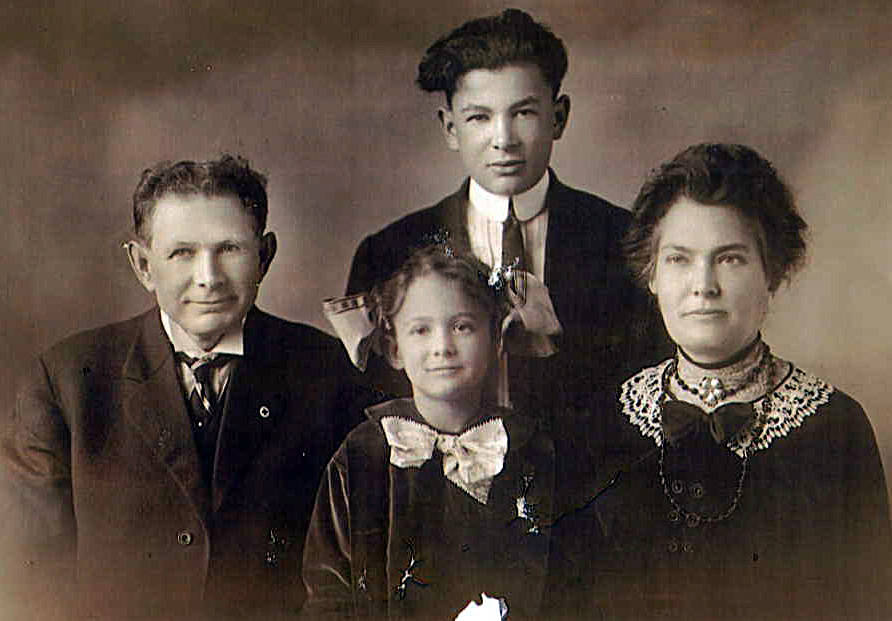
This circa 1913 Alcorn family portrait shows Dr. R. J. Alcorn, his son Argie, his daughter Wilma, and his wife, Dr. Cora E. Alcorn. (Photo from Ancestry.com)
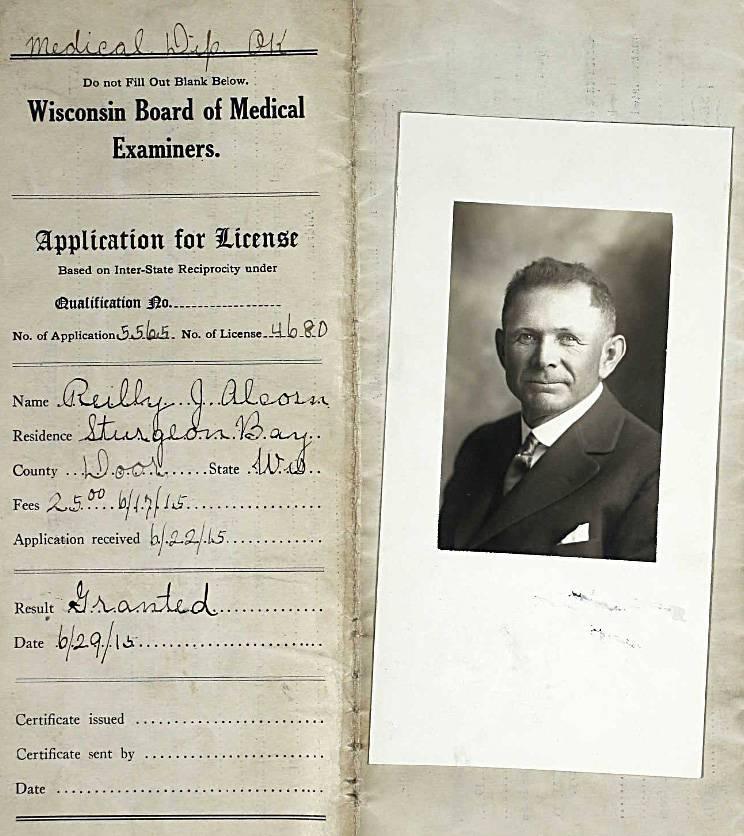
This photo of Dr. Reilly Jefferson Alcorn accompanied his 1915 application to be licensed to practice medicine in the State of Wisconsin. (Document from Ancestry.com)
