
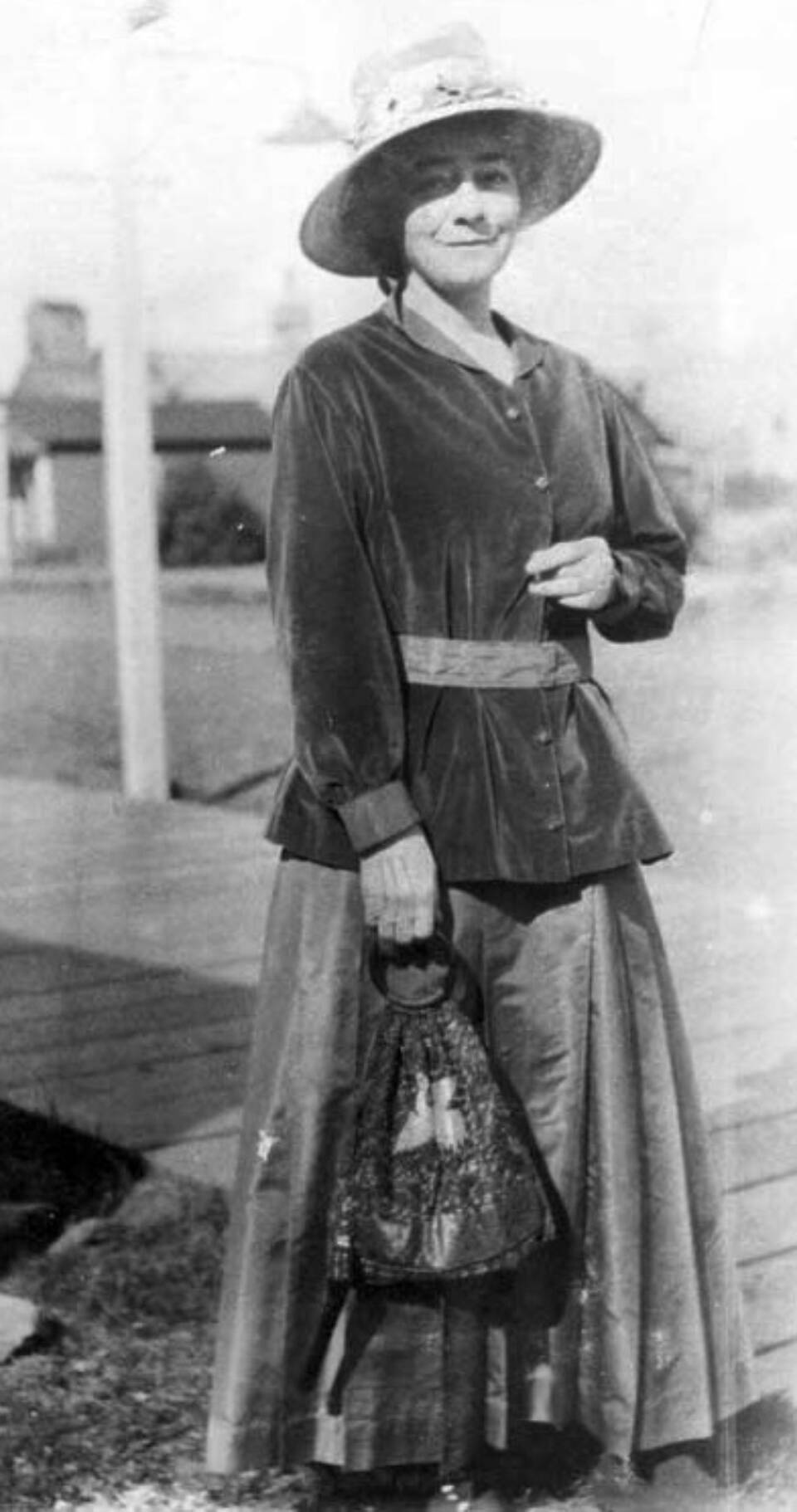
AUTHOR’S NOTE: Michigan’s hard-luck Swesey clan sprang into existence because of the misfortunes of the Basom clan. All those trials and tribulations, however, led Benjamin Swesey to a life of adventure on the Kenai Peninsula.
It had been a rough beginning for Benjamin F. Swesey and his siblings, Merrit and Millie. Their mother, Eliza, had died in the Dakota Territory in 1874, when Ben was seven years old, Merrit was nine and Millie was five.
Their father, Enoch, had kept Ben with him, had sent Merrit to live with the Washburn family in nearby Vermillion, and Millie to live with Enoch’s parents in Emporium, Pennsylvania. The clues are few beyond this, but by early 1892, Enoch was a resident of Boston Harbor, Washington, where he died of pneumonia in April. Ben was either 23 or 25, depending on the source.
Enoch’s obituary specified that he had three children—one in Dakota, one in Pennsylvania, and one in Washington.
Ben Swesey rang in 1895 at a New Year’s Eve party in Seattle. A year later, he was northbound to Alaska.
Building a reputation
In May 1896, according to Kenai Peninsula mining historian Mary J. Barry, Ben Swesey and mining partner Pete Ogle arrived on Turnagain Arm, climbed into Turnagain Pass and began prospecting on Bertha Creek.
A year and a half later, in the midst of a growing national gold-rush fervor, Swesey wrote from Alaska to a half-sister in Michigan and told her, according to the Muskegon (Michigan) Chronicle, that “the stories of many successful finds of gold in the Klondike are false. Of the hundreds who have reached there … few have struck it rich.”
The gold-rush misfortunes of others aside, Swesey was not ready to give up on the prospects of a big strike. When the 1900 U.S. Census was enumerated in Sunrise City, on upper Cook Inlet, Swesey was listed as a resident and a miner. He was also still living and working with Pete Ogle, who, like Swesey, had located in Alaska from Washington.
On the other hand, old census records could be notorious for errors—whether caused by enumerator carelessness, poor or inaccurate or misleading information from sources, or various other reasons—and Swesey’s information presented some interesting discrepancies.
The 1900 census stated that Swesey’s home post-office address was in Emporium, Pennsylvania, home of his paternal grandparents; that he had been born in January 1869, two years later than indicated in the 1870 census; that his mother had been born in Michigan, instead of New York; and that his occupation “at home” had been lumberman.
In late spring 1901, Swesey made national news unintentionally when he wrote to a friend in Washington and described the recent Lynx Creek avalanche that had killed five of the seven miners caught in its wake. The friend spread the word, and Swesey—tabbed as “a pioneer miner of that section”—was given credit for breaking the news.
Between 1902 and 1907, various men were contracted to carry mail by dog sled from Resurrection Bay to Sunrise and Hope. Ben Swesey and Pete Ogle were among them.
In the spring and summer of 1908, Swesey was a member of the Northern Baseball team, based out of Seward. As autumn turned into winter, he was doing assessment work on copper claims in Porcupine Bay, south of town.
Then, on Feb. 25, 1910, area game warden Christopher Shea sent a package of documents and a note to the territorial governor. The note said, “Dear Sir, enclosed you will find applications for guides license from B.F. Sweasey [sic]…. B.F. Sweasey I find to be an old-time mail carrier, is well known and well liked around Seward, and is a thorough woodsman. I also recommend him.”
Although the U.S. Census taken that spring noted only one other change in Swesey’s life—a different mining partner, Jerome Hatchey—Swesey had a new title: He was a licensed Alaska hunting guide, badge #16. As a guide, Swesey also began his career association with William Weaver, badge #18.
In mid-October 1917, the two men, after the end of another guiding season, would launch a dory into Resurrection Bay, apparently for a two-week bear hunt in Aialik Bay. They would never be seen again.
Weaver’s tale
It’s remarkable that William G. “Bill” Weaver was still alive in 1917.
Seven years earlier—also in mid-October—these words appeared as part of a multi-deck headline in the Seward Gateway: “SMITH AND LOWELL MEET DEATH IN WATERS OF KENAI. William Weaver Has Battle for Life….” The story below the large print included this line: “William Weaver narrowly escaped a watery grave.”
The article, after a summary of the incident, included a lengthy quote from Weaver himself, recounting the experience, which involved Howard B. Smith, a wealthy Connecticut pharmacist and avid hunter, who sought big-game trophies and had hired Weaver as his guide, along with Alfred Lowell (from Seward’s pioneering Lowell family) as his packer.
On their return to Seward from their hunting grounds in the Kenai Mountains, they had stopped on Oct. 10, 1910, to camp at Cooper Creek (just downriver from what is now Cooper Landing). The next morning, they continued upstream for Kenai Lake, which they reached about noon. After a lunch break in Snug Harbor, they decided to head for the Shackleford cabin, near the mouth of Shackleford Creek, further up the lakeshore.
According to Weaver, a breeze was blowing down the lake, but the seas were “not particularly rough,” and he believed that their dory was capable of handling the water. “There appeared to be no danger whatever,” he stated.
Upon rounding a point, however, he saw that he had been mistaken, as they “encountered heavy seas. Our boat failed to ride but plowed through them,” he said. “She quickly filled, then capsized, and threw us into the sea.”
Of the three men, only Weaver knew how to swim.
They managed to right the boat, and Weaver urged Smith, who was heavily dressed, to grab the stern and hold on. Weaver then grabbed an oar and used it to reach out to Lowell, who was struggling to stay afloat. Lowell had just grabbed the oar when a strong wave caused Weaver to lose his hold on the boat. By the time he had regained his grip, he could no longer see Lowell.
The shore, Weaver said, lay only about 150 feet away, and the waves were slowly pushing the dory in that direction. He encouraged Smith to hang on until the boat reached the shore, and then he swam through the cold, churning water until his feet touched the bottom and he was able to wade to safety.
He looked back. Smith was gone.
Weaver hurried toward the Shackleford cabin, which he knew to be occupied. Along with some men from the cabin, he returned to the lake but could find no sign of the bodies. The next morning, that vicinity of the lake was dragged with grappling hooks. Only Smith’s body was ever recovered.
Weaver concluded his recollection this way: “Both Lowell and myself were thoroughly familiar with the waters of Lake Kenai, having traveled over the lake numerous times for years past. The seas which were encountered were exceptionally big ones for this body of water….”
William Weaver was born in about 1872 in California. Mary J. Barry, who also penned a three-volume history of Seward, said that Weaver, the son of a cattleman, was, to the best of her knowledge, one of the “Pioneers of 1903,” meaning that he was among the men and women who arrived in Resurrection Bay in or before that year and helped form the actual City of Seward.
She appears to be correct. She says Weaver came to Sunrise in 1900, although he does not appear in the census data for Sunrise at that time. He was, she asserts, employed in 1902 on a survey party for the Alaska Central Railway, which began construction in Seward the following year.
Barry called Weaver the first messenger and mail carrier employed on an Alaska Central Railway line. He was still a mail carrier in 1907, when he switched occupations to mining and guiding. He received his licensed-guide badge from Christopher Shea in August 1910, the same month in which he and Ben Swesey welcomed their first licensed, nonresident clients into Seward. Swesey acted as guide, with Weaver as his packer.
TO BE CONTINUED….
