
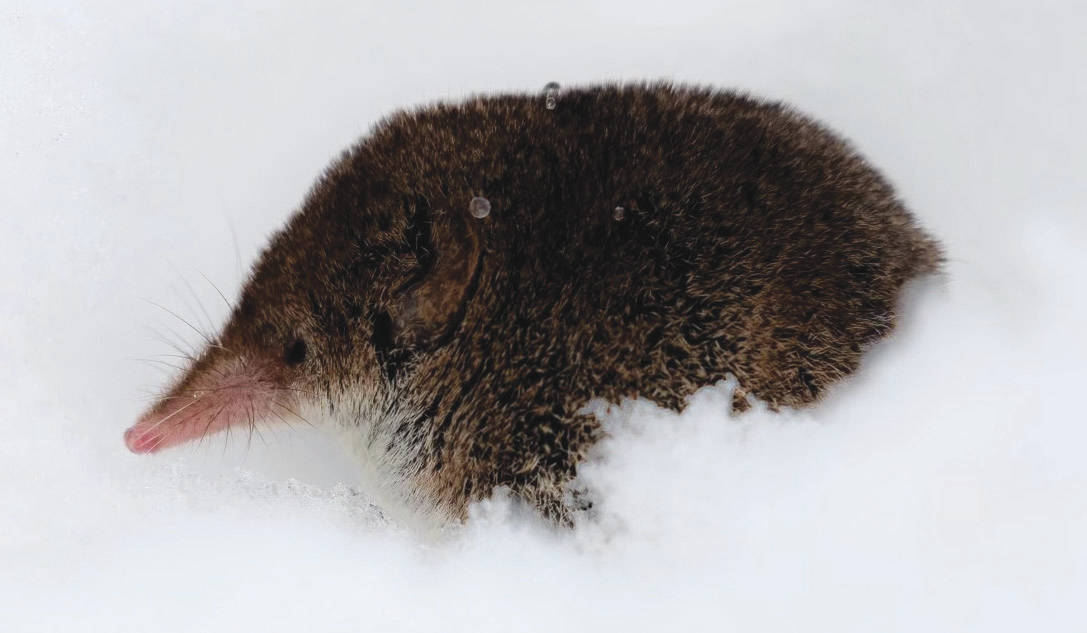
A rare photograph of a shrew during winter. This shrew was observed above the snow where it had been sneaking out of the subnivean zone for short periods of time, possibly to exploit seeds or suet that had fallen on top of the snow beneath a bird feeder in Soldotna. (Photo by Colin Canterbury/USFWS)

A rare photograph of a shrew during winter. This shrew was observed above the snow where it had been sneaking out of the subnivean zone for short periods of time, possibly to exploit seeds or suet that had fallen on top of the snow beneath a bird feeder in Soldotna. (Photo by Colin Canterbury/USFWS)

Refuge notebook: The hidden subnivean

  • By DOM WATTS Kenai National Wildlife Refuge
  • Thursday, January 28, 2021 6:09pm
  • Sports

Alaska summers are fast paced with people, wildlife and plants all in apparent frenzy trying to capitalize on warm temperatures and sunlight. And with good reason: winter is always looming just around the corner.

During winter, much of life seems to slow down and relax. Bears go into dens to hibernate and many birds fly south to avoid winter. Many wildlife species simply tough out the harsh winters waiting for better days to come. Other species, however, capitalize on a hidden winter habitat.

Often overlooked and seldom seen, many small mammals are basically going about business as usual in a realm known as the subnivean. As with many scientific terms, the word subnivean is descriptive and comes from Latin, describing a place “under” (sub) “snow” (nivis).

To us, looking from above, the subnivean looks like a solid blanket of snow and it’s hard to imagine anything living in it. Underneath the snowpack, however, lies another world.

When the inevitable snows of winter fall and cover the landscape in snow, vegetation and rocks shelter the ground underneath from snow buildup.

As snows continue to build up and the snowpack forms above, heat radiating from the ground causes the ice crystals near the ground to sublimate into water vapors, rise and refreeze above as an ice layer. This process creates a snow-free zone between the ground and the bottom of the snowpack, known as the subnivean zone.

Voles, shrews, lemmings and other small mammals thrive in this subnivean zone where they can weather even the harshest Alaska winters in relative comfort.

Voles and shrews are among the smallest mammals in Alaska. Because of their small body size and high metabolic demands, most cannot survive cold temperatures for very long.

In the subnivean zone, however, the snowpack serves as an insulating layer from colder temperatures and winds above. With temperatures typically remaining above freezing all winter, small mammals exploit this warmer zone where they can move about in relative freedom.

In the subnivean zone, small mammals are active throughout the winter and create extensive snow tunnel networks to travel between foraging areas, food caches, nests and latrine sites.

Small mammals also dig up through the snow to create air shafts that allow fresh air to circulate through their tunnel networks. Because temperatures are generally above freezing in the subnivean zone, the foods that small mammals rely on, such as grasses, leaves, seeds and insects, generally remain unfrozen and accessible.

The layer of snow and ice above also offers increased protection from predators that prey on small mammals. As might be expected, however, the subnivean zone is not exactly a paradise for small mammals either.

Some predators have, of course, also figured out how to exploit small mammals in the subnivean zone. Intuitively, larger predators cannot see small mammals under snow, but some species have evolved attributes or behaviors that use other senses and allow them to effectively hunt small mammals in their subnivean lairs.

Coyotes and foxes, for example, locate small mammals under the snow by sound. Once prey has been located they leap into the air and pounce down on unsuspecting prey.

Although these predators use this technique year-round, it is particularly effective for hunting small mammals in the subnivean zone because the layer of snow helps conceal the predator’s approach, allowing them to close the distance quickly, without being seen, and break through the snow to catch prey beneath.

Owls have mastered a similar technique whereby they locate prey moving under the snow by sound with astounding accuracy. Their ability to pinpoint sounds made by small mammals under the snow is aided by their dish-shaped faces, which help funnel sounds to their ear openings, and by asymmetric ear openings that allow owls to accurately pinpoint sounds in both horizontal and vertical planes.

Once prey is located under the snow, owls simply glide into position on silent wings, and dive through the snow to catch prey underneath.

Predators above the snow are not the only thing with which small mammals in the subnivean must contend. Smaller mustelids, such as least weasel and ermine, also take advantage of the warmer temperatures in the subnivean zone.

And, since these mustelids forage primarily on small mammals, the subnivean zone offers not only shelter from cold temperatures, but also an abundance of small mammal prey. With their small size and elongated bodies, least weasels can effectively navigate the myriad tunnels and clearings in the subnivean zone and are a major predator of small mammals.

Although the hidden subnivean remains largely out of sight, it’s always fun to think about the populations of creatures thriving just out of view under the snow.

Dom Watts is a Wildlife Biologist at Kenai National Wildlife Refuge. Find more Refuge Notebook articles (1999–present) at https://www.fws.gov/refuge/Kenai/community/refuge_notebook.html.


By DOM WATTS

Kenai National Wildlife Refuge


More in Sports

ski tease
Kenai sweeps Tsalteshi ski meet

The Kenai Central High boys and girls teams both placed first last Friday.

tease
Homer boys basketball tops Nikiski

Homer will host the annual Winter Carnival basketball tournament this weekend, starting Thursday.

Flanked by JDHS freshmen Manu Adams, left, and Paxton Willoughby, right, Homer junior Berend Pearson looks for a pass from a teammate. The Crimson Bears and the Mariners faced off at the Treadwell Arena in Juneau following the Bears’ senior night ceremony on Friday, Jan. 23.<ins>, 2026</ins>
Juneau hockey celebrates senior night with sweeping victory over Homer

The Crimson Bears saw an 8-2 victory over the Mariners Friday night.

Ninilchik's Austin White puts down a two-handed dunk against the Aniak Halfbreeds Wednesday at the Class 1A state basketball tournament at the Alaska Airlines Center in Anchorage. (Photo by Joey Klecka/Peninsula Clarion)
Sports briefs: SoHi boys top Kenai, Eagle River in shootout

The Soldotna varsity boys came out 2-1 in the Al Howard Shootout last weekend.

tease
Homer boys, Soldotna girls place 1st in ski invitational

Soldotna’s Tania Boonstra took first place for the girls’ division, leading her team to victory at the meet. The Homer girls’ varsity team placed second overall.

Senior Mason Bock exclaims after winning the state title during the ASAA Division I state championships in Anchorage, Alaska on Dec. 20, 2025. Bock beat No. 2 seed Isaiah Schultz of Colony High School in the final, securing his victory in the 135-pound title as the No. 4 seed. Bock said standing on the podium was the best moment of his life, telling the Clarion that since he had lost to Schultz once earlier in the season, he was “focused and determined to have a different outcome” during the final match. Photo courtesy of Andie Bock/Andie’s Alaskan Adventures Photography
SoHi girls 3-peat at state wrestling championships

The boys team placed second and saw five wrestlers win state titles in the Division I tournament.

Seward’s Atlin Ryan wrestles against a Mountain City Christian Academy athlete during the regional Kachemak Conference Wrestling Championships on Saturday, Dec. 13, 2025, at Homer High School in Homer, Alaska. (Delcenia Cosman/Homer News)
Homer girls wrestling team named regional champions

Kenai boys, girls both placed third overall in the Kachemak Conference Wrestling Championships on Saturday.

The Soldotna High School wrestling team is pictured after the Northern Lights regional conference in Wasilla, Alaska, on Saturday, Dec. 13, 2025. SoHi sent 33 boys and 11 girls to regionals. 22 boys and nine girls will compete in the state tournament at the Alaska Airlines Center this weekend. Photo courtesy of Soldotna High School Athletics
SoHi wrestling wins regional title; 31 wrestlers advance to state

22 boys and nine girls will compete in the state tournament this weekend.

Homer and Soldotna hockey players battle for the puck during the Carlin Cup home varsity game on Saturday, Dec. 13, 2025, at the Kevin Bell Arena in Homer, Alaska. (Delcenia Cosman/Homer News)
SoHi hockey claims 3rd Carlin Cup victory

The Soldotna varsity hockey team defeated Homer 9-1 Saturday at Kevin Bell Arena.

Sophie Tapley is photographed with her parents, Josh and Whitney Tapley, during Sophie’s signing ceremony at Kenai Central High School on Nov. 26, 2025. Tapley committed to playing volleyball at the University of Alaska Anchorage during the 2026-2027 school year. Photo courtesy of Jesse Settlemyer, Kenai Central Athletics
Kenai Central’s Sophie Tapley signs with UAA volleyball

Tapley will trade her Kardinals jersey for a Seawolf one during the 2026-2027 academic year.

Photo courtesy Pete Dickinson
The SoHi junior varsity and varsity wrestling teams compete in the Battle for the Bird at Soldotna High School on Wednesday, Nov. 26. The Kenai Peninsula Athletics Sapphire dance team performed the halftime show.
SoHi, Nikiski wrestling teams compete for Thanksgiving dinner

The Stars and Bulldogs faced off during the Battle for the Bird duals last Wednesday.

Runners of all ages gather for a photo in the Homer High School Commons after the annual Thanksgiving Turkey Trot on Thursday, Nov. 27, 2025, in Homer, Alaska. Due to icy outdoor conditions, the official run was moved to the high school halls. Photo courtesy Matthew Smith
55 turn out for Homer Turkey Trot

Each Thanksgiving morning, the Kachemak Bay Running Club and the City of… Continue reading