
I did not fully appreciate the recent history of the Kenai River and surrounding watershed until I read Shana Loushbaugh’s thesis, “The history of land use on Alaska’s Kenai River and its implication for sustaining salmon.”
As a fisheries biologist, my first takeaway was that this should be required reading for any natural resource professional working in the Kenai River Watershed. As a member of this community, my second takeaway is an appreciation for a river that does it all.
Of particular interest to me is the public debate during the 1980s and 1990s sparked by changing land-use trends that began in the 1960s and included rapid expansion of residential subdivisions, growth in incorporated areas, and the road-building needed to connect everything. With the rapidity of development, the impact on the environment was an afterthought.
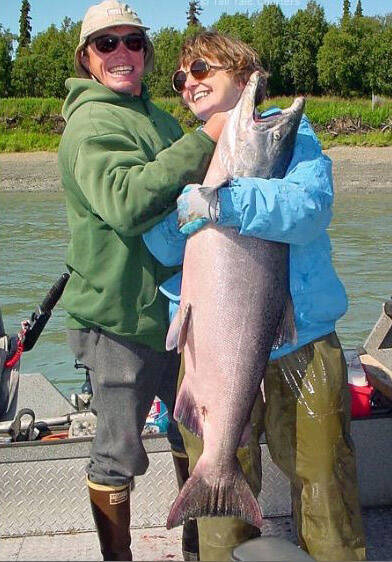
By the 1970s, the sport fishery for the Kenai River became a driving force of land-use changes with the rise of angling and associated real estate activity. As recreational development along the river proliferated — the public became concerned that too many people were putting pressure on streambanks.
Simultaneously, the fledgling Alaska Division of State Parks and Outdoor Recreation (i.e., State Parks) was concerned about the massive growth in visitation, a 450% increase from 1977 to 1980! In response to the demand, the state acquired a dozen Kenai River properties during the same period.
Still, the burgeoning popularity of the Kenai River sport fishery left visible changes to streambanks, including loss of vegetation, pollution, crude erosion control structures, and increasing densities of recreation structures.
Thus began a series of actions spearheaded by Gov. Hammond’s Kenai River Task Force to overcome institutional gridlock and balance social pressure and habitat concerns on the river. In 1983, the Anchorage Daily News ran a series of articles titled “Crisis on the Kenai,” followed by an editorial, “Will Alaskans Save the Kenai River?” A challenge they met.
The case for change was largely driven by the community seeking improved stewardship of a river that is the identity and lifeblood of the central Kenai Peninsula. The first product of sweeping positive change was the establishment of the Kenai River Special Management Area.
Since much of the land in the river corridor is privately owned, the KRSMA designation and the associated plan hoped to support local governments to protect the river in the face of growth. As public interest spiked, the Kenai Peninsula Borough took an active role in protecting habitat on the Kenai River.
After enormous public debate that included two failed votes, the KPB Assembly passed the Kenai River Habitat Ordinance in 1996, including a setback provision commonly known as the “50-foot buffer.”
As Loushbaugh captures the 40-year history of habitat protection efforts that began with Gov. Hammond’s 1982 Kenai River Task Force, she points out that it was not a pretty, simple or even popular process. Instead, it was a “confusing tangle of ad hoc committees, assessment reports, data gaps, and repetitive projects consuming public funds and volunteer time.”
Significant progress has occurred despite the inherent flaws found in nearly any public process with differing visions. Immense amounts of time, money and talent have been applied to protecting the Kenai River and the surrounding watershed.
The results are a mix of seen and unseen changes in a river largely free of manmade debris, jetties or the need for toxic site cleanups. It is also a river system of improved fish passage and one that is stewarded through the establishment of the River Center.
The community changed, growing not just in density but in engagement, and responded to meet the challenges of more people drawn to a river that “has it all.”
While measuring changes in attitudes is difficult, key events such as the approval of the Kenai River Habitat Ordinance, establishment of the River Center, and formation of government programs and nongovernmental organizations to conserve habitat remain clear indications of public recognition of the power of working together to create positive change.
One such program that has endured since 1995 is popularly known as the Cost Share Program, a program built in the spirit of cooperation and shared visions for the Kenai River. This program is a joint venture between the U.S Fish and Wildlife Service and the Alaska Department of Fish and Game that initially focused on removing jetties and other artificial structures that harm juvenile salmon.
During the late 1990s and early 2000s, hundreds of jetties, bulkheads and riprap streambanks were removed from the river and replaced with native vegetation. The Cost Share Program remains an integral part of the socioeconomic challenge of administering the KRSMA and KPB’s Habitat Ordinance (21.18).
Equally as important as financial assistance to qualified landowners for technical expertise from agency personnel. As demographics change and land uses shift from production and extraction services toward recreation or nonresident owners, the need remains to ensure salmon-friendly land uses.
The story of the Kenai River and surrounding watershed is still being written. Differing visions of the past played out against the backdrop of increasing human population, globalization, land-use changes and the speed of technology. Real forces such as shifting political attitudes toward land-use restrictions and Alaska’s boom-and-bust resource-based economy will continue to play a significant role.
Similar to past decades, the need for community leaders to seek solutions and improve stewardship remains a constant. We are fortunate to have institutions such as the KRSMA Advisory Board and the Kenai Peninsula Fish Habitat Partnership (https://www.kenaifishpartnership.org) that provide diverse perspectives, a shared goal and a structure for collaborative decision making.
These stakeholder groups are relatively new but show promise in improving communication and providing stability in engagement while proactively planning for the future.
Kyle Graham is a Fish and Wildlife Biologist at the Kenai Fish Wildlife Conservation Office. Find out more about refuge events, recreation, and more at kenai.fws.gov or Facebook: https://www.facebook.com/kenainationalwildliferefuge. To find more Refuge Notebook Articles go to https://www.fws.gov/kenai-refuge-notebook
