
Climate change is changing conservation. We used to set goals and objectives around returning to historical conditions, a time when people’s impact on land, water and wildlife were more local in scale and less complex.
Any person who studies the longer, glacial history of Alaska knows the idea of some stable past condition isn’t really true or even realistic. Ecosystems and species assemblages have always been in flux, but we have managed them as if they are stable. Climate change shatters our ability to continue to operate under this assumption.
We both have spent the last two decades contemplating what this means for how we steward the lands that we care about. The tricky part, at first, was letting go of resisting change toward a measurable historical condition.
But, once we did that another challenge emerges: How do we steward our lands, water and wildlife toward uncertain future conditions? One way to unwrap this puzzle is to understand what we have and how that will change under different climate change scenarios we expect to see on the Kenai.
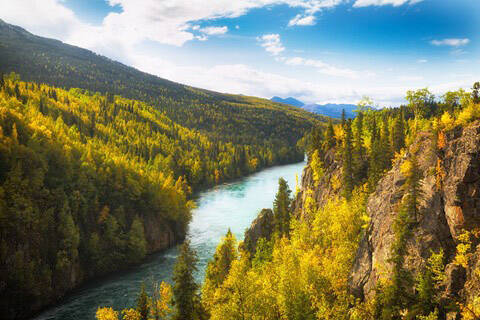
The Kenai National Wildlife Refuge spans the southern edge of the boreal forest and the northeastern edge of the Pacific maritime rainforest. Like all of Alaska, climate change is already impacting refuge resources.
Annual temperature has warmed 3 to 3.4 degrees Fahrenheit from 1969 to 2018 and annual precipitation has increased from 3.4% to 16.5% depending on whether you are looking at the boreal or rainforest side of the Kenai Mountains. Climatologists forecast even more change in the future.
The climate future for rainforests on the Kenai Peninsula, which spans from the Kenai along the coast all the way through Southeast Alaska to Oregon, remains within the range of climate conditions of that ecotype.
Our Kenai rainforests were historically colder and less diverse than the temperate rainforests to the south — for example, Western hemlock and yellow cedar are in Southeast, but not part of our forest assemblage.
Over 1 million acres of yellow cedar stands have died in Southeast Alaska as snow cover becomes less reliable in the warming climate and late-season freeze events kill many trees.
Some, like the U.S. Forest Service, are considering whether the Kenai is a place where yellow cedar could be translocated outside its historical range. As our winters become less harsh, the Kenai could accommodate species like yellow cedar. Thus, we could make management decisions that accelerate the expansion of the northern range of this species.
The boreal side is a different story. Climate futures shift away from conditions historically associated with boreal forest, but it won’t be expansion of the rainforest to our east because the rain shadow effect of the Kenai Mountains make the boreal forest too dry.
So, depending on the model used, the climate future for the boreal lowlands can look more like the climate associated with temperate forests in the Rocky Mountains or Northeastern deciduous forests or even Canadian grasslands.
No matter the direction, it is likely the current Kenai boreal trees will still find places they can survive, but the future climate has the potential to allow many other species to survive here too.
What does this mean? The only thing we can expect is the unexpected. In times of rapid climate change, ecosystems are more likely to transform after disturbance. Each disturbance rolls the dice and we could be surprised by what species dominate under the emerging climate conditions.
Should we try to manage to only promote the survival of tree species that were here when the refuge was established or adapt to changing climate conditions, either naturally or intentionally?
If we choose to adapt, this may mean considering new species and our current strategy considers new species to be non-native. For example, chokecherry was historically widely distributed across southern Canada and the northern continental United States.
In congruence with models that indicate that our climate is becoming more hospitable to chokecherry, people found they could plant this fragrant blooming tree on the Kenai. It has escaped from the lawns where it was originally planted and is currently being actively removed as an invasive species.
At what point will we need to switch strategies to managing toward future change? Should we welcome all species that thrive or only some? Browsing chokecherry can be toxic to moose, which may not make it a great addition even as it provides berries.
These questions are not easy for those of us trained to maintain historical conditions. It is a new paradigm to consider managing toward an unknown and perhaps unknowable future.
It will take a combination of being willing to think beyond managing toward historical conditions, science and engagement with stakeholders to understand how managing toward different future climate conditions impacts this place from both an ecological and social standpoint.
With this understanding, we can shift the conservation paradigm that considers a past with fewer people to one that reflects the future, one where people are not just the problem but the solution.
Dawn Magness is an ecologist and Kris Inman is the Supervisory Wildlife Biologist on the Kenai National Wildlife Refuge. Find out more about refuge events, recreation, and more at kenai.fws.gov or Facebook: https://www.facebook.com/kenainationalwildliferefuge and more Refuge Notebook articles (1999–present) at https://www.fws.gov/kenai-refuge-notebook.
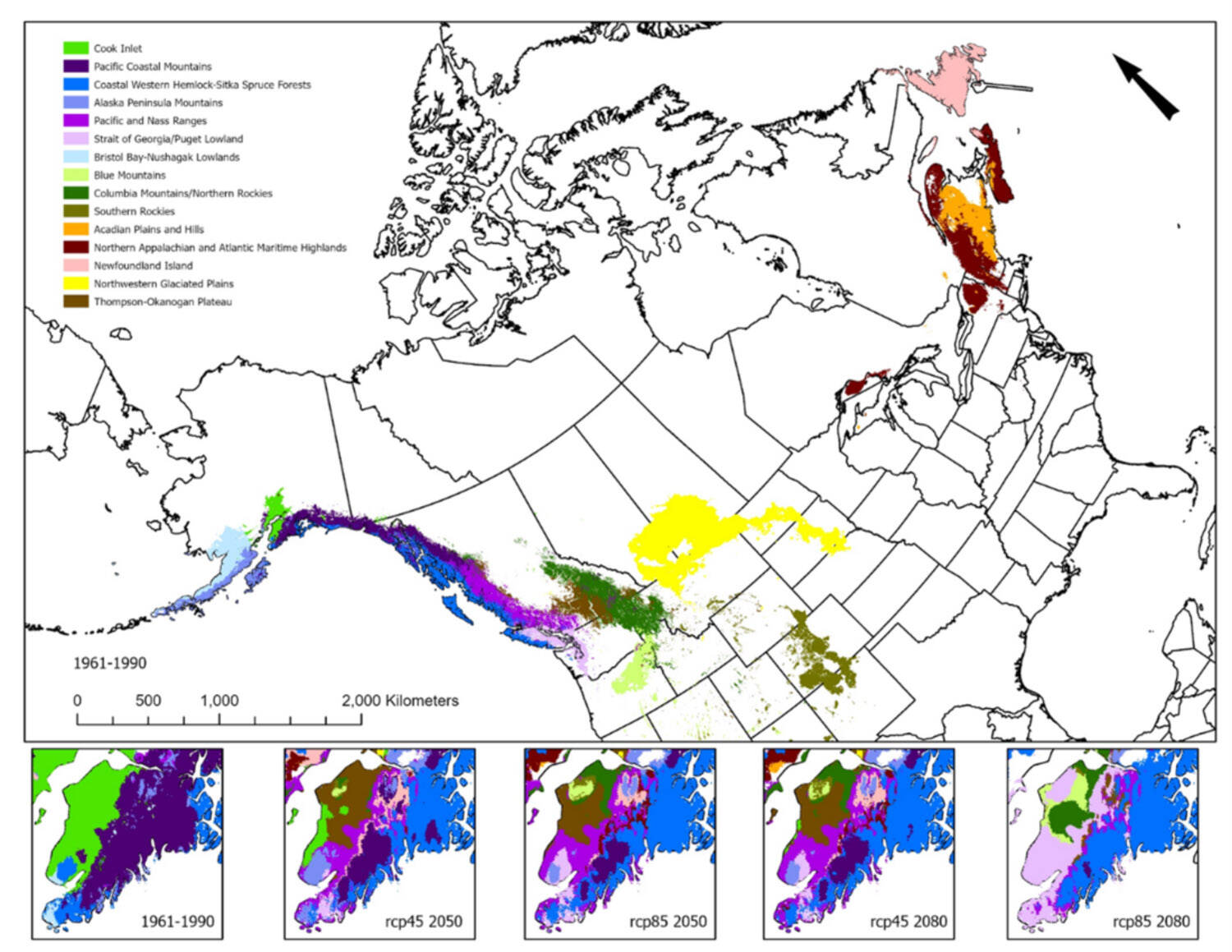
Ecoregions that are forecast to align with the future climate of the Kenai National Wildlife Refuge in 2050 and 2080 under high (rcp85) and low (rcp45) emission scenarios. The western Kenai continues to be associated with temperate rainforests to the south. The boreal lowlands can be associated with a variety of ecoregions across North America. Data reference: Stralberg, D. 2019. Velocity-based macrorefugia for North American ecoregions. Zenodo. http://doi.org/10.5281/zenodo.2579337.
