
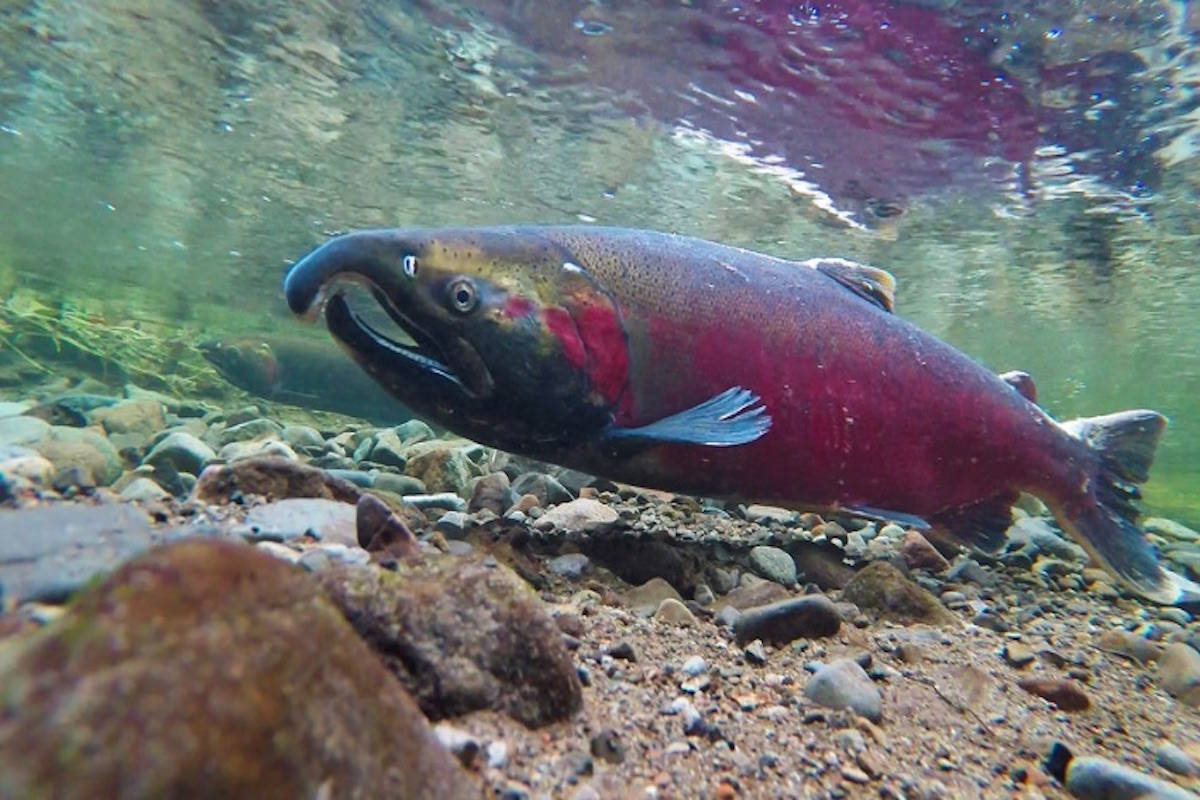
The first chinook hatchery enhancement project on the Kenai Peninsula occurred after the Territory of Alaska opened a hatchery in 1924 at the head of Grouse Lake, near Seward. They received chinook eggs from Washington state and released fingerlings into Grouse Lake. Since no natural run of chinook exists in Resurrection Bay it is unlikely that the Washington immigrants colonized a stream.
The Alaska Legislature created the Fisheries Rehabilitation, Enhancement, and Development (FRED) Division within the Department of Fish and Game (F&G) in 1971. Resulting bond packages for hatcheries were approved by high voter margins. The first two FRED hatcheries were built in 1973, one of which was at Crooked Creek, about 6 miles from my house. Bob Palmer probably influenced its location. He was a senator/commercial fisherman from Ninilchik. I remember a speech he made about salmon hatcheries to my high school class. Salmon that lay eggs in streams typically have about 10% hatch. Incubation in hatcheries commonly have 90% hatch. Female Crooked Creek chinook have an average of 6,878 eggs. There, a pair of chinook produce about 689 fry. In a hatchery that number soars to near 5,846. Hatchery incubated and reared Crooked Creek chinook began being released back into the creek in August of 1975. A sport fishery opened in 1978 on the Kasilof River targeting Crooked Creek chinook. As of the fall of 1977, only 216 chinook adults had returned from the enhancement project.
Even through 1978 only 1,071 adults had returned, of which 859 were “1-ocean jacks” weighing about three pounds. In other words, only 212 larger chinook had returned from hatchery stocking. From humble beginnings the stocking has continued (except for 1982) to this day and the sport fishery has thrived. Ocean survival improved some years, hitting 6.3% from the 1981 stocking.
The Kasilof River chinook fishery gained favor with sport fishers. Generally, about half the harvest is made up of adipose fin clipped, hatchery-produced fish that have returned from frolicking in the Pacific Ocean. Kasilof River offers a unique experience in that fishing from motorized or anchored boats is not allowed.
Salmon hatcheries face growing criticism on several fronts. For instance: are there too many salmon for the ocean to feed? Bob Palmer brought up that question when he spoke to my class. In 1970 Pacific Ocean hatcheries released 500 million salmon, by 2008 that number had risen to 5 billion. Lately, more than one in five salmon in the Pacific Ocean originated in a hatchery. However, natural salmon numbers have plummeted in the last 150 years, reducing potential stress on ocean food resources.
According to Laine Welch, Russia is the number one salmon harvester, catching 51% of the harvest of Pacific salmon. They are followed by the U.S. at 33% (97% of the U.S. catch comes from Alaska), Japan at 13%. Canada at 3%, and South Korea under 1%. Russia is currently expending its hatchery program.
One of the indicators of too many fish in the ocean is smaller fish and data indicate that commercially caught salmon have gotten smaller.
For chinook, the decline may be genetic, caused by sport fishers’ long practice of retaining large fish and releasing smaller ones. Weight reduction could be caused by climate change, ocean acidification, pollution, habitat loss, or other things. Pacific halibut that weighed 120 pounds on average about 30 years ago heft 45 pounds today, and that probably has nothing to do with hatcheries. Discovering the cause of reduced salmon weights is something that should be studied.
Washington has about 150 salmon hatcheries between state, tribal and federal programs. In Alaska wild stocks have priority, but our state shouldn’t blindly quit hatchery programs, leaving the ocean resources to other states and countries. Crooked Creek chinook enhancement has been a success in Cohoe/Kasilof. And these fish have been used for numerous other fisheries, including to start the Pothole fishery on the Homer Spit. According to a F&G report:
“Crooked Creek chinook salmon smolts have been released in creeks and ocean bays at 15 different sites throughout Cook Inlet and Prince William Sound …. In addition, there have been 35 landlocked lakes … stocked with Crooked Creek chinook …”
Brent Johnson is president of Cook Inlet Aquaculture Association and president of Kasilof Regional Historical Association.
• Brent Johnson is president of Cook Inlet Aquaculture Association and president of Kasilof Regional Historical Association.
