
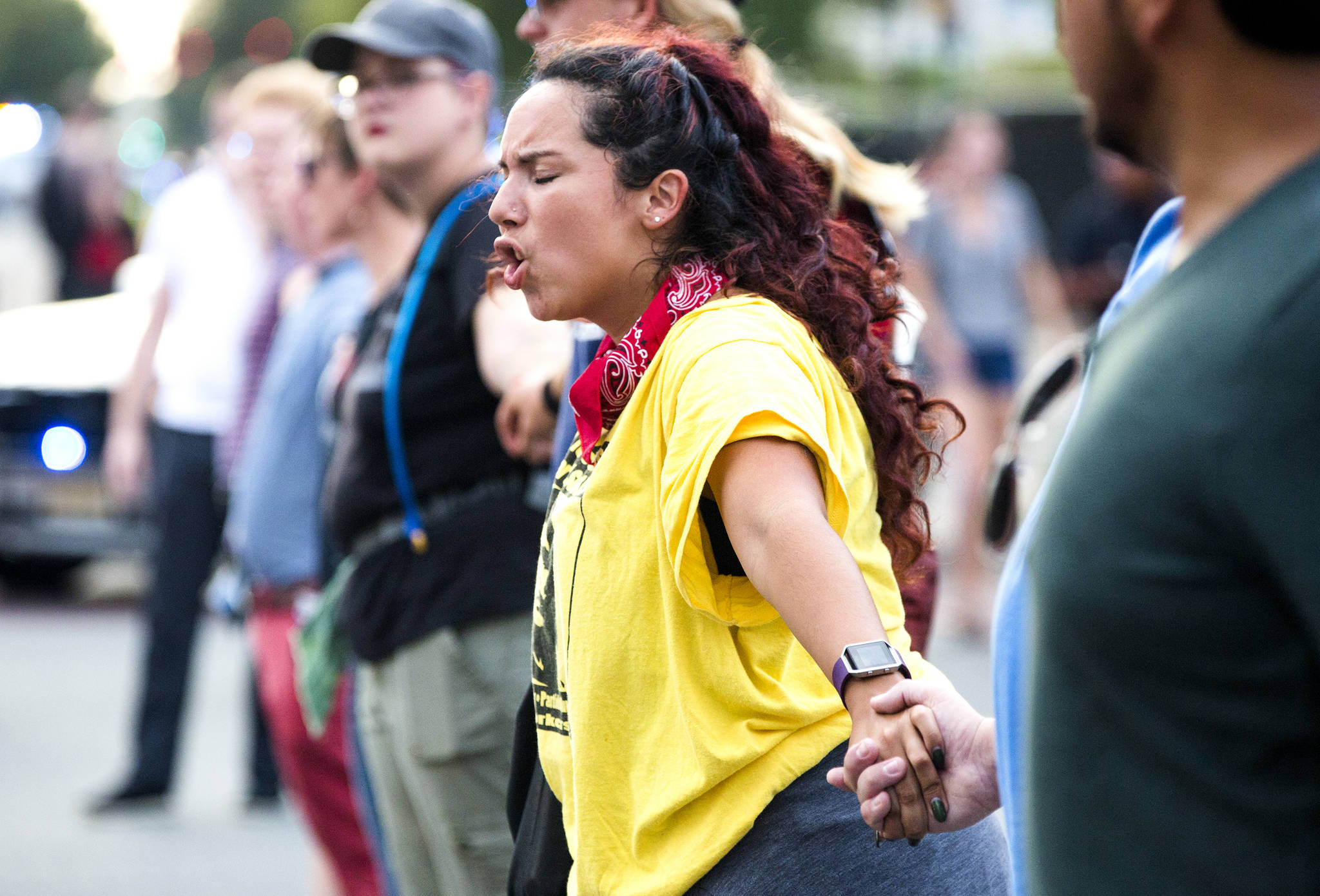
By SHARON COHEN
AP National Writer
The violent clashes in Charlottesville, Virginia, have turned a spotlight on the freedom of speech — one of the first rights enumerated in the U.S. Constitution, and one of the messiest.
In Charlottesville, white nationalists and other extremist groups including neo-Nazis and the Ku Klux Klan rallied — but only after a federal judge ruled they had the right to gather at Emancipation Park and protest the removal of a statue of Confederate Gen. Robert E. Lee.
Their rights were defended by the American Civil Liberties Union, despised by many conservatives as a liberal bastion. The ACLU deplored the “voices of white supremacy,” and condemned the violence that killed a 32-year-old woman and injured dozens of others. But the ACLU made no apologies for its defense of speech that many find distasteful or even dangerous.
“The First Amendment is a critical part of our democracy and it protects vile, hateful, and ignorant speech,” the organization said.
So what are the boundaries of free speech? And how is it playing out in this politically charged landscape?
Free speech rights
“Even groups that have hateful messages still have a right under the First Amendment to express those positions, whether it’s in rallies or protests or gatherings or writing,” says Roy Gutterman, a First Amendment expert at Syracuse University.
But free speech does have boundaries. “You have no right to incite violence, you have no right to defame someone or disseminate child pornography,” he says. “There are limits and some of the limits are easier to define than others. Even the concept of inciting a riot can get into some subjective and nebulous standards.”
The limits of free speech were recognized in a 1919 Supreme Court decision in which the justices said the First Amendment could be restricted if the words represented a “clear and present danger.” In that ruling, Justice Oliver Wendell Holmes said “the most stringent protection of free speech would not protect a man in falsely shouting fire in a theater and causing a panic.”
Strange bedfellows
The ACLU has a long history of defending free speech rights, at times on behalf of bigoted groups with offensive messages. In one of its most controversial cases, the ACLU in the late 1970s argued that a neo-Nazi group should be allowed to march in the Chicago suburb of Skokie, which was home to thousands of Holocaust survivors. The demonstrators planned to wear Nazi uniforms with swastika armbands. Attorneys for Skokie argued that would be traumatic for many residents. The neo-Nazis ultimately won the legal battle as a free speech argument, but didn’t follow through with the march. Instead, they held a rally in a federal plaza in downtown Chicago.
In a recent case the ACLU said it was defending right-wing writer Milo Yiannopoulos in a free speech lawsuit even though it disagrees with his positions, saying he has fostered “anti-Muslim views and disdain for women” and has compared Black Lives Matter activists to the Klan.
“We understand the pain caused by Mr. Yiannopoulos’ views,” James Esseks, director of the ACLU’s LGBT and HIV Project wrote last week. “We also understand the importance of the principles we seek to defend. The constitutional principle here, of course, is that government can’t censor our speech just because it doesn’t like what we say.”
Tolerance on college campuses
The debate over political expression and free speech has roiled college campuses in recent years, most notably at the University of California-Berkeley. An appearance by Yiannopoulos last winter was canceled after demonstrators dressed in black, broke windows, hurled rocks at police and set fires on the campus. A speech by conservative commentator Ann Coulter at Berkeley was later canceled because of safety concerns. And in Middlebury College, a small liberal arts campus in Vermont, scores of students shouted down political scientist Charles Murray, the author of “The Bell Curve,” a controversial book that deals with race and intelligence.
Syracuse’s Gutterman says what’s happening now is a dramatic shift from the era between the 1940s and 1960s when people on college campuses who were being punished, censored and kicked out of school were on the political left. “Fast forward to today,” he says. “It’s people on the right or the far right who feel they’re not getting a chance to articulate their viewpoint.”
“‘I think college campuses are a pretty precarious place for the free exchange of information,” he says. “Berkeley is the birthplace of the Free Speech movement in the ’60s. There’s a huge irony there. College campuses have become kind of soft places because of speech codes, codes of conduct and things like that that tend to over-insulate people.”
But Fanta Aw, interim vice president of campus life at American University in Washington, D.C., told the Senate Judiciary Committee in June: “As an institution, we draw the line when expression has the potential to incite violence and/or is a direct threat to members of our community.”
The view from abroad
Many other democracies do not share America’s broad protections of speech.
After World War II, several European countries enacted laws that were designed to curb religious and racial hatred. The punishment can range from fines to prison. In 2006, British historian David Irving was sentenced to prison in Austria for denying the Holocaust and gas chambers at Auschwitz. In 2011, a French court found the flamboyant fashion designer John Galliano guilty of making anti-Semitic comments at a Paris bistro.
