
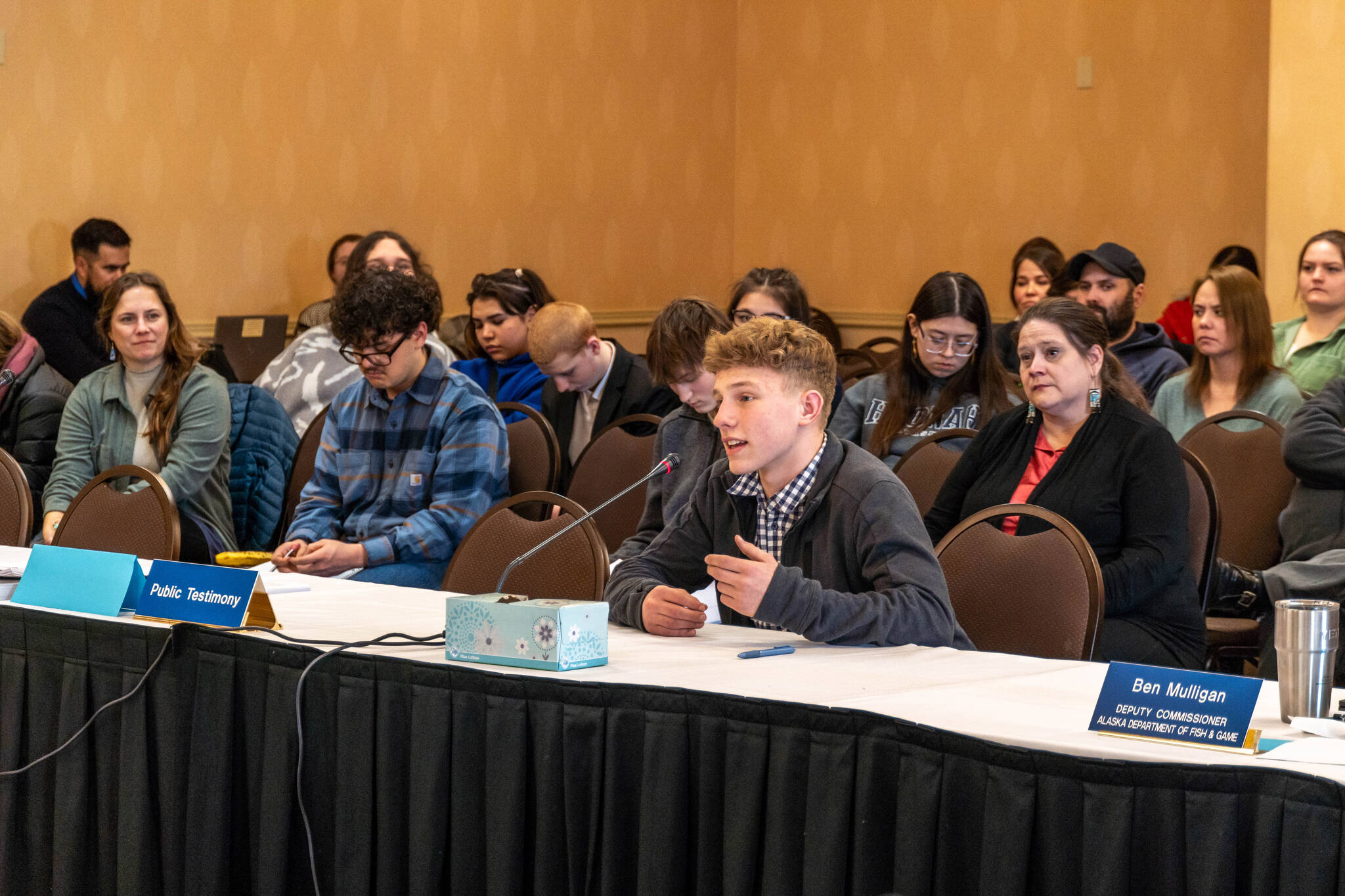
Alaska’s public lands and waters are used by virtually every Alaskan who hunts, fishes, traps, and wants to keep doing it — though not every Alaskan knows how to advocate for management that is rooted in their and their community’s best interests. For the past 10 years, Heather Bauscher, an adjunct professor at the University of Southeast Alaska, has been working with young people to ensure they know how to make decision-makers hear their voices. It all started when she was a student at UAS, taking the same class she now teaches, as part of her goal of becoming a wildlife biologist.
“At first I was overwhelmed, like a deer in the headlights. Then I watched folks go up and give testimony and change outcomes,” she said. “People in Alaska have more ability to influence how their fish and wildlife resources are managed than anywhere else in the country.”
She attended so many management meetings that board members started teasing her about it. Then, between commercial fishing, leading an after-school program at Pacific High School, finishing her Master of Arts in Teaching, and working seasonally in wildlife management, she began teaching the class that had first familiarized her with public processes governing the management of Alaska’s lands and waters.
Now, that class, Federal Subsistence Board Policy and Procedures, is a four-week practicum, with two weeks of classes leading up to federal subsistence board meetings. The University of Alaska Southeast, USDA Office of Tribal Relations and U.S. Forest Service are partners, along with the Sitka Conservation Society, where Bauscher now works as the Fisheries Community Engagement Specialist.
In addition to teaching the practicum course at UAS, now with additional support from USFS Tongass Subsistence Biologist Ashley Bolwerk, and at the request of the Southeast Regional Advisory Council (SERAC), the course has been collaboratively turned into a four-hour workshop that has been taken “on the road.” Over the past three years, they have traveled to 13 communities, providing more than 100 people across Southeast Alaska with a toolkit on public engagement.
“You can’t learn to navigate these spaces through books. It’s all about being there,” Bauscher said. “You can set them up for success, so they have positive first experiences. And they can apply that to the other regional boards, their local assembly, their Tribal council.”
This year, students from Hoonah, Petersburg, Wrangell, Sitka, Tyonek, Kenai, Nondalton and the Iliamna Lake area attended the Federal Subsistence Board meeting in Anchorage. They spoke on topics from sea otter management, to gillnetting on the Stikine River, to herring. Ultimately, all of those topics came from who they are, where they’re from, and what practices are important to their family.
“It was a really cool realization that they (board members) were just like you and me,” said Jackson Carney of Wrangell after the Federal Subsistence Board meeting. “No matter what we’re trying to change in the future, whether it’s when we can go hunting or something in my community, I can use the skills that I learned in that meeting.”
Carney testified on gillnetting.
“It means a lot to me and my family — having the ability to get smoked salmon is a really unique thing we get the opportunity to do,” he said. When the class attended the North Pacific Fishery Management Council meeting, which in February focused on proposals to reduce chum bycatch by trawlers, he ended up talking with people from around the state about different ways of smoking salmon. “Smoked salmon is something that ties together all Alaskans,” he said. “We all have our own ways. And the ability to pass that on to our kids is something we want to have forever and ever and ever.”
Some of the young people have already expressed a desire to stay involved, and to be members of their Regional Advisory Councils. One is interested in employment helping to manage the councils. That’s something that makes Bauscher happy.
“When there aren’t enough local people bringing this perspective, that’s part of the reason we end up with the decisions we end up with,” Bauscher said. “That disappointment builds resentment of process, rejection of participation, and ultimately hurts us more. It allows others to dominate those spaces. Hopefully these opportunities help change that.”
One of the students, Naomi Jones of Tyonek, authored a commentary about her experience, and the importance of subsistence, in the Alaska Beacon.
“This class showed me how much our regional advisory councils listen to the voices in their communities, and that they actually bring these concerns to the Federal Subsistence Board. The board members listen to these concerns as well, and they make sure they are doing the right thing for the rural communities across Alaska,” she wrote.
Ultimately, the goal is to ensure Alaskans, and young people, have a say in the decisions that affect them.
“True prosperity comes from ensuring our resources remain healthy and abundant for future generations,” Bauscher said.
Mary Catharine Martin is the communications director of SalmonState, an organization that works to keep Alaska a place where wild salmon and the people whose lives are interconnected with them thrive.
