
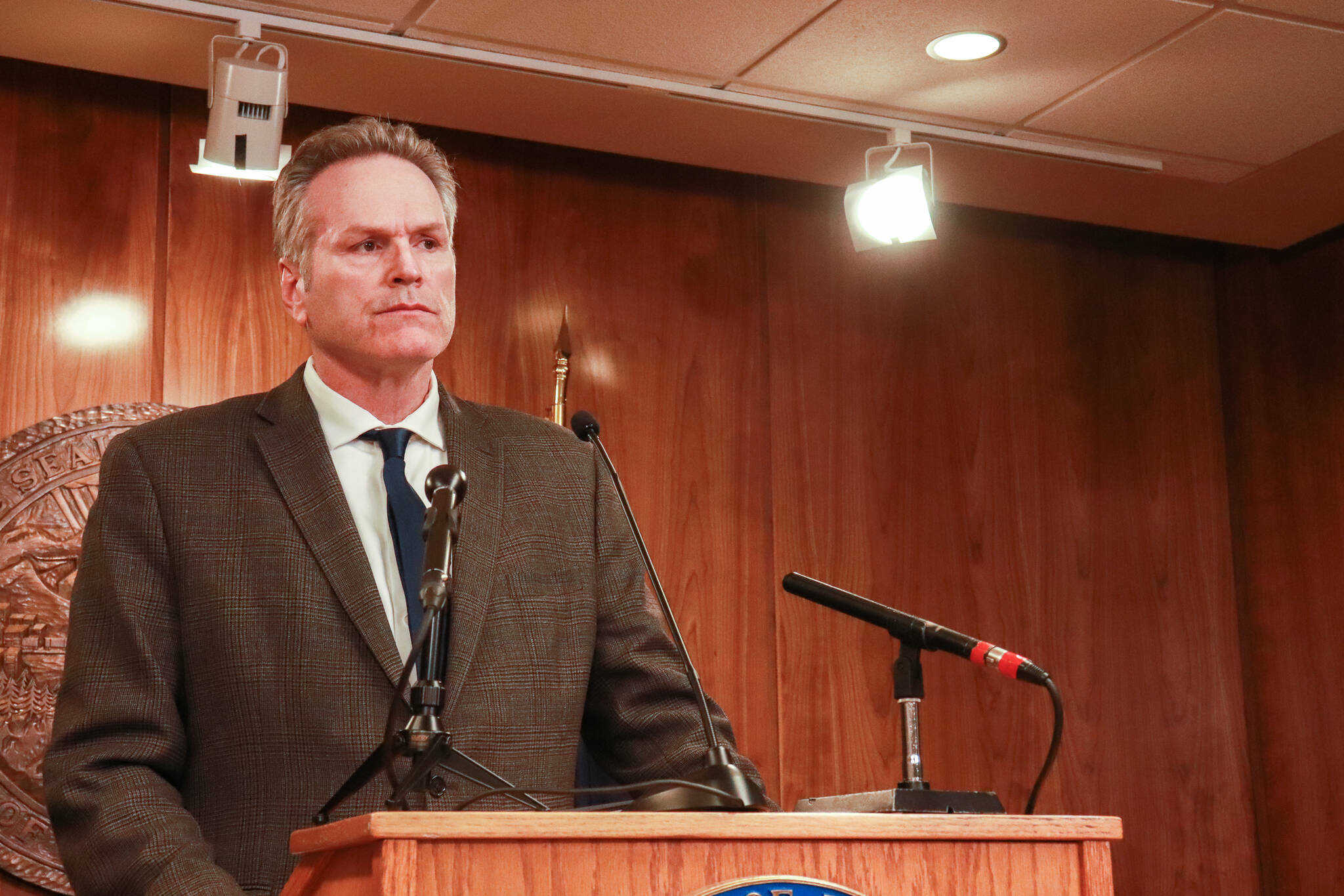
“Any serious effort to stabilize Alaska’s fiscal future must also focus on diversifying our economy and creating new industries, which in turn broadens the economic base for potential revenue,” Gov. Mike Dunleavy wrote in a letter he sent the Legislature two weeks ago. On Monday, he told reporters he’s “going to actually put together a package” for a sustainable fiscal plan.
At this point in his six-year tenure though, his fiscal credibility is so close to zero that lawmakers have no reason to take him seriously.
During his first State of the State speech in 2019, he called for a permanent fiscal plan “that will put our state on solid footing for decades to come.” However, unlike his predecessor who actually developed a complex one, he proposed three simple but improbable constitutional amendments as the “foundation” of his plan.
One of them would have prohibited changing the statutory formula for the PFD without a vote of the people. Had that been enacted, there would be nothing left in the Permanent Fund.
Another would have required voters to approve any new taxes. That would have left the Legislature with little or no ability to ever raise new revenue.
The foundation crumbled when they justifiably ignored him.
Then he turned to the standard Republican promise of generating new revenue by growing the economy. He put together a team of experts that was supposed to “market Alaska to the world” and “inform investors, industries, and individuals that Alaska is open for business.”
That was a bust too.
The final part of his plan was dramatically reducing the size of state government. He used his line item veto power to cut $444 million from appropriations approved by the Legislature.
It still required borrowing more than $400 million from the state’s budget reserves to close the budget deficit. Later, he more or less conceded that cutting spending alone wouldn’t solve the problem.
But he hasn’t let go of his pursuit of finding new revenue from other sources.
Two years ago he proposed a carbon sequestration program that supposedly had the potential to bring in “millions, if not billions, of dollars,” even as much “as $30 billion or more over 20 years, just from our forest lands alone.”
He asked legislators “to take this legislation seriously as the cornerstone of a long-term fiscal solution that complements revenue from oil and gas and the Permanent Fund.” And plugged $7 billion of new revenue into his 10-year budget plan.
They humored him by appropriating $140,000 for one new state employee to “implement the bill” they passed “and support a contracted project developer.” Nothing has happened since.
Now it’s the Alaska LNG project. It won’t directly create a significant revenue stream for the state. But when Fox’s Stuart Varney asked Dunleavy what it means for Alaska, he said “Everything. It would be 60 years, I think, of prosperity.” And he evoked his Alaska is open for business fantasy by suggesting it would support development of “manufacturing and data farms” here “well into the future.”
If the $40 billion project comes to fruition, it will move gas through a new pipeline from the north slope, much of which could then be exported to Asian markets. Dunleavy thinks construction could be completed within 2½ years.
However, nothing will flow through it until a gas treatment plant is built. Nothing will be exported until an LNG terminal is built. The design of those hasn’t started yet.
And so far, only Taiwan has signed a nonbinding letter of intent to purchase gas.
“You don’t get much squishier than that,” Larry Persily said. The former Federal Coordinator of the Alaska Natural Gas Transportation Projects also thinks Dunleavy’s construction timeline is unrealistic. Even with a miracle, he doesn’t think it’ll be operational for at least eight years.
After six years at the helm, Dunleavy has proven that he excels in daydreaming but not much more. And if he stubbornly clings to the idea that a sustainable fiscal plan is possible without new taxes while paying full statutory PFDs, then the Legislature will be stuck working with a governor in name only for the remainder of his term.
• Rich Moniak is a Juneau resident and retired civil engineer with more than 25 years of experience working in the public sector. Columns, My Turns and Letters to the Editor represent the view of the author, not the view of the Juneau Empire. Have something to say? Here’s how to submit a My Turn or letter.
