
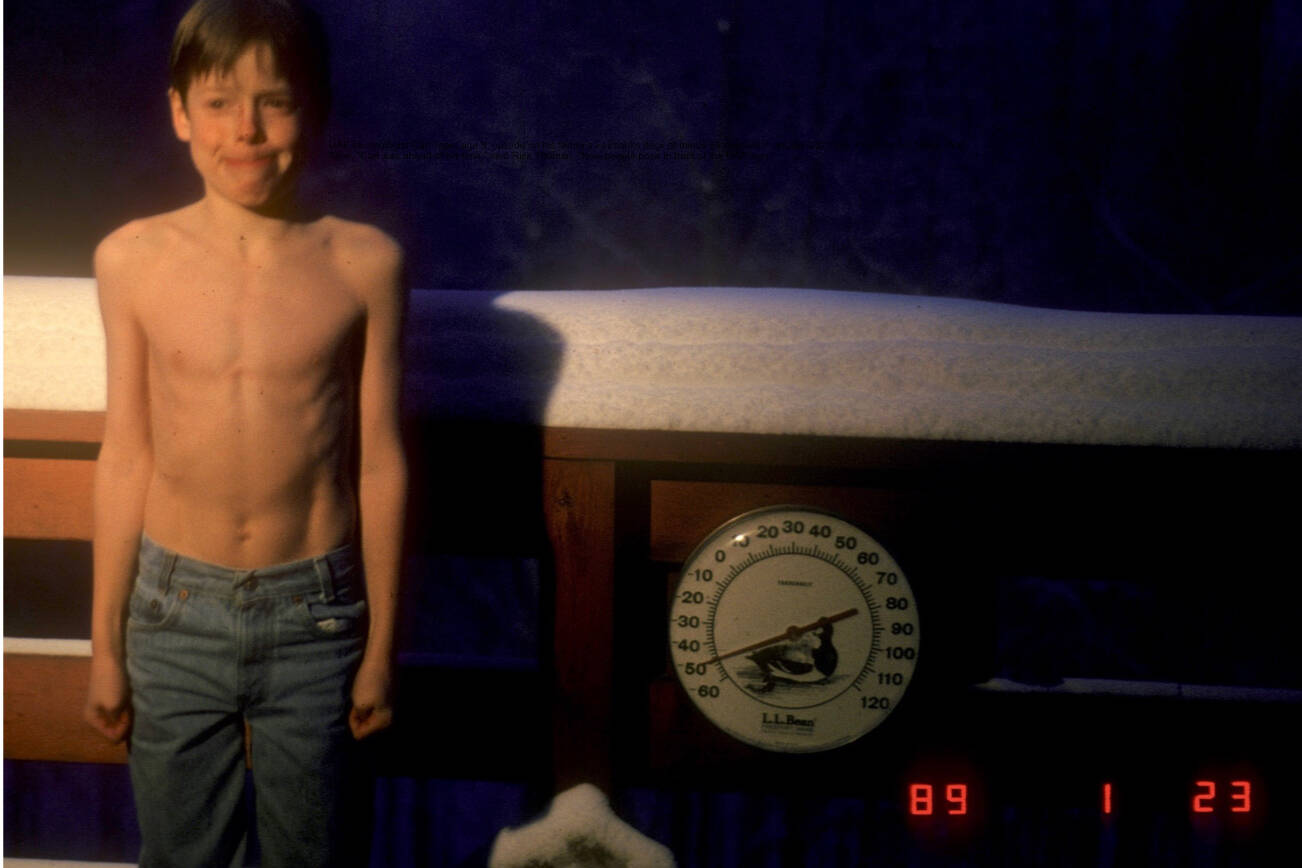
UAF seismologist Carl Tape, age 9, stands outside on his family’s Fairbanks deck at minus 50 degrees F on Jan. 23, 1989. “Carl was ahead of his time,” said Rick Thoman. “Now people pose in front of the UAF sign.” Photo courtesy Walt Tape

Fuzzy memories of a real Alaska cold snap

More than 35 years have ticked away since I turned my pickup left onto a North Pole road and noticed the clutch pedal remained on the floor. In a panic, I reached down with my mittened hand and pulled. The frozen plunger oozed back into position.

Driving at minus 50 degrees Fahrenheit is not a smart thing to do. But I was in my mid-20s and had a firefighting class to attend on Badger Road. That location, fuzzy with ice fog, was the real deal during the last time Alaska had a genuine statewide cold snap — one that lasted 14 days.

Late January 1989 featured a low temperature of minus 76 degrees F in the village of Tanana. That’s just four degrees off Alaska’s (and America’s) all-time low of 80 below zero, recorded at Prospect Creek on January 23, 1971.

Those are old numbers, but climatologist Brian Brettschneider applied today’s wind-chill formula to them, noting that McGrath residents on Jan. 27, 1989, experienced a world-record windchill for a place in which humans live: 100 degrees below zero.

The whole state was locked up with the coldest temperatures some people (including me) have ever felt. For six straight days, thermometers in Fairbanks did not read warmer than minus 40. Anchorage hit 30 below, Homer minus 24 and even Juneau went subzero, at minus 3.

The cold endured for a few weeks because of an unusual combination of several high-pressure systems piled atop one another. It started when an expanding ridge from Siberia shoved polar air over the body of Alaska. The mass of cold air molecules was so large that warmer air from the Gulf of Alaska could not budge it.

Then, a second dome of frigid air from the North Slope rolled in and squatted on the first. The impressive weight of those air molecules pressing on the Earth resulted in the highest barometric pressure reading ever recorded in North America, at Northway: 31.85 inches of mercury.

The cold festered. Thermometers in Tanana, McGrath, Ambler, Aniak, Farewell Lake, Galena and Manley Hot Springs all registered 70 below zero or colder on Jan. 27, 1989.

Since that winter, a few Alaska places have dropped to minus 70 — Chicken, O’Brien Creek, an automated weather station near Kaltag in January 1999 and Chicken again in February 2008 — but you can count those events on one hand.

Alaska still has the basic ingredients for an extended cold spell: A white ground surface that reflects warmth from the sun and the winter tilt of the planet that limits that solar input to near zero.

But given the steadily rising yearly average temperatures in Alaska, and the dwindling sea-ice extent on the northern ocean that is a refrigerator of the world, could the 1989 cold snap ever happen again?

“I think it’s possible,” said Rick Thoman of the Alaska Center for Climate Assessment and Policy at the University of Alaska Fairbanks and a living encyclopedia on northern weather. “But it’s less likely than in the 20th century.”

Ned Rozell is a science writer with the Geophysical Institute at the University of Alaska Fairbanks. Since the late 1970s, the institute has provided this column free in cooperation with the UAF research community. A version of this story appeared in 2019.

More in Opinion

UAF seismologist Carl Tape, age 9, stands outside on his family’s Fairbanks deck at minus 50 degrees F on Jan. 23, 1989. “Carl was ahead of his time,” said Rick Thoman. “Now people pose in front of the UAF sign.” Photo courtesy Walt Tape
Fuzzy memories of a real Alaska cold snap

More than 35 years have ticked away since I turned my pickup… Continue reading

Larry Persily. (Juneau Empire file photo)
Opinion: Low oil prices a ‘bah humbug’ for state treasury

It’s the season of warm wishes, goodwill, families and friends. It’s a… Continue reading

Seismologist Carl Tape stands at the site of Dome City in summer 2025. Dome City ghosted out many years ago, but not before miners unearthed many fossils, some of which they donated to the University of Alaska. Photo courtesy Ned Rozell
A whale of a mammoth tale

Matthew Wooller couldn’t believe his ears after a California researcher rang his… Continue reading

A vintage Underwood typewriter sits on a table on Tuesday, Feb. 22, 2022, at the Homer News in Homer, Alaska. (Photo by Michael Armstrong/Homer News)
Letters to the editor

Soldotna needs better funding for all student sports An issue that has… Continue reading

Larry Persily. (Juneau Empire file photo)
Opinion: Governor misses the point of fiscal leadership

Gov. Mike Dunleavy, now in his final year in office, has spent… Continue reading

Voting booths are filled at the Kenai No. 2 precinct, the Challenger Learning Center of Alaska in Kenai, Alaska, on Tuesday, Nov. 5, 2024. (Jake Dye/Peninsula Clarion)
Point of View: Alaskans, don’t be duped by the Citizens Voter initiative

A signature drive is underway for a ballot measure officially titled the… Continue reading

A 1958 earthquake on the Fairweather Fault that passes through Lituya Bay shook a mountaintop into the water and produced a wave that reached 1,740 feet on the hillside in the background, shearing off rainforest spruce trees. Photo courtesy Ned Rozell
A wrinkle beneath the icy face of Alaska

A few days ago, the forces beneath Alaska rattled people within a… Continue reading

A vintage Underwood typewriter sits on a table on Tuesday, Feb. 22, 2022, at the Homer News in Homer, Alaska. (Photo by Michael Armstrong/Homer News)
Letters to the editor

Brine makes life less affordable About a year after the 2024 presidential… Continue reading

Larry Persily. (Juneau Empire file photo)
Opinion: Maybe the 5-day-old leftovers are to blame

I don’t ever throw away leftovers. I figure anything wrapped in petrochemical-based… Continue reading

This figure shows the approximately 2,700 earthquakes that occurred in Southcentral Alaska between Sept. 10 and Nov. 12, 2025. Also shown are the locations of the two research sites in Homer and Kodiak. Figure by Cade Quigley
The people behind earthquake early warning

Alders, alders, everywhere. When you follow scientists in the Alaska wilderness, you’ll… Continue reading

Patricia Ann Davis drew this illustration of dancing wires affected by air movement. From the book “Alaska Science Nuggets” by Neil Davis
The mystery of the dancing wires

In this quiet, peaceful time of year, with all the noisy birds… Continue reading

Photo courtesy Kaila Pfister
A parent and teen use conversation cards created by the Alaska Children’s Trust.
Opinion: Staying connected starts with showing up

When our daughter was 11 and the COVID lockdown was in full… Continue reading