
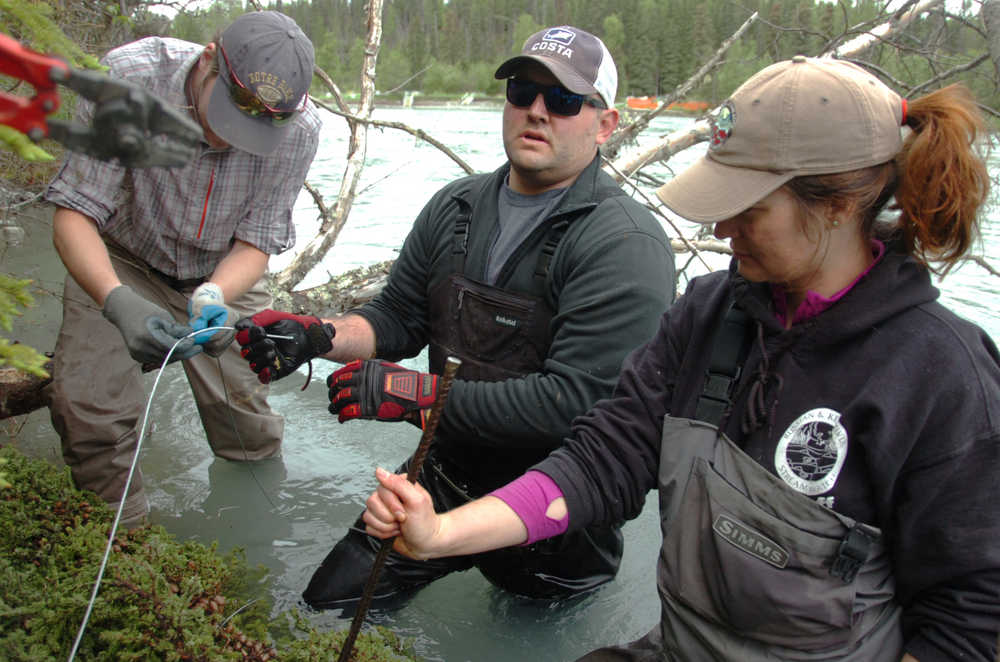
At 9 a.m on Saturday — a drizzly, overcast morning — Kenai Watershed Forum Stream Watch coordinator Lisa Beranek gathered 17 volunteers on a bank of the Kenai River past the end of Funny River Road. After about an hour of training, the volunteers began work: some in boots and waders and entered the stream, while others began moving a pile of black spruce trunks down the steep riverbank to the water’s edge. Their task was to install the spruce debris along the shoreline as a barrier to erosion and a habitat for young fish.
“The fancy-pants terminology for it is ‘spruce tree revetment,’” Beranek said. “Basically what we’re doing is mimicking nature. Plants are very important along the river corridor, both standing plants — whose roots hold the soil in place — and downed plants and trees.”
Steel cables attached to rebar driven into the riverbank will hold the spruce debris in place against the current, which the trees will deflect from the vulnerable soil of the bank. Beranek said the revetment will have short-term benefits for fish and long-term benefits for the riverbank.
First, the debris will slow the current and attract fish food.
Salmon swimming up the Cook Inlet and then the Kenai River can travel more than 80 miles.
“That’s pretty intense,” Beranek said. “It’s a big physical endeavor. So having backwater areas and slow water areas is pretty important to increasing their survival. So (the spruce debris) is creating some microclimate for them to have slow water.”
She said the revetted habitat has other advantages as well.
“It’s also good for them to have areas were they can tuck in and have protection from predators, whether they be birds, bears, other fish,” Beranek said. “And a food source is created there. You’re going to have bugs coming in to break those trees down.”
Over a longer period of time, the trees will capture silt from the river, building up the bank. Eventually they will form a fertile ledge where plants may sprout, laying a web of roots that will make the bank stronger.
Beranek said that spruce, as the region’s dominant native tree, was the best material for the project. Stream Watch purchased its spruce trunks from a forestry group that took them from a stand in need of thinning.
Stream Watch is a non-profit partner of the US Forest Service and the Kenai Watershed Forum.
It organizes volunteer river conservation projects. Beranek said that the property where Saturday’s work was done is a conservation easement owned by Kachemak Heritage Land Trust, which sought a revetment from Stream Watch because it was concerned about the silt their land contributed to the river.
Shortly after 1p.m., the volunteers had installed debris along 150 feet of the bank, completing the project. As they ate a lunch provided by the Kenai Chapter of Trout Unlimited, several of them examined another section of the property’s riverbank, which had been revetted years early in a similar project. Unlike the fresh green spruce that had just been put into the water, the older spruce was waterlogged and decaying. Trout fingerlings were visible among the bare remaining branches.
Lauren Sattely is a nurse from Anchorage who said she had come to the Peninsula to work on the project and to spend the rest of the weekend rafting. She had previously worked with Stream Watch in building fences, but hadn’t done shoreline revetment before. “It’s a change of scenery for me,” she said.
Andy Wakeman had met Beranek in the Kenai Peninsula Outdoor Club, and said he was recruited for Saturday’s work because Beranek “said she needed some muscle.”
“Better than watching TV, that’s for sure,” Wakeman said. “A lot of fishing’s closed right now. Might as well go and help the fish.”
The Stream Watch project is currently seeking more volunteers for future revetment and conservation work. It will have a volunteer orientation on June 27.
Reach Ben Boettger at ben.boettger@peninsulaclarion.com
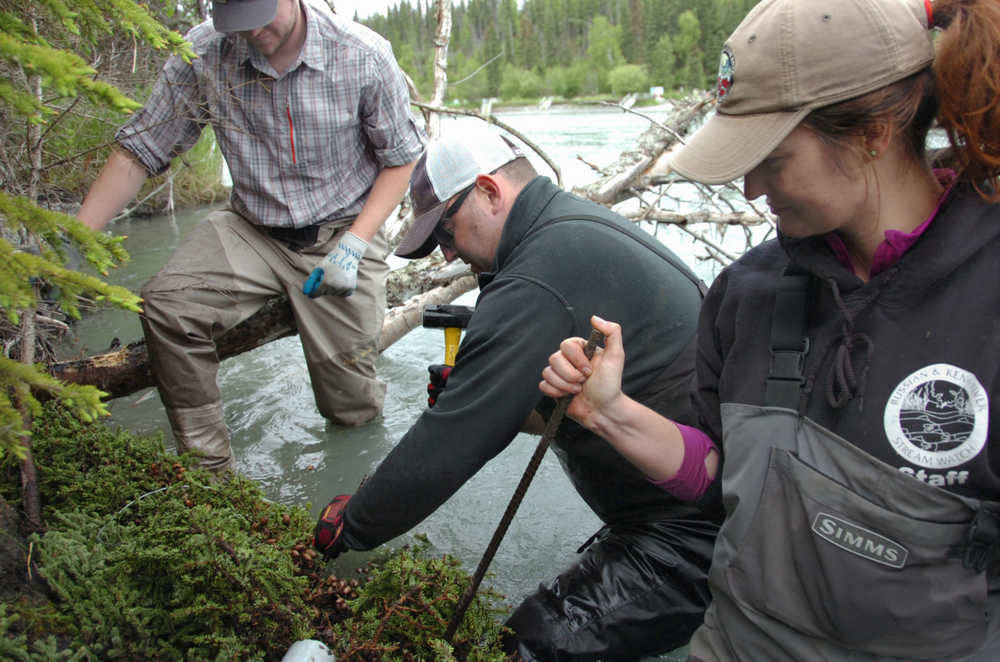
Ben Boettger/Peninsula Clarion Volunteer Andy Wakeman hammers an anchor into the riverbank with assistance from intern Grant Humpreys (right) and coordinator Lisa Beranek (left) of the Kenai Watershed Forum on Saturday on the shore of the Kenai River near the end of Funny River Road.
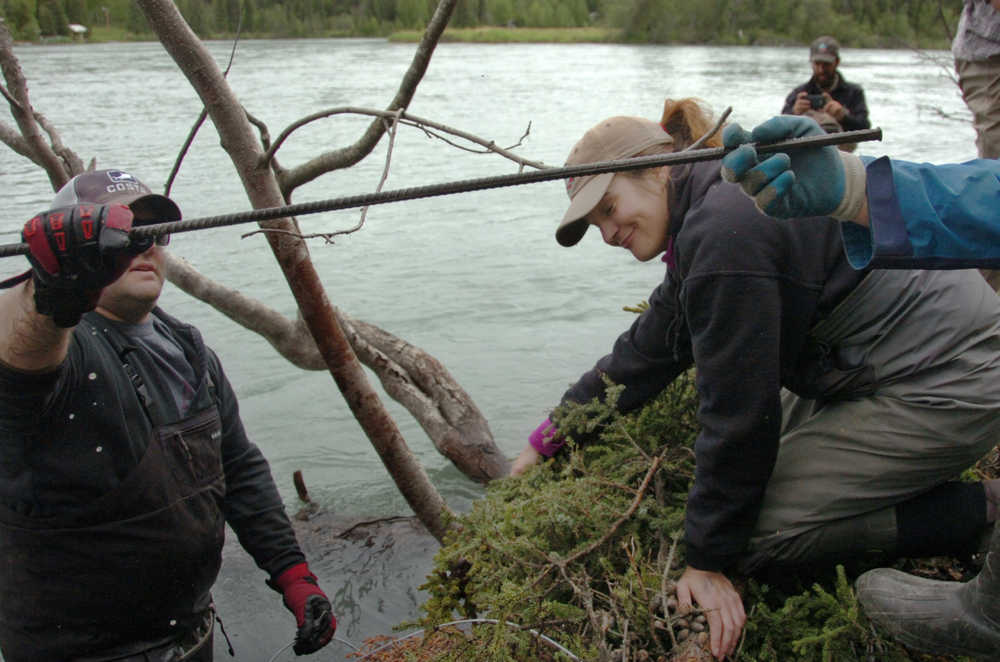
Ben Boettger/Peninsula Clarion Volunteer Andy Wakeman takes a segment of rebar used to anchor spruce debris to the shore while Kenai Watershed Forum coordinator Lisa Beranek holds the debris in place during the Streamwatch shorebank revetment on Saturday on the shore of the Kenai River near the end of Funny River Road.
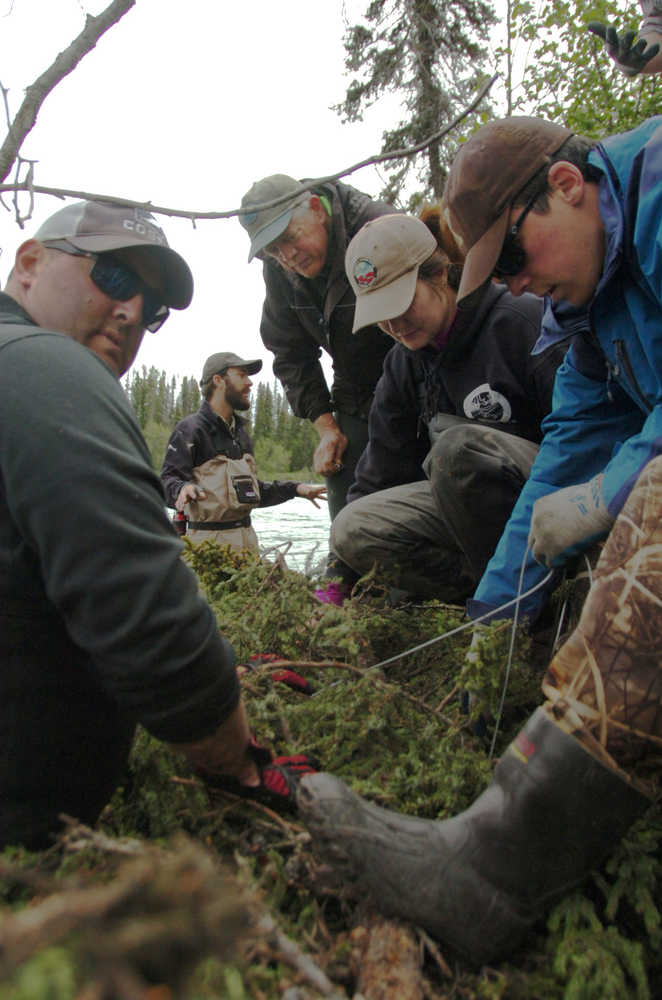
Ben Boettger/Peninsula Clarion Kenai Watershed Forum Environmental Specialist Jeff Sires (right, in blue) cables a cluster of black spruce trunks to the shore of the Kenai River during the Streamwatch shoreline revetment on Saturday on the Kenai riverbank near the end of Funny River Road.
