
By SUSAN
MONTOYA BRYAN
and FELICIA FONSECA
Associated Press
ALBUQUERQUE, N.M. — Nearly 40 law enforcement officials, tribal leaders, social workers and survivors of violence have been named to a federal commission tasked with helping improve how the government addresses a decadeslong crisis of missing and murdered Native Americans and Alaska Natives, U.S. Interior Secretary Deb Haaland announced Thursday.
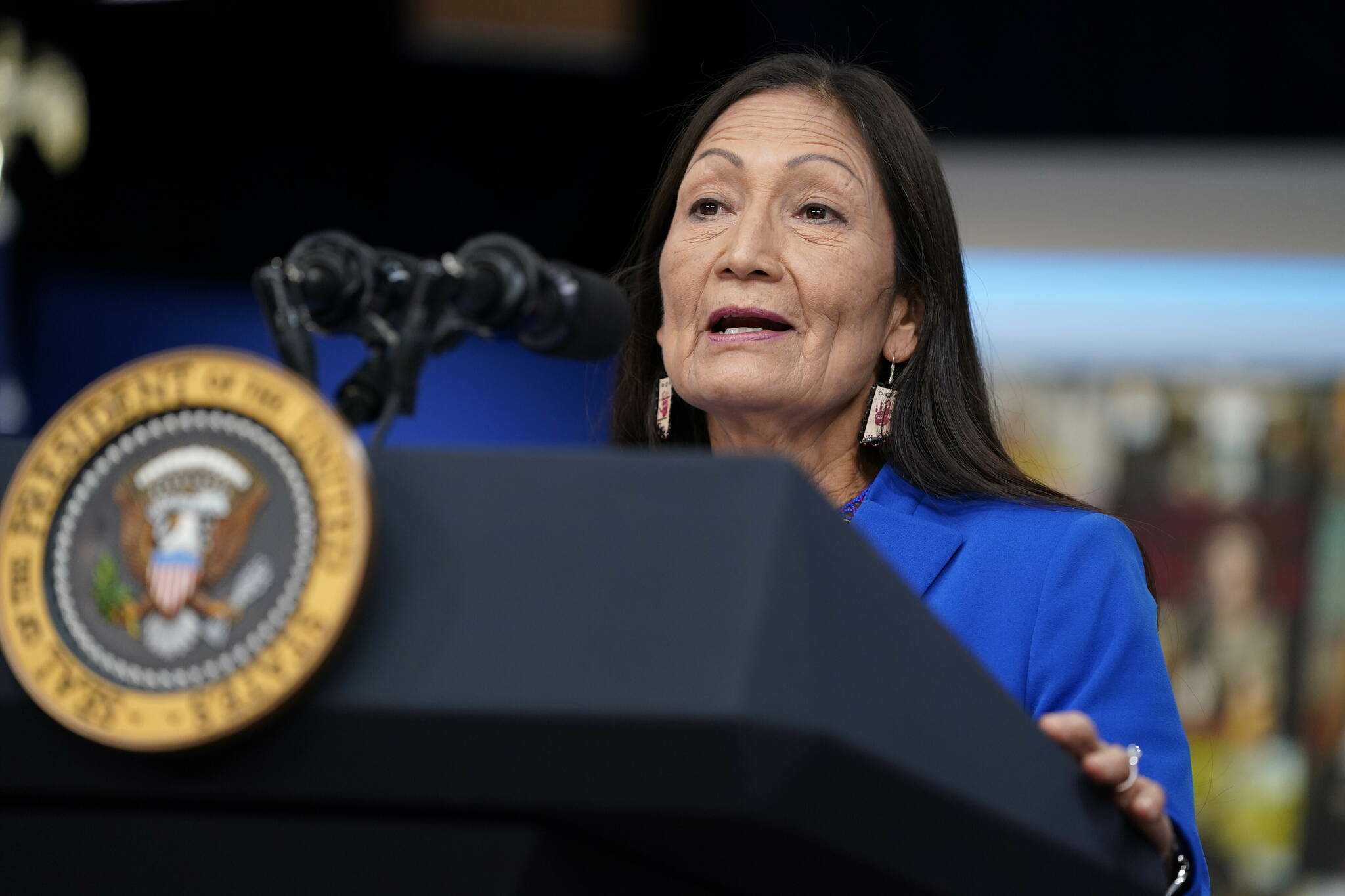
The committee’s creation means that for the first time, the voices guiding the Interior and Justice departments in the effort will include people most affected by the epidemic, said Haaland, the first Native American to lead a cabinet department.
She said the panel includes members with diverse experiences and backgrounds, representing communities from Alaska and Washington to Arizona, Oklahoma and Michigan. It will craft recommendations on how the government can better tackle a disproportionately high number of unsolved cases in which Native Americans and Alaska Natives have disappeared or been killed.
“It will take a focused effort — and time — to unravel the many threads that contribute to the alarming rates of these cases,” Haaland said during a virtual event.
Some members of Congress have expressed concern that work to address the crisis as required under the law isn’t on track. In the case of appointing members to the commission, federal officials are more than a year behind schedule.
The Not Invisible Act, signed into law in October 2020, required that the commission be named by February 2021 and that findings be made public last month.
Another law signed around the same time directed the U.S. Attorney General’s Office to find ways to increase cooperation among law enforcement agencies, provide tribes resources and address data collection. Savanna’s Act was named for 22-year-old Savanna LaFontaine-Greywind, who went missing while pregnant in 2017 before her body was found in a North Dakota River.
U.S. Sens. Catherine Cortez Masto of Nevada, who faces a tough reelection campaign; Jon Tester of Montana; and Lisa Murkowski of Alaska, the vice-chair of the Senate Indian Affairs Committee, outlined their concerns in a letter earlier this week.
“Both of these laws outlined specific time frames and deadlines for implementation; however, it is unclear which provisions have been undertaken, and it appears that almost every deadline has been missed,” the lawmakers wrote.
Deputy U.S. Attorney General Lisa Monaco said Thursday the naming of the commission marks a major milestone that follows ongoing work by a separate steering committee to marshal more federal resources to address the problem.
She also announced the creation of a new position within the executive office of U.S. attorneys that will be responsible for working with victims and families to ensure they have a voice while navigating the criminal justice system.
Federal officials also plugged work being done by the FBI and the Bureau of Indian Affairs, which now has 17 offices across the country that have at least one agent dedicated to solving casing involving missing or slain Native Americans.
As for the 37-member commission, its mission includes tracking and reporting data on missing-person, homicide and human trafficking cases and increasing information sharing with tribal governments on violent crimes investigations and other prosecutions on Indian lands.
The commission is expected to hold hearings and gather testimony before making recommendations to the Interior and Justice departments to improve coordination among agencies and to establish best practices for state, tribal and federal law enforcement. The panel also is tasked with boosting resources for survivors and victims’ families.
Meanwhile, some communities already have created their own response plans to address the problem. In New Mexico, officials on Thursday rolled out the state’s plan, highlighting goals that include building more support services for survivors and families, doing more outreach on education and prevention and leveraging resources for tribal judicial systems.
Fawn Sharp, president of the tribal advocacy group National Congress of American Indians, said during Thursday’s virtual event that although funding for law enforcement in Indian Country has increased in recent years, it doesn’t come close to meeting the needs.
She pointed to research showing that failure to provide funding undermined the ability to provide adequate public safety in tribal communities.
“Having the authority to hold perpetrators accountable is an important first step, but tribal nations cannot follow through to hold bad actors accountable without adequate and consistent funding for tribal justice systems,” she said.
Other advocates said they were hopeful the federal commission’s recommendations will cover the need for safe housing for victims of domestic violence and other social services and health care that could help prevent violence.
