
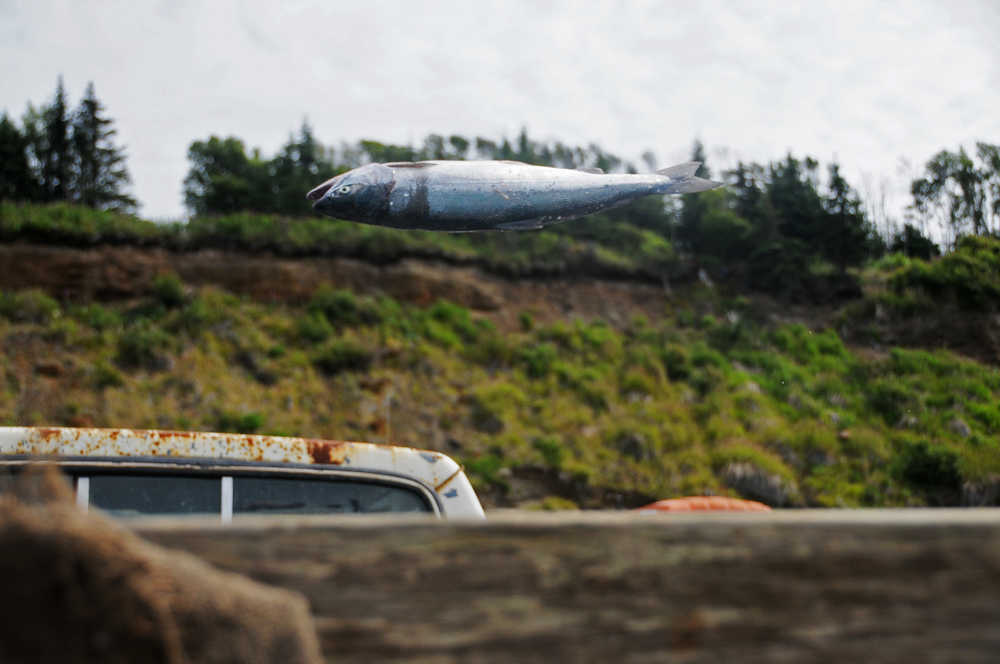
The boom of fish the commercial operations in Upper Cook Inlet expected never arrived this year.
High preseason expectations made the 2016 season a disappointment for many commercial fishermen. The Alaska Department of Fish and Game originally projected about 7.1 million sockeye salmon to return to the Upper Cook Inlet streams, but by Wednesday, only 5.2 million had.
The harvest of approximately 3,023,462 million fish wasn’t the lowest in the last decade — 2009 and 2006 both had lower harvests, with approximately 2.5 million and 2.9 million fish harvested, respectively. Altogether, the commercial fishery has harvested 2,382,167 sockeye salmon and 379,064 pinks, the two most populous species commercial fishermen harvest, as of Aug. 22. They also caught 127,971 coho, 124,648 chum and 9,612 king salmon, according to Fish and Game data.
So far, it looks like two ages of sockeye salmon — the 4- and 5-year-olds — had a hard time making it back this year, said Pat Shields, area management biologist for the Division of Commercial Fisheries in Soldotna.
“Conditions in the ocean environment appear to have been unfavorable to the 4-year-olds and 5-year-olds,” he said.
While the Kenai River’s run was middle-sized, the Kasilof saw one of its lowest returns, Shields said. While Fish and Game had originally predicted about 861,000 sockeye salmon to return to the system, which was about 13 percent lower than the 10-year average. Only about 560,000 sockeye showed up, a little more than half of the average yearly return since 2000.
“The average run since 2000 has been about 1.1 million (sockeye salmon),” Shields said. “The folks in the Kasilof section had a pretty poor year.”
The run just didn’t live up to expectations, said Erik Huebsch, a Cook Inlet drift fisherman.
“The fish looked normal — they were really healthy looking, as opposed to last year,” he said. “There just wasn’t really enough of them.”
The prevailing theory for the low harvest in the drift fleet is that the fish are swimming deeper than they usually do and are more spread out, passing beneath the nets. Shields said the boats’ fish finders and the trend of fish hitting the nets lower in the mesh than they have in past years support the depth theory.
For the second year, the fish appeared more spread out as well, he said.
“They’re spreading out deeper and more east and west than they usually are,” Shields said.
Success in the East Side setnet fishery was mixed. Early in the season, setnetters in the Kenai and East Forelands districts reported good fishing and healthy fish, while setnetters in the Kasilof sections said the catch was weak, though they hoped it would pick up.
It never did. By late July, setnetters in the Kasilof section had only harvested a fraction of what they usually take. Comparatively, the setnetters in the Kenai and East Forelands sections did better. Shields said it seems the fish circulated further north before entering the Kenai River.
“That’s normal — they always do that, but more of them did it than usual, and we do not know why,” Shields said. “It could be ocean conditions, salinity, but something caused them to swim by the Kenai and swing back around to come back to the Kenai.”
It’s hard to say what caused the run to fall below projections. Right now, the only thing Fish and Game managers can surmise is that ocean conditions made survival less than ideal for those two age classes of sockeye salmon, Shields said. Without the resources to do more ocean research, that’s the best explanation Fish and Game has right now, he said.
At the same time, Fish and Game exceeded one of its sockeye salmon escapement goals for the Kenai River. As of Aug. 19, the last day of counts, 1,381,929 sockeye had passed the sonar at river mile 19. The inriver goal in the Kenai River for sockeye salmon ranges from 1.1 million to 1.35 million sockeye salmon.
The department didn’t exceed the goal by much — only about 31,000 fish — and that does not take into account the harvest above the sonar, Shields said. While Fish and Game technically surpassed that particular goal on the Kenai River, it likely does not mean there will be significant stock consequences for the sockeye on the Kenai.
There are also five goals for sockeye salmon on the Kenai — two different inriver goals based on the run size, the Sustainable Escapement Goal, the Optimum Escapement Goal and the Biological Escapement Goal.
The Optimum Escapement Goal runs up to 1.4 million, while the upper end of the biological escapement goal falls at 900,000 fish. Overescapement depends on the goal being referred to, Shields said.
In general, managers met all of the sockeye salmon escapement goals for the stream systems in Upper Cook Inlet this year, he said. They are still waiting to get the video data from Packers Lake on Kalgin Island, but the other numbers look good, he said.
“It most likely exceeded the goal at Chelatna Lake, we met the goal at Fish Creek, and we don’t know yet about Packers Lake until we get the video,” he said. “We don’t know yet about Larson Lake. We’re doing a pretty good job about making our goals this year.”
Huebsch said he was concerned about overescapement on the rivers for the past several years. Fish and Game exceeded its inriver goal by more than 350,000 fish in 2015 and by about 174,000 in 2014, according to the sonar counts. He said Board of Fisheries policies have restricted Fish and Game from being able to use the commercial fishery to control escapement ideally.
“We have to harvest the fish when they’re here,” he said. “If the fish go by, you can’t unescape them. If we’re not allowed to harvest the fish on the run here, then you go over the goal, and you can’t fix it at that point.”
Shields said one reason for the elevated escapement while the commercial fleet did not harvest as many sockeye as they might have is that for most of the season, department staff was managing for the higher forecasted run. By the time the managers recognized that the run would come in lower, most of the season was gone, he said.
The Division of Commercial Fisheries staff will be uploading data from fish tickets taken throughout the season for the next several months, which will provide them with poundage.
Commercial fishermen and sportfishermen alike have been reporting exceptionally large pink salmon all season, but biologists won’t be able to confirm a trend until they look at the data from the commercial poundage, Shields said. The same goes for the anecdotal reports of heavier sockeye salmon.
Reach Elizabeth Earl at elizabeth.earl@peninsulaclarion.com.
