
The Alaska Senate passed a bill Friday to formally recognize the state’s 229 federally recognized Alaska Native tribes, moving the state closer to a goal many said is long overdue.
“Hopefully we will embark upon a path we can go forward with unity,” said Sen. Lyman Hoffman, D-Bethel, the sponsor of House Bill 123 in the Senate.
“Passage of this Act is nothing more or less than a recognition of tribes’ unique role in the state’s past, present, and future,” HB 123 says.
The bill establishes that the state recognizes the special and unique relationship between the U.S. government and federally recognized tribes in the state. According to the bill, the state is to recognize all tribes in the state that are federally recognized under federal law, but also states nothing in the bill, “diminishes the U.S. government’s trust responsibility or other obligations to federally recognized tribes in the state or creates a concurrent trust relationship between the state and federally recognized tribes.”
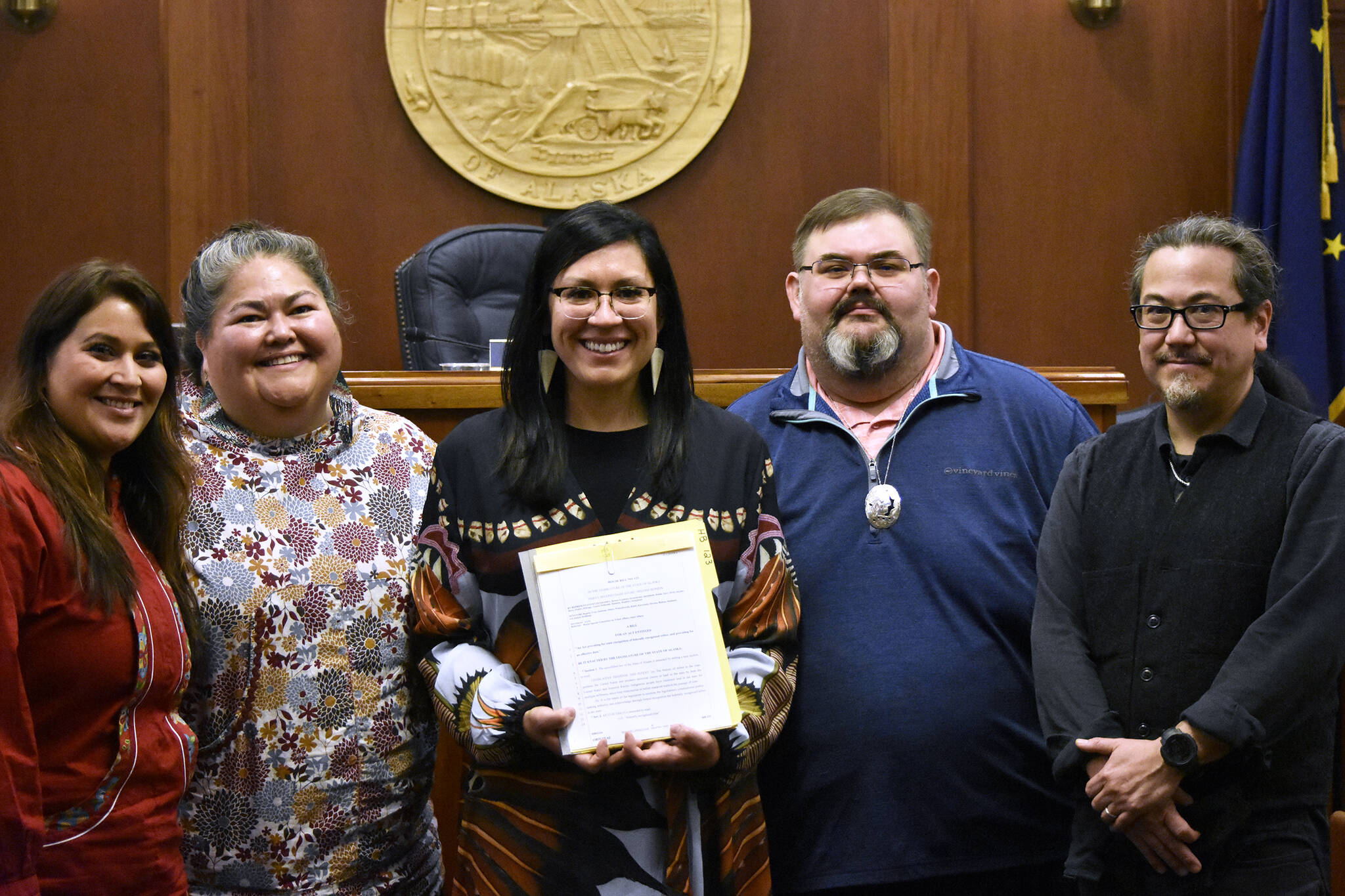
From left to right, ‘Wáahlaal Gidáak Barbara Blake, La quen náay Liz Medicine Crow, Rep. Tiffany Zulkowsky, D-Bethel; Richard Chalyee Éesh Peterson and Joe Nelson on Friday, May 13, 2022, pose with the text of House Bill 123, a bill sponsored by Zulkosky to have the state formally recognize Alaska’s 229 federally-recognized tribes. (Peter Segall / Juneau Empire)
Similar bills have been before the Legislature before, and the Alaska House of Representatives passed an earlier version of the bill in 2020, but that legislative session was cut short by the COVID-19 pandemic. The bill was picked up again in 2021 by Rep. Tiffany Zulkosky, D-Bethel, who helped guide the bill through the House in that year.
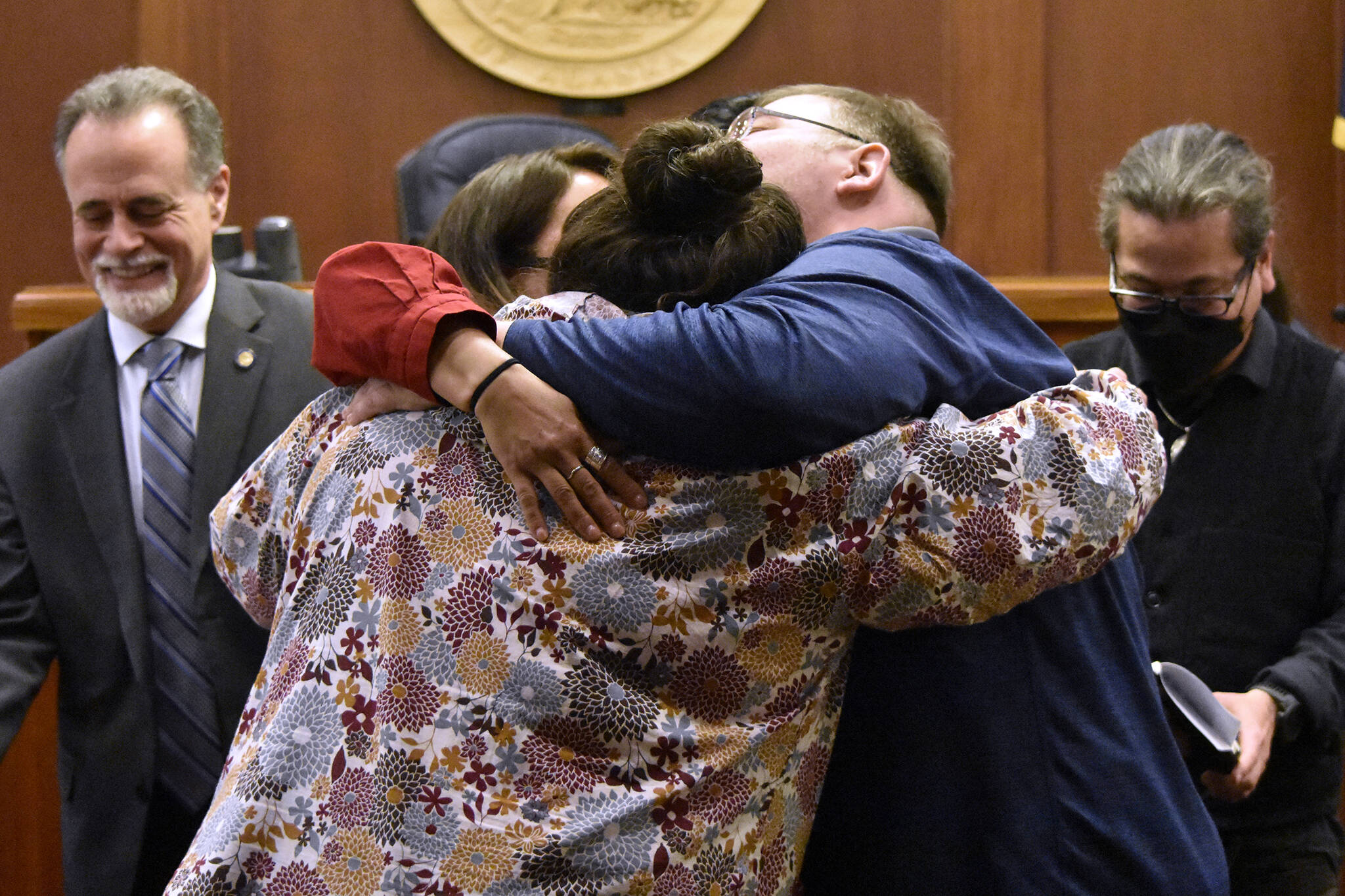
But there was less confidence the bill would be able to make it through the Senate, and in the interim supporters of tribal sovereignty organized to have a ballot initiative in the November 2022 election with language almost identical to the bill. Members of that organization — Alaskans for Better Government — were in the Senate gallery Friday, and embraced when the bill was passed.
“Thankfully, I think the Legislature did their job and we don’t have to leave it to the voice of our citizens,” said Richard Chalyee Éesh Peterson, president of the Central Council of Tlingit and Haida Indian Tribes of Alaska and chairperson of Alaskans for Better Government.
[With thin margins in the House, floor debate is delayed]
The campaign submitted more than 56,000 signatures in support of the ballot initiative, well above the 36,140 required by the Alaska Division of Elections. At the time, ‘Wáahlaal Gidáak Barbara Blake, one of Alaskans for Better Government’s sponsors and a City and Borough of Juneau Assembly member, told the Empire the large number of signatures was evidence of how much support there was for tribal sovereignty.
Blake was in the Senate gallery Friday, as were Alaskans for Better Government members La quen náay Liz Medicine Crow, president of First Alaskans Institute, and Joe Nelson, co-chair of the Alaska Federation of Natives Board of Directors and chairman of the Sealaska Corp. board of directors.
Following Friday’s Senate session, members of the campaign hugged and took pictures with lawmakers on the Senate floor.
“Now the work begins,” Medicine Crow said. “It’s a long time coming.”
The state and tribal entities already work together in many areas including education, health care and the justice systems. But with formal recognition, Medicine Crow said there are new options available for the state and tribal governments to develop their relationships.
Speaking with reporters after the vote, Peterson said he believed the ballot initiative would have been successful.
“Alaskans believe this was already done, they didn’t know this needed to be done and were kind of shocked by that,” Peterson said.
The campaign group would meet later Friday, Peterson said, but if the bill is signed by the governor, the ballot initiative will be unnecessary.
Several of the senators — both Republicans and Democrats — who spoke in support of the bill said the move was long overdue, and expressed regret it had taken the state so long. Sen. Bert Stedman, R-Sitka, said local governments in Sitka had worked with the local tribal governments for years, and that the state was “a little late in the day.”
“This is about respect, this is about dignity,” said Sen. Tom Begich, D-Anchorage.
Sen. Mike Shower, R-Wasilla, chairman of the Senate State Affairs Committee where the bill was amended, said there was a lot of misunderstanding around the role and the history of tribal governments. Shower said critics of the bill argued having the state recognize tribal governments would undermine the State of Alaska’s own sovereignty, and make it more difficult for the state to govern itself.
“There was a lot of mistrust on both sides of the issue,” Shower said. “This is not going to unravel the state; this is about how do we step forward from where we are.”
The bill was amended in the Senate State Affairs Committee and will need to go back to the House for a concurrence vote. Once out of the Legislature the bill will go to Gov. Mike Dunleavy for signing.
In an email, Dunleavy spokesperson Jeff Turner said it’s the governor’s policy not to take a position on a bill until it reaches his desk.
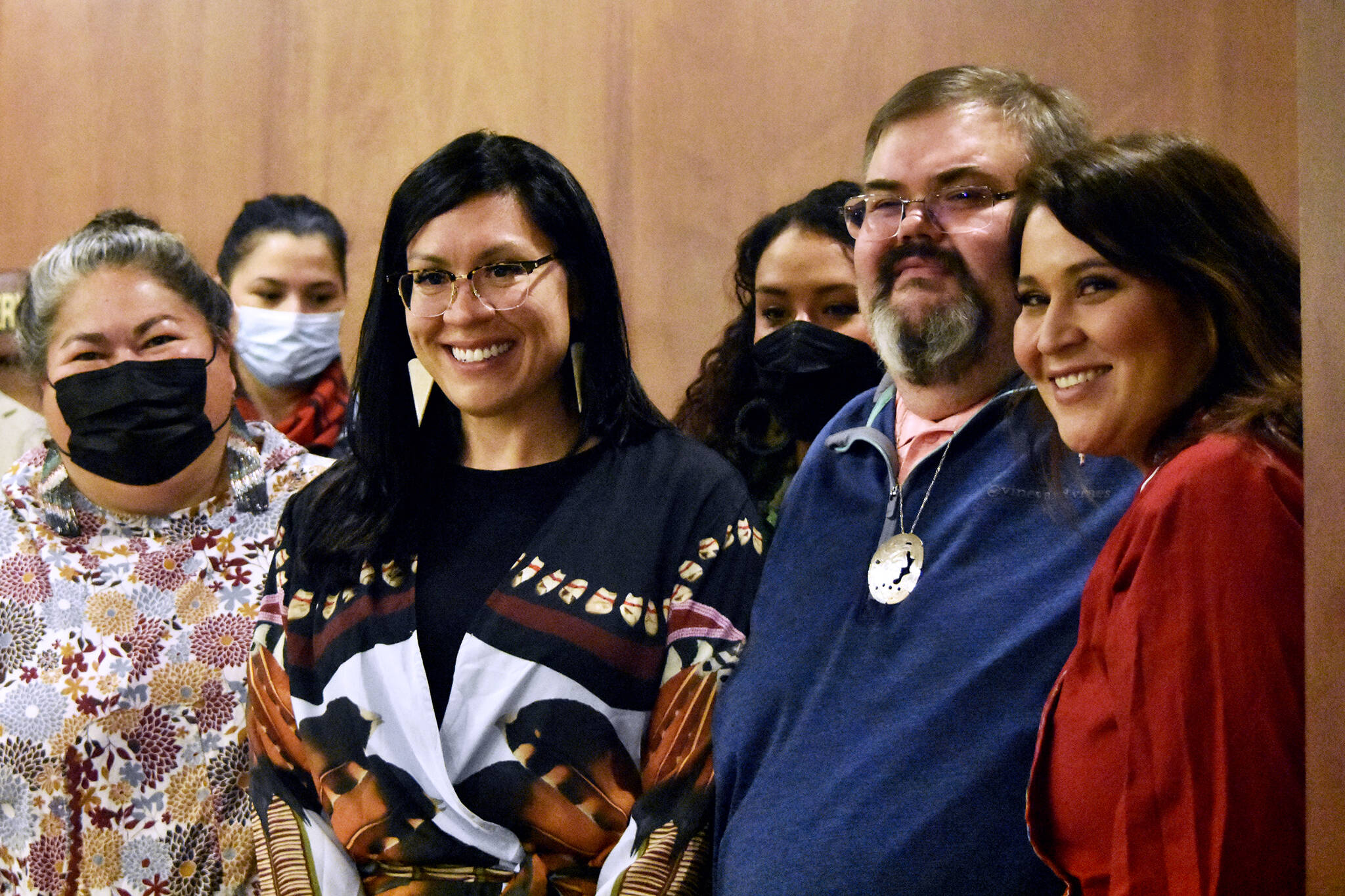
From left to right, La quen náay Liz Medicine Crow, Rep. Tiffany Zulkosky, D-Bethel; Richard Chalyee Éesh Peterson and ‘Wáahlaal Gidáak Barbara Blake were in the gallery of the Alaska State Senate on Friday, May 13, 2022, to watch debate on House Bill 123, a bill to formally recognize Alaska’s federally-recognized tribes. The bill bassed unanimously. (Peter Segall / Juneau Empire)
The bill passed the Senate 15-0, with five absences from the Senate, four of whom — Sens. Elvi Gray-Jackson, D-Anchorage; Donny Olson, D-Golovin; Josh Revak, R-Anchorage, and Natasha von Imhof, R-Anchorage — were listed as co-sponsors of the bill. Before the bill was heard on the floor Friday, it had 12 sponsors in the Senate, which represented more than enough votes to pass. On the floor, the bill picked up an additional three sponsors for a total of 15 out of 20 Senators.
Sen. Lora Reinbold, R-Eagle River, was absent from the Senate Friday, but was in the Senate chamber immediately following the floor session.
The House still needs to concur on the bill, but has been stalled in negotiations over the state’s budget bill since Wednesday. Friday afternoon a House floor session was scheduled for 10 a.m. Saturday morning, with 11 bills already on the calendar not including HB 123. The House has scheduled, then delayed and canceled several floor sessions already this week, as budget negotiations continue. The end of the Legislative session is May 18. If the bill is not passed this session, it must begin the entire legislative process again.
Contact reporter Peter Segall at psegall@juneauempire.com. Follow him on Twitter at @SegallJnuEmpire.
