
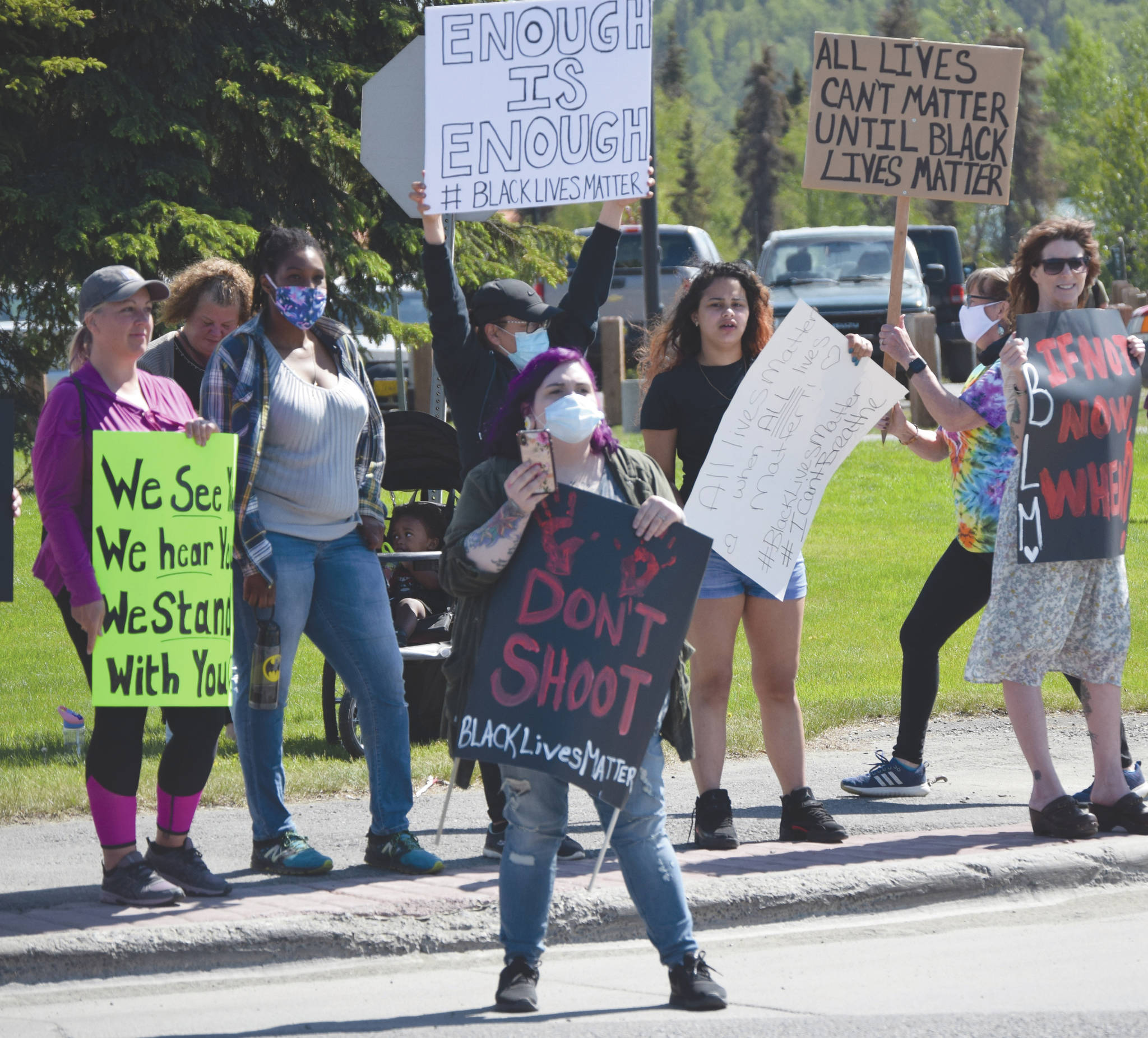
A Black Lives Matter protest Saturday in Soldotna Creek Park surprised organizers by drawing about 500 to listen to speeches, carry signs and shout chants.
“When I put it together, I thought it would be like 20 people,” said Faith Borromeo, 28, who has been in Alaska since she was 8. “I’m just somebody who works at a grocery store. I didn’t think my voice would carry this far.”
Black Lives Matter protests have spread across the country, across the world and across Alaska since the death of 46-year-old George Floyd in police custody in Minneapolis on May 25.
Borromeo said she is Mexican and Native American and has dealt with racism here. After announcing the protest on social media, Borromeo said she faced harassment and some threats, but that wasn’t going to stop her.
“After seeing the George Floyd video, I couldn’t take it anymore,” she said. “This has to stop. I saw the peaceful protest in Anchorage and wanted to do something.”
The nonviolent Soldotna protest started with an hour of speeches from about 10 speakers in Soldotna Creek Park, then protesters lined the Sterling Highway from Birch Street to auto dealer Kendall DCJR of Soldotna, gradually thinning out over the course of a few hours. While lining the highway, sign-waving protesters chanted “I can’t breathe” and “Black Lives Matter.”
Michele Vasquez, one of the speakers, said she has attended many protests since coming to Soldotna 10 years ago. The most well-attended event she’d seen in the past — the Women’s March in January 2017 — drew about 325 people. But Saturday the count along the Sterling Highway was 483, she said.
“I am so thankful to see so many young people,” she said. “That thrills this old heart to death.
“This has totally galvanized young people. They care about inequality and justice. People have to pay attention, especially the politicians. These people will vote.”
Many of the nationwide protests have been peaceful, but some led to looting, riots, fires and violence by police and protesters.
Shanette Jackson, who has lived in Kenai since 2008, spoke first and said she is happy to live in a community where images like those from the Lower 48 aren’t happening. The Soldotna Police had a modest presence at the event, with an officer walking through the park and police vehicles driving by on the Sterling Highway from time to time.
“We’re fortunate to live in a place where racism isn’t blatantly in our face every day,” Jackson said. “That doesn’t mean it doesn’t exist.”
Even living on the central peninsula, Jackson said she has had to have conversations with her son and daughter about precautions they need to take due to their race. She asked the crowd for empathy — to think about what it would be like to have those conversations with children.
Hannah Warren came here from Peru in 1987. She said she has faced racism since she was younger than her 9-year-old son. She’s happy the area has grown more diverse.
“I’m so happy this generation has it because we needed it bad,” Warren said.
Even with more diversity, problems persist.
“I debated bringing my son,” Warren said. “I was scared because of comments I saw on Facebook.”
She brought her son because she wants him to see all those who stand with him.
Warren said she has been told that if she doesn’t like the way minorities are treated on the central peninsula, she can leave.
“I’m not going anywhere,” she said to cheers from the crowd.
Jazmine Henry, who came to the peninsula when she was 7, gave more examples of racism. She said a teacher once told her, “You have that beautiful mulatto complexion.”
She said she was too young at the time to fully understand the implications of that comment, but as she grew older, she started to wonder, “What if I was dark like my father? Would you feel the same way?”
Growing up on the central peninsula, Henry said she felt alone a lot of the time. When George Zimmerman was acquitted for the shooting of Trayvon Martin, Henry said she had trouble convincing her classmates why that was important.
Alberta Cole spent 24 years in the military, where she said her skin color didn’t matter. That changed last year, when she retired and moved to Alaska, where she said racism is very much alive. She said it’s not enough to turn and look the other way when seeing racism.
“When you see something, say something,” she said.
Adam Swan is an Alaska Native who grew up on the central peninsula and moved to Tacoma, Washington, when he was 11. There Swan made some black friends and was shocked when something like a drive to Safeway would invoke fear in them.
Swan has had cerebral palsy since birth. He said no matter how hard he studies, cooks or cleans, he is still judged by physical shaking when he goes in public.
“There’s still some idiot out there, when he sees me shaking, he’s like, ‘You’re dumb,’” Swan said.
Swan wanted to emphasize that he’s not equating being black to having cerebral palsy. He said his point is people have to take the time to delve below physical appearance.
“We have to listen, to understand,” he said.
Azrael Gabriel said that responsibility to listen, understand and learn rests with white people. Gabriel grew up spending half his time in Detroit, where he was the only white kid in the trailer park, and half his time on the predominately white central peninsula.
Living in such different situations showed Gabriel that too many times people think the responsibility for education on systemic racism falls to people of color. He emphasized the responsibility lies with white people, not people of color.
“We need to take this energy home to our families, especially if we are white,” Gabriel said.
Peggy Mullen also took the stage to tell the crowd about the plight of Alaska Natives, who cared for this land before whites arrived.
“Many of us turned hatred of blacks into hatred of Natives,” she said.
In addition to talking about education, understanding and not standing idly by when witnessing racism, organizers and speakers focused on voting. The only politician to address the crowd was Paul Dale, a Nikiski resident and candidate for House District 29.
Cheryl Carattini of Kenai, a speaker who has Hispanic and American Indian children and black, Hispanic and American Indian grandchildren, said the rally was inspiring, but only a start.
“My heart is so full,” she said as the rally wound down. “When I watched these people come in I got so emotional I cried. I’m so thankful to everyone who is here.”
Editor’s note: This story corrects a previous version that had the country from which Hannah Warren came to Alaska incorrect.
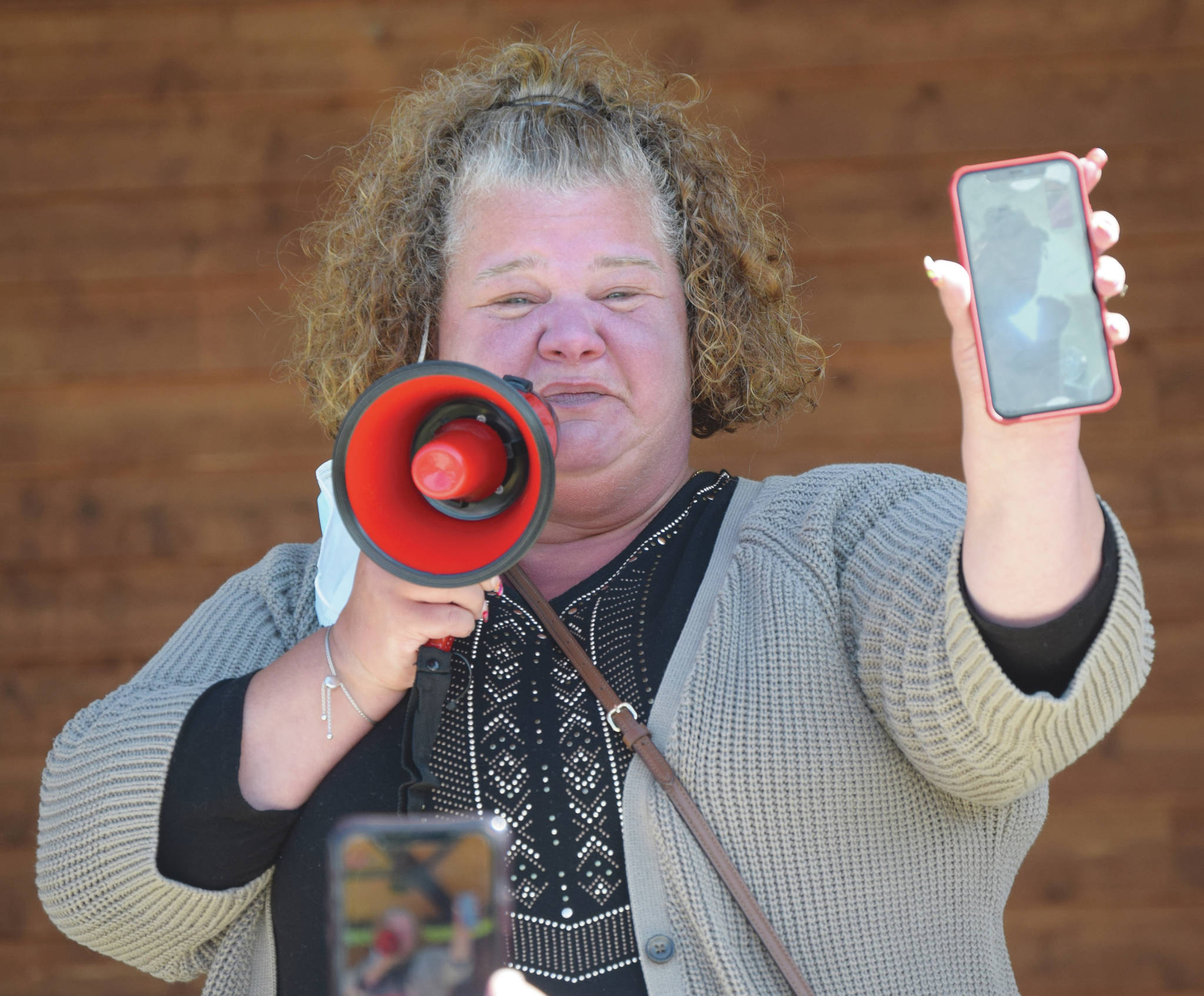
Cheryl Carattini speaks at the Black Lives Matter protest in Soldotna Creek Park on Saturday, May 6, 2020, in Soldotna, Alaska. Carattini used her smartphone so family members that were not present could see the crowd. (Photo by Jeff Helminiak/Peninsula Clarion)
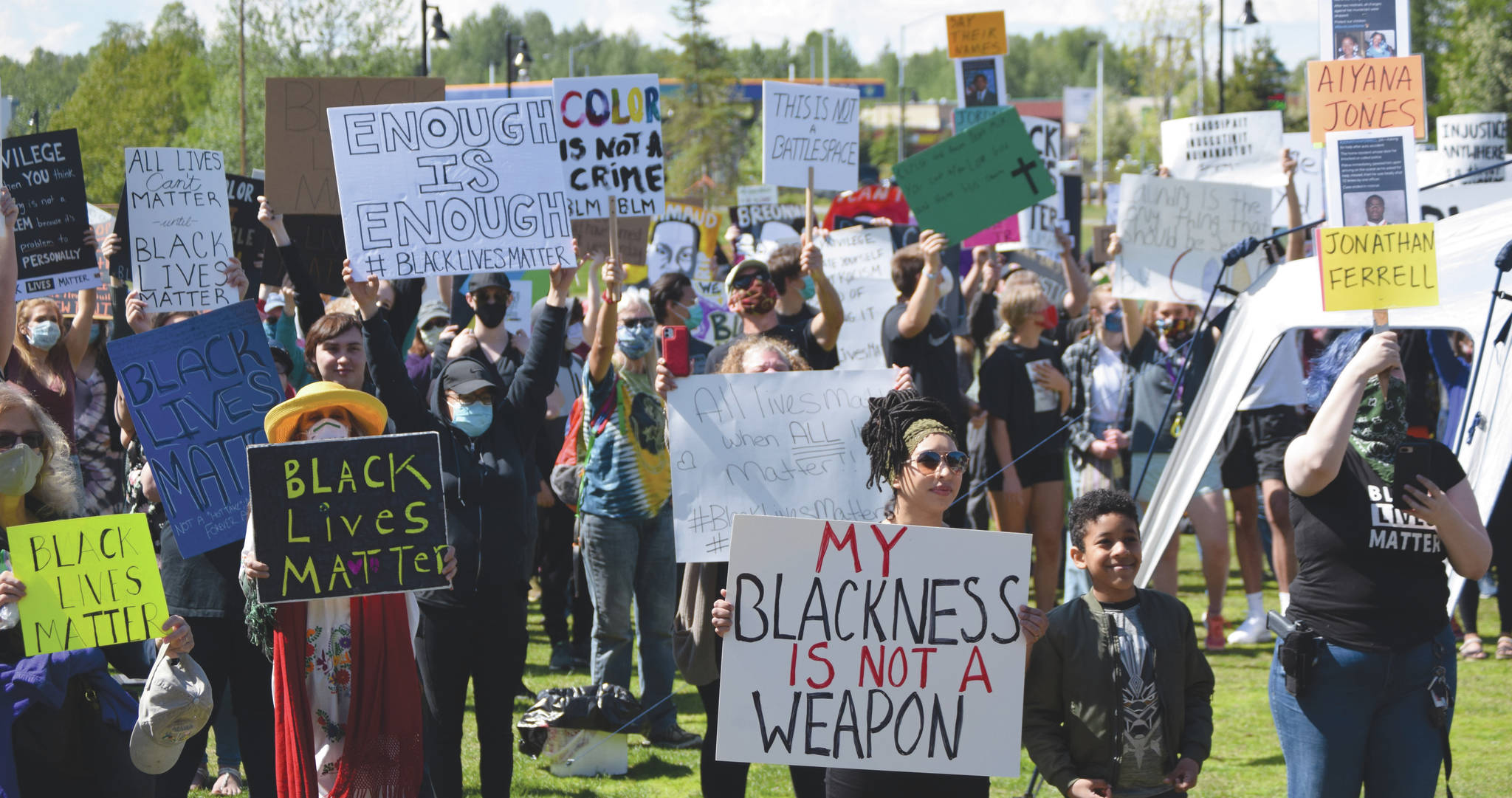
Photo by Jeff Helminiak/Peninsula Clarion Black Lives Matter protesters hold up signs at Soldotna Creek Park in Soldotna on Saturday. Front and center is speaker Hannah Warren with her son. She said she debated not bringing her son due to threatening comments the protest drew on Facebook, but wanted him to see everyone who stands with him.
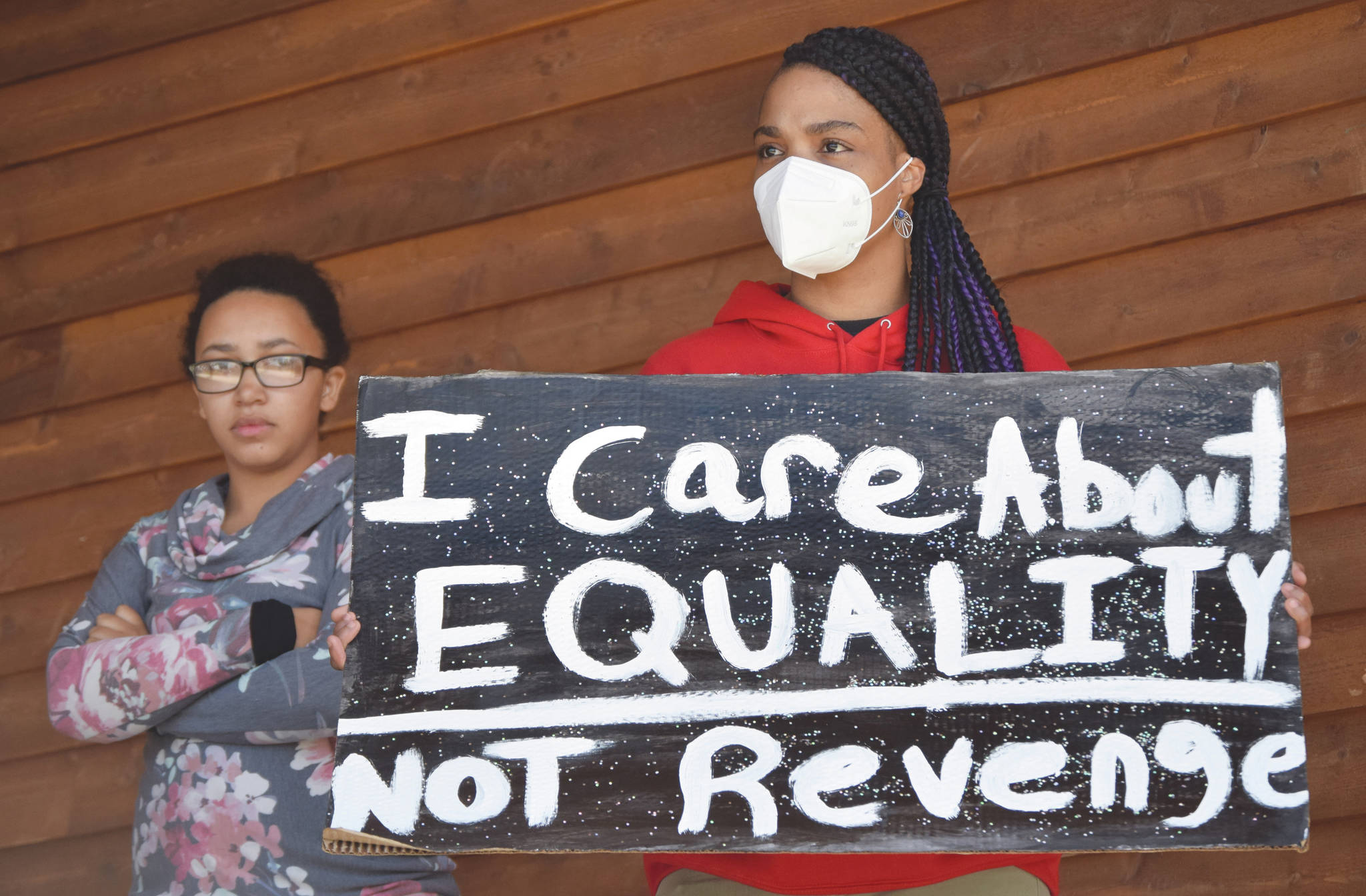
Photo by Jeff Helminiak/Peninsula Clarion Speakers Jazmine Henry and Shanette Jackson wait onstage at the Black Lives Matter protest at Soldotna Creek Park in Soldotna, on Saturday.
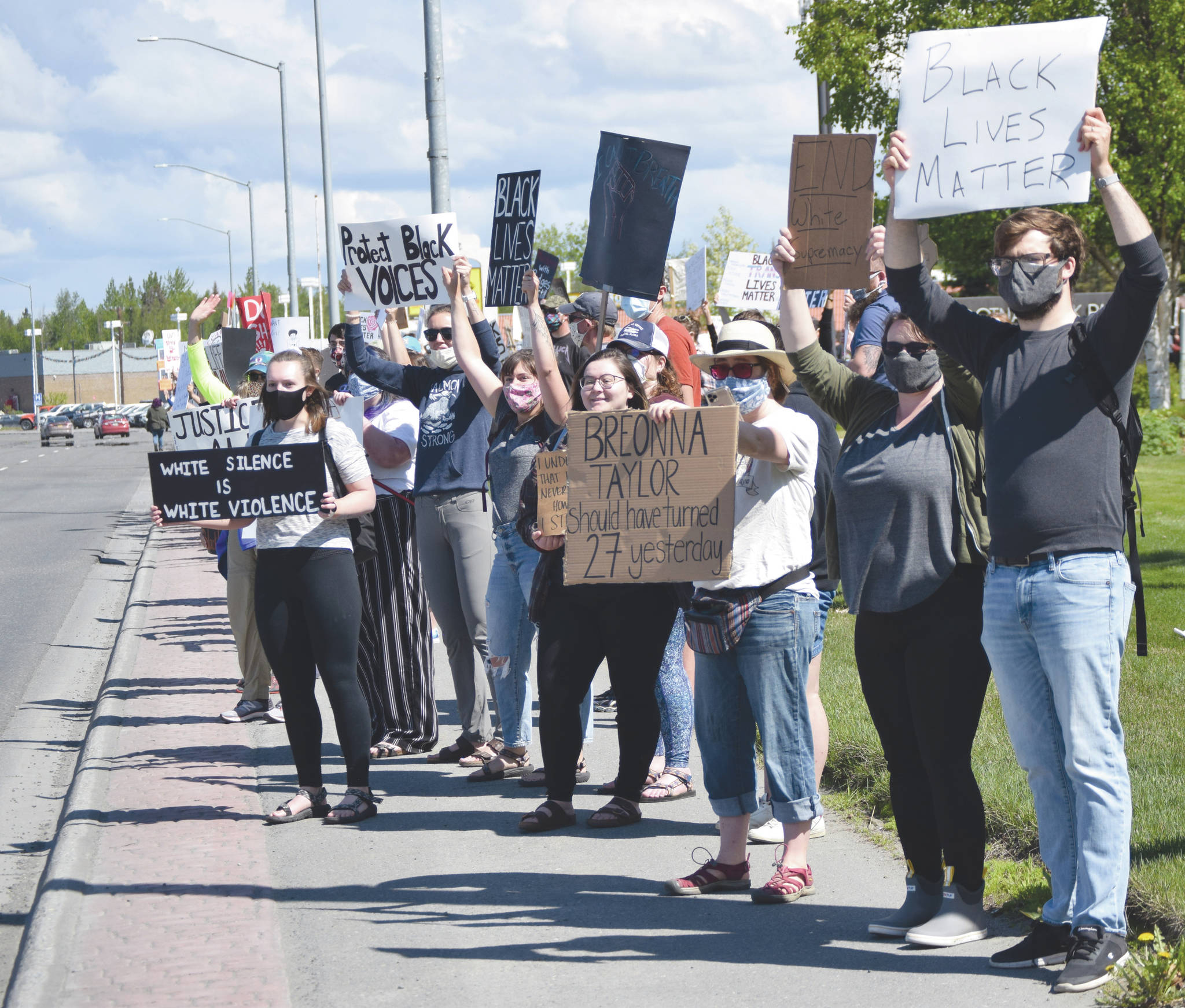
Photo by Jeff Helminiak/Peninsula Clarion Black Lives Matter protesters line the Sterling Highway in Soldotna, on Saturday.
