By Yereth Rosen
Alaska Beacon
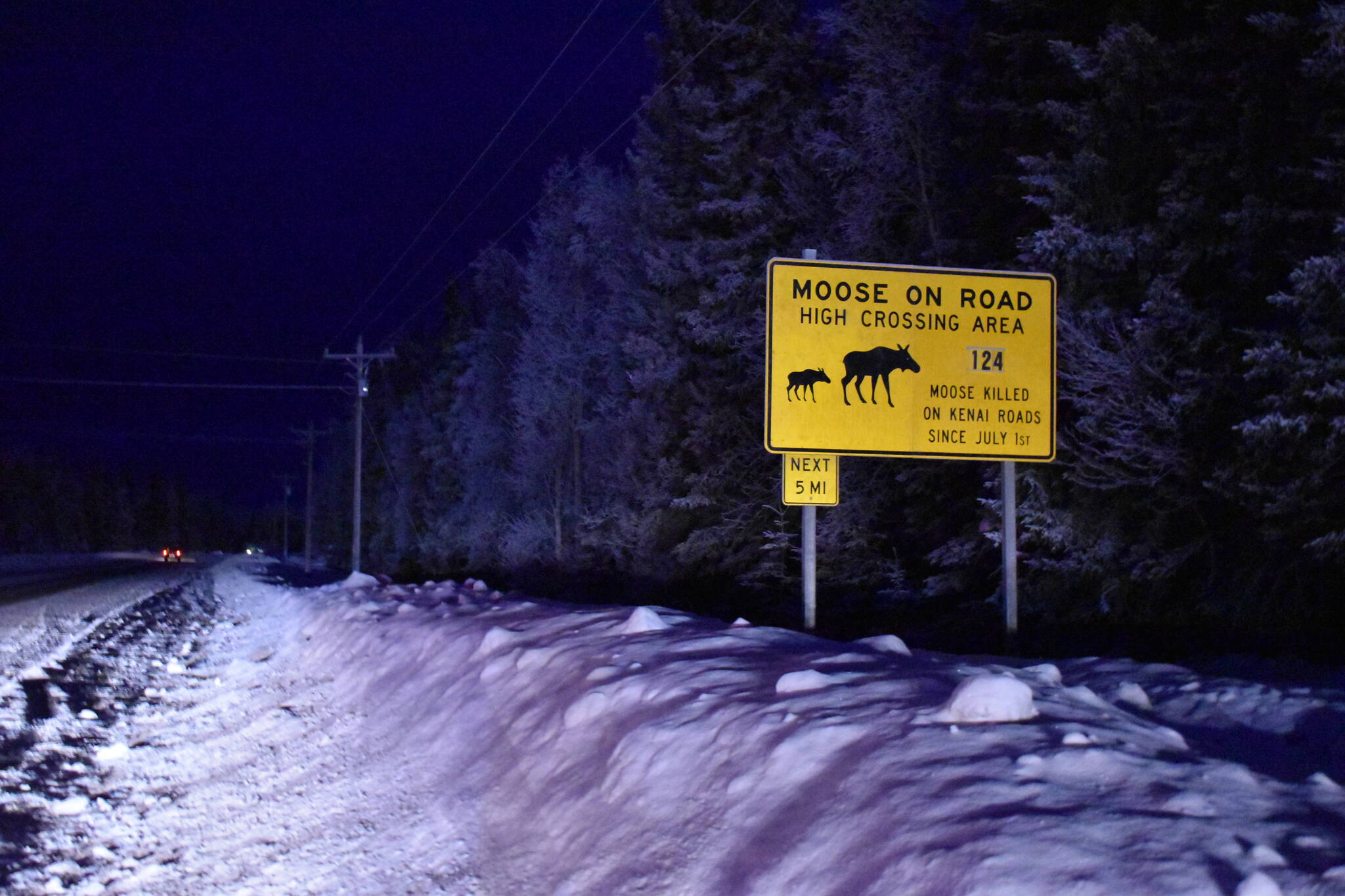
Moose-vehicle collisions are a constant problem in Alaska. Each year, there are probably more than 800 such collisions in the state, though many go unreported, according to Alaska Department of Fish and Game estimates.
Now a new study has quantified collisions and produced statistical analysis that might help motorists and transportation managers better plan around risks.
The study, published in the journal Environmental Research Letters, analyzes the relationships between moose movements, snowpack and traffic patterns in Alaska and areas of western Canada.
“Collisions with moose can be absolutely catastrophic for both humans and moose. We hoped to understand the processes that increase the risk of collisions in order to reduce the societal and environmental toll,” University of Washington researcher Calum Cunningham, the lead author, said by email.
The factors that are most likely to produce moose-vehicle collisions, the study found, are evening darkness, winter and snow adjacent to the road that is less than 120 centimeters deep, or about 4 feet deep.
While it may not be surprising that risks are highest in the dark winter months, the study puts some numbers to those risks. In Alaska, collisions with moose are 5.7 times as frequent in the December-to-February period as in the least collision-prone time of the year, the late spring.
Within those winter numbers is a revelation: Collisions are much more numerous in the evening-commute hours than in the pre-dawn morning-commute hours, even though both periods are dark.
To coauthor Kyle Joly, a National Park Service biologist, the reason is not clear.
“Is it a person thing, or is it a moose thing?” he said.
To Cunningham, it is likely a people thing. Typically, vehicle traffic is heavier in the evening than in the morning, he said.
Another difference revealed was Alaska’s more accentuated seasonal pattern for elevated collision risks. In British Columbia, which is farther south and therefore subject to less midwinter darkness, the likelihood of vehicle-moose collisions was less than half that in Alaska during the December to February period, the study found.
The study used data from 113 GPS-collared moose in five study areas in Alaska and Canada’s Yukon Territory and the provinces of British Columbia and Alberta. That data was collected over several years, from 2001 to 2013; in Alaska, the tracking data came from collared moose in the upper Koyukuk region.
The study also used analysis of snow patterns over four decades in 2.2 million square miles of Arctic-boreal habitat, motor-vehicle traffic statistics from Alaska and the Canadian regions and statistics on known collisions. It takes a broad view of collisions across a large geographic region. Though it includes information about collisions within Anchorage, it does not specify whether there are differences between the state’s biggest city and other regions, Cunningham said.
Moose responses to snow varied somewhat according to vegetation type, but generally a depth of 100 centimeters, or just under 40 inches, was the threshold at which they flushed out of higher elevations to lower and more developed areas where roads are more plentiful, the study found.
Moose are moving away from areas that are getting deep snow, “and that gets them into trouble,” Joly said.
But when snow was especially deep in areas near roads, collisions were few because moose were generally unable or unwilling to go to those areas, the study found.
Policy responses could include reduced nighttime speed limits from December to February, enhanced driver education and lighting improvements for both roads and vehicles, the study said.
Climate change may also affect moose movements and vehicle-collision risks in the future, the study said. Very cold areas are expected to get increased snowfall, while warmer areas of the far north are expected to wind up with shallower snowpacks as more of the winter precipitation falls as rain.
The study was funded by NASA’s Arctic Boreal Vulnerability Experiment, or ABoVE.
This article originally appeared online at alaskabeacon.com. Alaska Beacon, an affiliate of States Newsroom, is an independent, nonpartisan news organization focused on connecting Alaskans to their state government.
Yereth Rosen came to Alaska in 1987 to work for the Anchorage Times. She has been reporting on Alaska news ever since, covering stories ranging from oil spills to sled-dog races. She has reported for Reuters, for the Alaska Dispatch News, for Arctic Today and for other organizations.
