
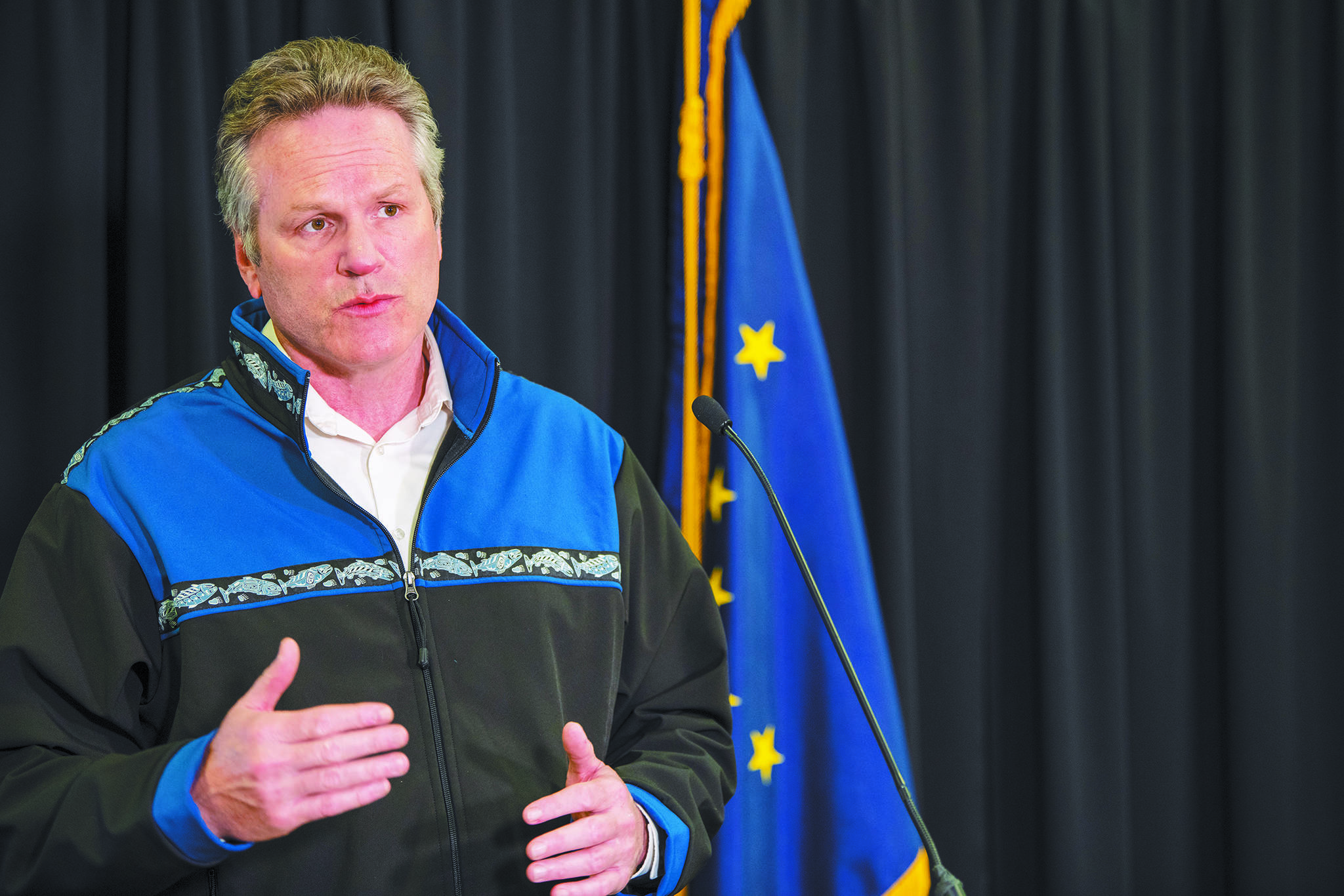
Gov. Mike Dunleavy speaks during a Friday, May 1, 2020 press conference in the Atwood Building in Anchorage, Alaska. (Photo courtesy Office of the Governor)

Gov. Mike Dunleavy speaks during a Friday, May 1, 2020 press conference in the Atwood Building in Anchorage, Alaska. (Photo courtesy Office of the Governor)

State ups unemployment assistance by $300

About 88,000 Alaskans have received unemployment benefits since March 1.

The $600 per week in federal unemployment assistance for Alaskans ended at the end of July, but on Thursday Gov. Mike Dunleavy authorized the state’s Department of Labor and Workforce Development to provide a $300 weekly increase in state assistance for those who are still unemployed.

“After reviewing in detail all of the federal unemployment aid options presented to me and my team, choosing to give $300 more per week allows us to use the state’s unemployment trust fund and helps us to best serve Alaskans who need unemployment assistance across the entire state as they weather a very difficult period in our history,” Dunleavy said in a release.

The benefits will draw from the state’s Unemployment Insurance Trust Funds while the Department of Labor works through the FEMA application for federal funds.

“This option ensures additional resources to UI claimants in the quickest manner possible without compromising the state budget,” Department of Labor Commissioner Tamika Ledbetter said in the press release. “It also keeps in place increased benefits during the time period leading to a longer term Congressional solution.”

About 88,000 Alaskans have received unemployment benefits since March 1, for a total of about $700 million in federal and state funds so far, according to the release.

In the August issue of the Department of Labor’s monthly analysis of Alaska economic trends, state economists Lennon Weller and Dan Robinson looked at the impacts that the end of federal unemployment benefits would have on Alaska’s economy and found that the complete loss of the extra benefits would have meant a “sizable economic shock” across the state in August, equivalent to about $87 million in lost wages.

In June, for example, they found that 3,326 residents of the Kenai Peninsula Borough received $6,130,200 from the temporary federal add-on and $2,834,675 in state unemployment benefits. The additional benefits authorized by Dunleavy will replace half of the federal funds, which will mean an average of $575 per week for these recipients.

For information on how to apply for unemployment insurance, visit labor.alaska.gov/unemployment.

Reach reporter Brian Mazurek at bmazurek@peninsulaclarion.com.

More in News

A snowmachine rider takes advantage of 2 feet of fresh snow on a field down Murwood Avenue in Soldotna, Alaska, on Monday, Dec. 12, 2022. (Jake Dye/Peninsula Clarion)
Ice fishing opens on some Kenai National Wildlife Refuge lakes

Snowmachines are permitted for ice fishing access on Hidden, Kelly, Petersen, Engineer and Watson lakes.

The waters of Cook Inlet lap against Nikishka Beach in Nikiski, Alaska, where several local fish sites are located, on Friday, March 24, 2023. (Jake Dye/Peninsula Clarion)
Kenai asks for fishery economic disaster declaration

The Kenai City Council requested that Gov. Dunleavy declare a disaster and support a recovery plan for the Upper Cook Inlet East Side Set Net fishery.

The Kenai Peninsula Borough School District logo. (Photo courtesy of Kenai Peninsula Borough School District)
District superintendent dispels rumors about student construction

Superintendent Clayton Holland said student involvement in Seward High School construction is “based on rumor, not fact.”

Anchorage-based singer and songwriter Keeley Boyle is pictured in Anchorage<ins>, Alaska,</ins> on Sept. 26, 2023. Boyle, who was raised on the Kenai Peninsula, will use a $10,000 grant she received from the Rasmuson Foundation to create an album of songs about her grandparents’ home in Nikiski. Photo courtesy of Jovell Rennie
Musician hailing from Kenai receives Rasmuson grant

Keeley Boyle will record an album of songs about her grandparents’ Nikiski home.

Commercial fishing and recreational vessels are docked in the Homer harbor on Oct. 23, 2025. The commercial fishing industry endured a series of challenges over the year, some of them imposed by the new Trump administration. (Photo by Yereth Rosen/Alaska Beacon)
Alaska fisheries in 2025: turmoil, economic and environmental challenges and some bright spots

NOAA cuts, economic headwinds and invasive species pose problems, but there was some recovery in crab stocks and salmon harvests.

Cook Inlet near Clam Gulch is seen on Oct. 23, 2025. (Photo by Yereth Rosen/Alaska Beacon)
Disputed oil lease sale in Alaska’s Cook Inlet upheld in new Trump administration decision

After completing a court-ordered environmental study, the Bureau of Ocean Energy Management said no changes are needed for the 2022 sale that drew just one bid.

The Kenai Peninsula Borough School District logo.
School district projects $7.5 million budget deficit for fiscal year 2027

Decreased enrollment and increased property values mean less local and state funding.

The sign in front of the Homer Electric Association building in Kenai, Alaska as seen on April 1, 2020. (Photo by Brian Mazurek/Peninsula Clarion)
Homer Electric Association announces rate increase

The proposed increase, if approved by the Regulatory Commission of Alaska, will go into effect Jan. 1.

A photo of Anesha “Duffy” Murnane, missing since Oct. 17, 2019, in Homer, Alaska. (Photo provided, Homer Police Department)
Calderwood pretrial hearing rescheduled

The omnibus hearing for Kirby Calderwood was continued to Jan. 21. Trial week is currently scheduled for Feb. 17, barring finalization of a plea agreement.

Most Read