
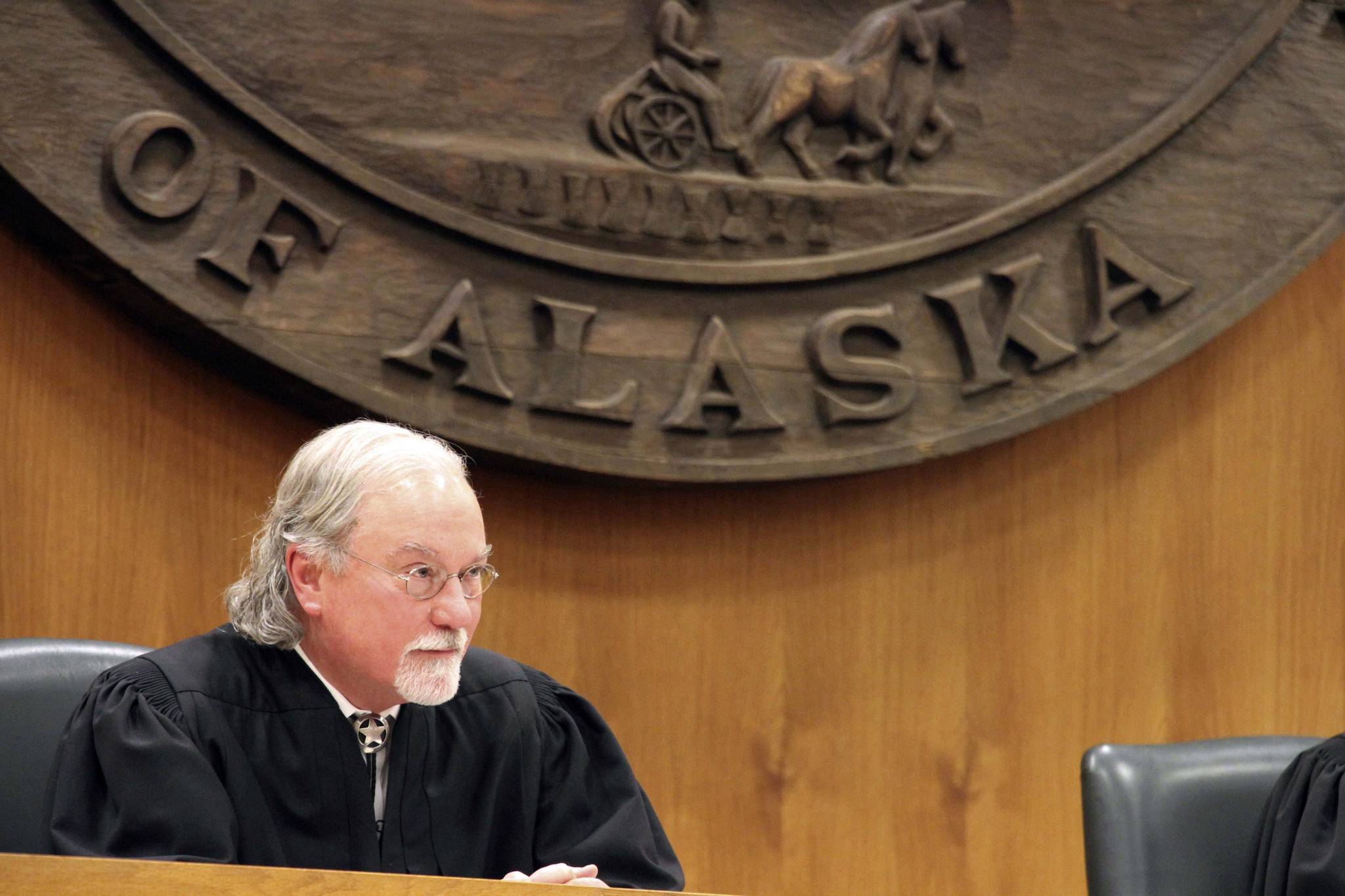
Alaska Supreme Court Justice Craig Stowers listens to arguments in a lawsuit that claims state policy on fossil fuels is harming the constitutional right of young Alaskans to a safe climate Wednesday, Oct. 9, 2019, in Anchorage, Alaska. Sixteen Alaska youths in 2017 sued the state, claiming that human-caused greenhouse gas emission leading to climate change is creating long-term, dangerous health effects. They lost in Superior Court, but appealed to Alaska’s highest court. (AP Photo/Mark Thiessen)

Alaska Supreme Court Justice Craig Stowers listens to arguments in a lawsuit that claims state policy on fossil fuels is harming the constitutional right of young Alaskans to a safe climate Wednesday, Oct. 9, 2019, in Anchorage, Alaska. Sixteen Alaska youths in 2017 sued the state, claiming that human-caused greenhouse gas emission leading to climate change is creating long-term, dangerous health effects. They lost in Superior Court, but appealed to Alaska’s highest court. (AP Photo/Mark Thiessen)

State Supreme Court hears youth climate suit

16 youth claim long-term effects of climate change will interfere with their constitutional rights.

  • By Dan Joling Associated Press
  • Wednesday, October 9, 2019 11:40pm
  • News

ANCHORAGE — An Alaska law promoting fossil fuel development infringes on the constitutional rights of young residents to a healthy environment, a lawyer told Alaska Supreme Court justices on Wednesday.

A lawsuit filed by 16 Alaska youths claimed long-term effects of climate change will devastate the country’s northernmost state and interfere with their constitutional rights to life, liberty and public trust resources that sustain them.

The state’s legislative and executive branches have not taken steps to lower greenhouse gas emissions and adopted a policy that promotes putting more in the air, said attorney Andrew Welle of the Oregon-based Our Children’s Trust group.

“This is an issue that is squarely within the court’s authority,” Welle said.

Assistant Attorney General Anna Jay urged justices to affirm a lower court ruling rejecting the claims. Ultimately, the climate change issues raised by Alaska youth must be addressed by the political branches of government, she said.

“The court does not have the tools to engage in the type of legislative policy making endeavor required to formulate a broad state approach to greenhouse gas emissions,” she said.

The 16 youths sued in 2017 and claimed damages by greenhouse gas emissions are causing widespread damage in Alaska. The lawsuit said the state has experienced dangerously high temperatures, changed rain and snow patterns, rising seas, storm surge flooding, thawed permafrost, coastal erosion, violent storms and increased wildfires.

Our Children’s Trust is a nonprofit organization dedicated to protecting natural systems for present and future generations. The group in 2011 unsuccessfully sued the state, claiming the state failed to adopt measures to protect young people from climate change.

The judge in that case concluded that courts lack scientific, economic and technological resources that agencies can use to determine climate policy and it was best left in their hands.

Anchorage Superior Court Judge Gregory Miller rejected the current case a year ago.

Alaska has no state sales or income tax and historically has relied on the petroleum industry, which extracts crude oil and sends most of it to West Coast Refineries, for much of its revenue.

Welle said state policy promoting fossil fuels, expressed in a state statute, should be declared unconstitutional because it harms young Alaskans by trading short-term financial gains for long-term health problems.

The lead client in the case, Esau Sinnok, has had his constitutional right to health and happiness denied by state policy and lack of action on climate change, Welle said.

“His home village of Shishmaref is literally wiped off the map because of climate change,” Welle said before the hearing. “It’s endangering his culture, the very existence of his community, the health and safety of him and his community members.”

Justice Peter Maassen asked Welle if the energy policy was balanced by other policies in state law, such as protection for natural resources and the environment.

“How can we conclude that government agencies are following the energy policy blindly without consideration of these other policies?” Maassen asked.

Welle said that while statutes provide authority to protect the environment, state agencies have been directed to systemically promote fossil fuels.

Justice Susan Carney called Welle’s attention to a newspaper opinion piece by former Gov. Bill Walker in which he acknowledged severe economic effects of climate change.

“Isn’t that a sign that state policy has balanced those concerns?” she asked.

Welle replied that the court when assessing state policies, and their effects on fundamental constitutional rights, can assess the process, look at decisions and decide if balance struck is the most narrowly tailored choice.


• By Dan Joling, Associated Press
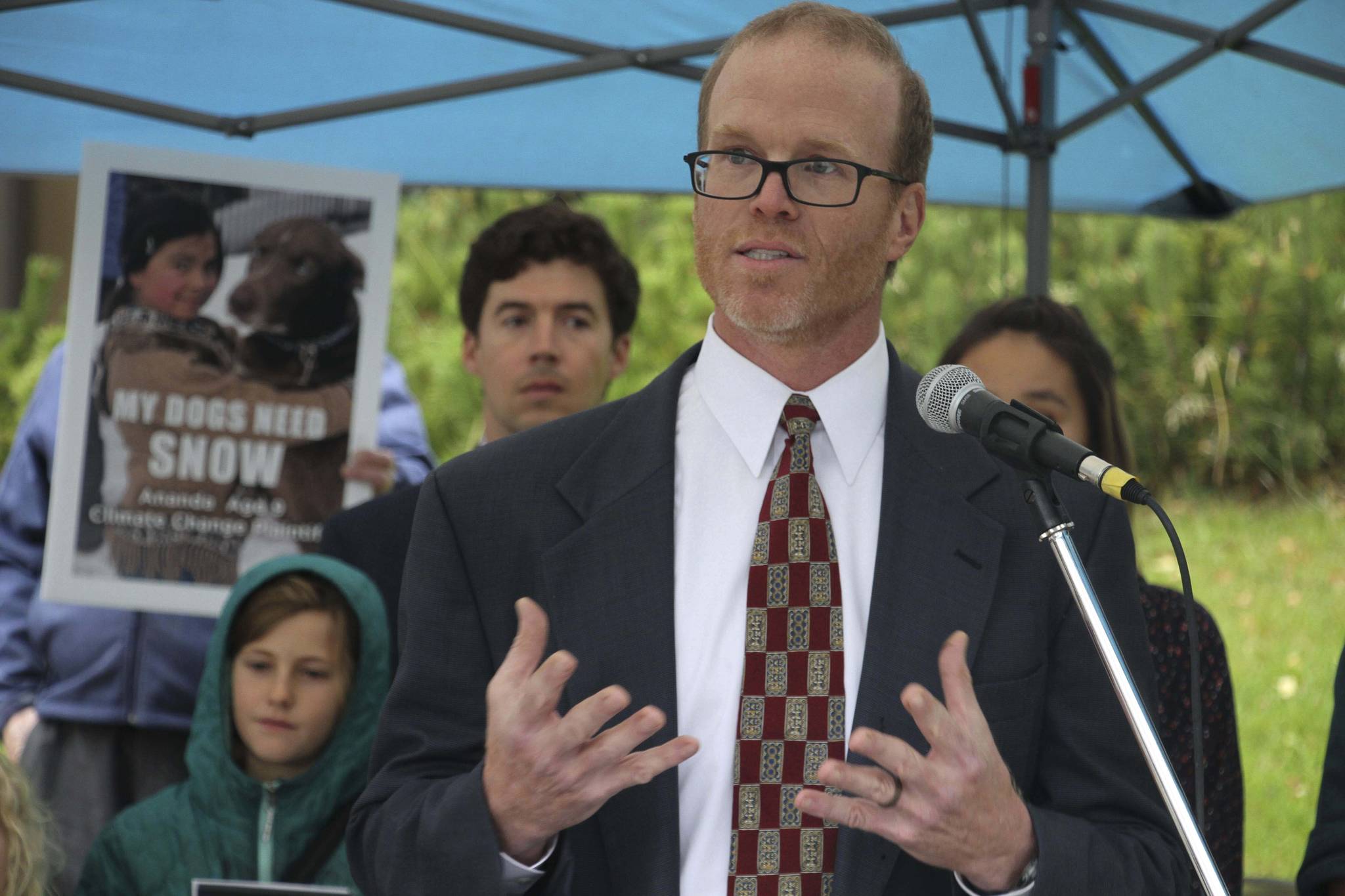

One of the plaintiffs’ attorneys, Brad De Noble of Eagle River, Alaska, speaks at a news conference after the Alaska Supreme Court heard arguments Wednesday, Oct. 9, 2019, in Anchorage, Alaska, in a lawsuit that claims state policy on fossil fuels is harming the constitutional right of young Alaskans to a safe climate. Sixteen Alaska youths in 2017 sued the state, claiming that human-caused greenhouse gas emission leading to climate change is creating long-term, dangerous health effects. They lost in Superior Court, but appealed to Alaska’s highest court. (AP Photo/Mark Thiessen)
One of the plaintiffs’ attorneys, Brad De Noble of Eagle River, Alaska, speaks at a news conference after the Alaska Supreme Court heard arguments Wednesday, Oct. 9, 2019, in Anchorage, Alaska, in a lawsuit that claims state policy on fossil fuels is harming the constitutional right of young Alaskans to a safe climate. Sixteen Alaska youths in 2017 sued the state, claiming that human-caused greenhouse gas emission leading to climate change is creating long-term, dangerous health effects. They lost in Superior Court, but appealed to Alaska’s highest court. (AP Photo/Mark Thiessen)

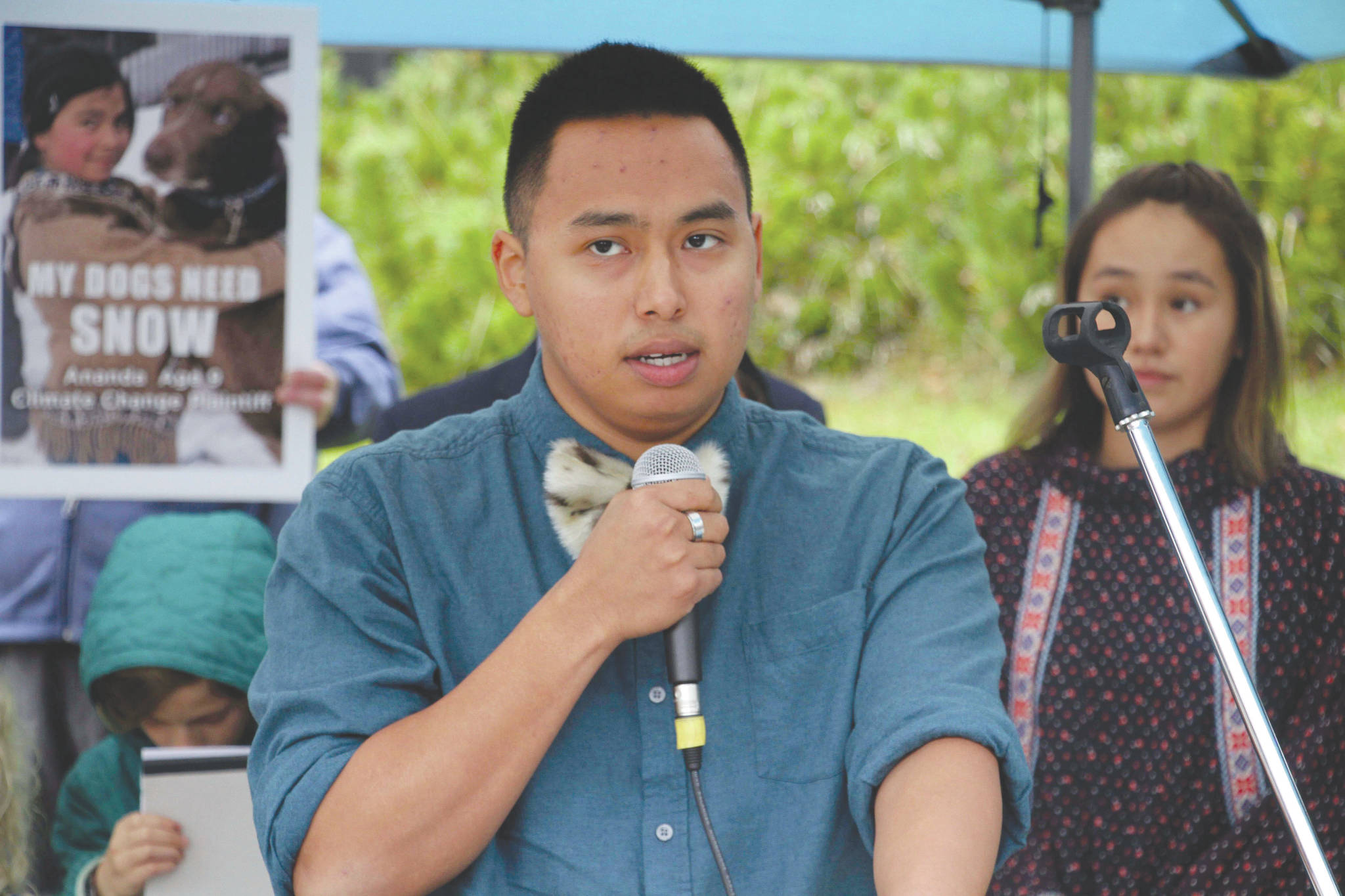
Mark Thiessen / Associated Press                                Esau Sinnok, of Shishmaref, speaks at a news conference Wednesday after the Alaska Supreme Court heard arguments in Anchorage, in a lawsuit that claims state policy on fossil fuels is harming the constitutional right of young Alaskans to a safe climate.

Mark Thiessen / Associated Press Esau Sinnok, of Shishmaref, speaks at a news conference Wednesday after the Alaska Supreme Court heard arguments in Anchorage, in a lawsuit that claims state policy on fossil fuels is harming the constitutional right of young Alaskans to a safe climate.

More in News

Kevin Ray Hunter is actively sought by Alaska State Troopers on Friday, Dec. 19, 2025. Photo courtesy of Alaska State Troopers
Update: Troopers arrest Kenai man accused of sexual abuse of a minor

A judge issued an arrest warrant for Kevin Ray Hunter, who was indicted on Wednesday for allegedly abusing multiple juveniles.

Staff at Soldotna Senior Citizens, Inc. are pictured on Dec. 17, 2025 in Soldotna, Alaska, in front of a new 15-passenger van purchased with funds the Rasmuson Foundation and several local businesses donated to the nonprofit organization. Photo courtesy of Soldotna Senior Citizens, Inc.
New van will expand Soldotna senior center’s service capacity

Soldotna Senior Citizens, Inc., recently purchased a 15-passenger van using funds donated by the Rasmuson Foundation and several local businesses.

Sen. Jesse Bjorkman, R-Nikiski, speaks at a town hall meeting in the Moose Pass Sportsman’s Club in Moose Pass, Alaska, on Friday, Feb. 28, 2025. (Jake Dye/Peninsula Clarion)
Bjorkman, Ruffridge and Elam host town hall

The lawmakers wanted to hear from constituents before the legislative session begins.

tease
Soldotna chamber lights up the town

Hundreds of folks gathered at the visitor center for the Holiday Christmas Tree Lighting last week.

The KBBI Public Radio office and studio is on Kachemak Way, as seen in this photo taken July 2, 2019, in Homer, Alaska. (Photo by Michael Armstrong/Homer News)
Peninsula radio receives ‘stabilization’ funds from national nonprofit

The Public Media Bridge Fund awarded an “initial” round of stabilization grants equaling $26 million to 74 organizations nationwide impacted by the loss of federal funding.

A map presented by the Alaska Department of Natural Resources during a virtual meeting on Dec. 11, 2025, shows the location of a potential Kenai Peninsula State Forest. The Division of Forestry and Fire Protection must gather community perspectives before creating a proposal, and so far they’ve received “mixed” input. Screenshot.
DNR receives “mixed” public input on proposed Kenai Peninsula State Forest

The potential proposal would expand the Tanana Valley State Forest by 600,000 acres.

Cook Inlet Region, Inc. President and CEO Sophie Minich speaks during a ribbon cutting ceremony at the Nikiski Shelter of Hope on Friday, May 20, 2022 in Nikiski, Alaska. (Ashlyn O’Hara/Peninsula Clarion)
Peninsula organizations awarded mental health trust grants

Organizations in Nikiski and Kenai received funding from the Alaska Mental Health Trust Authority.

Potholes are seen on Wildwood Drive on Thursday, April 22, 2021, in Kenai<ins>, Alaska</ins>. (Ashlyn O’Hara/Peninsula Clarion)
Kenai moves to purchase rights-of-way from Kenai Native Association

The Kenai City Council last week authorized $200,000 for the Wildwood Drive Rehabilitation Project.

Jake Dye / Peninsula Clarion
Kenai Peninsula Borough Mayor Peter Micciche speaks during a meeting of the Borough Assembly in Soldotna, Alaska, on Tuesday, May 21, 2024.
Assembly will ask state legislature for authority to enact caps on real property tax assessments

Mayor Peter Micciche said a 34% increase over three years has created “real financial hardships” for many in the borough.

Most Read