
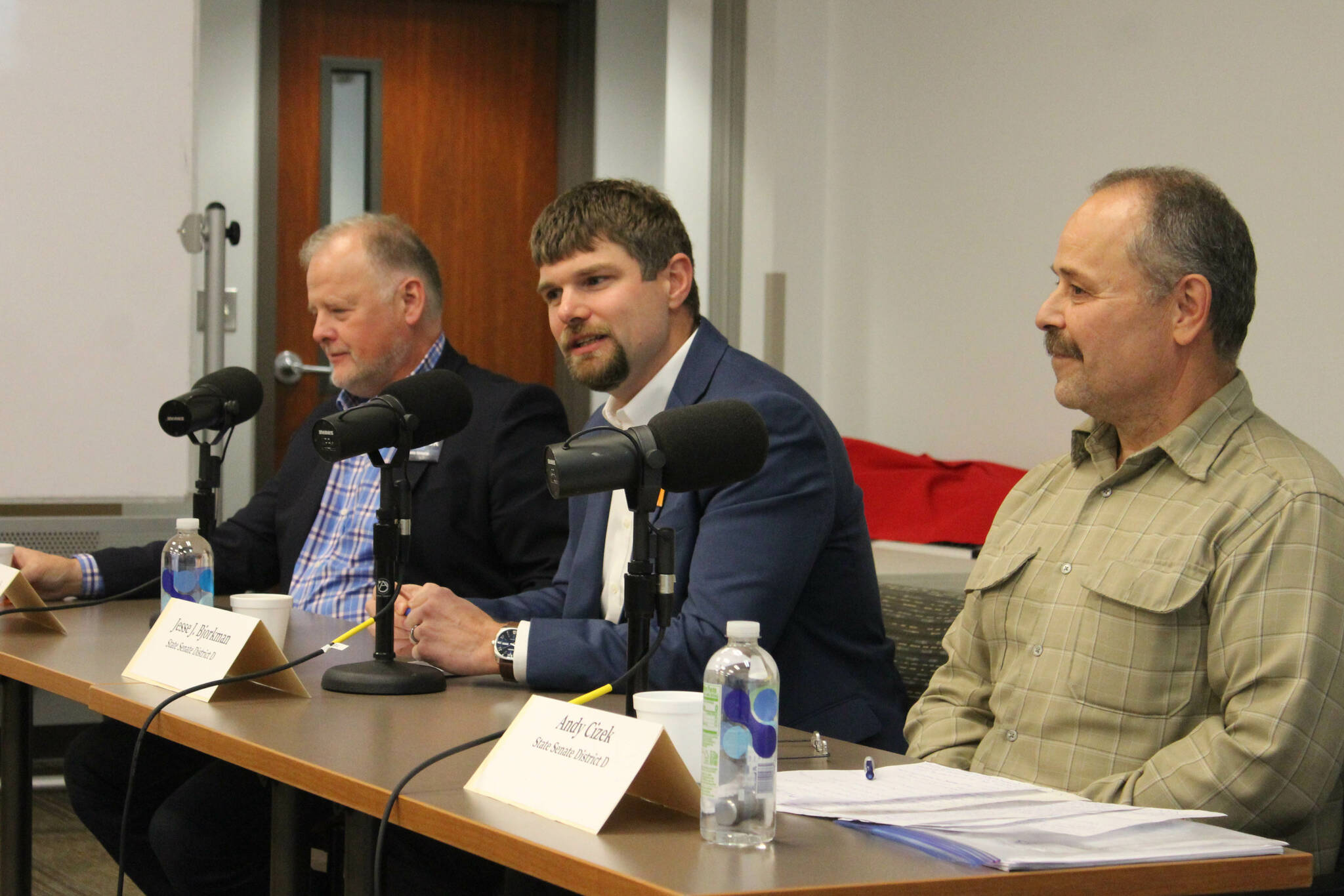
The three candidates vying to represent the northern half of the Kenai Peninsula in the Alaska State Senate took to the Soldotna Public Library on Monday to debate local and state issues as part of a legislative candidate forum.
Monday’s forum was attended by Republicans Tuckerman Babcock and Jesse Bjorkman, as well as nonpartisan candidate Andy Cizek. All are running for the District D seat in the Alaska Senate, which includes Kenai, Soldotna, Moose Pass, Nikiski, Hope and Bear Creek. That seat is currently held by Sen. President Peter Micciche, R-Soldotna, who announced earlier this year that he would not seek reelection.
The forum was the seventh of nine forums being hosted by The Peninsula Clarion and KDLL 91.9 FM in partnership with the Central Peninsula League of Women Voters. Over the course of roughly an hour, candidates fielded questions from moderators Sabine Poux, news director at KDLL, and Ashlyn O’Hara, government and education reporter at The Peninsula Clarion.
Babcock is a former chief of staff for Gov. Mike Dunleavy and chair of the Alaska Republican Party. Cizek is a former commercial pilot of 25 years and has lived in Alaska since the 1970s. Bjorkman is a teacher at Nikiski Middle/High School and currently represents Nikiski on the Kenai Peninsula Borough Assembly. Bjorkman was successfully reelected to the assembly earlier this month but has said he remains focused on his bid for a seat in the Alaska Legislature.
Babcock and Cizek said they support a constitutional convention, while Bjorkman said he supports changes to Alaska’s Constitution. In supporting a convention, Babcock said he trusts voters in the same way that constitutional framers trusted voters with the decennial question of whether or not to hold a convention.
“It’s a matter of whether you trust people and I do,” Babcock said. “I understand people being concerned about it and not thinking that there are structural issues that need to be resolved … but it’s really something each Alaskan should look at carefully for themselves and weigh the pros and cons.”
Cizek said he is glad voters will be given “the final say” on any changes proposed to the Alaska Constitution but that a convention is not something voters should take lightly. Bjorkman said some potential changes he would support include making the Alaska attorney general an elected position.
When it comes to crafting a long-term fiscal plan for the state, Bjorkman and Babcock proposed implementing a spending cap for the Alaska Legislature and cutting the state budget in a way that allows for efficiencies, while Cizek emphasized job growth. Bjorkman further proposed reevaluating what services residents want the State of Alaska to provide.
“This idea that we can have, somehow, our cake and eat it too in a fiscal situation is just not the truth,” Bjorkman said. “We need to look at things from a pragmatic standpoint of what it is that we would like to do.”
Babcock expressed skepticism that Alaska lawmakers would take it upon themselves to give themselves a spending cap, which he said is something else that could be addressed as part of a constitutional convention.
“If you’re (telling) legislators, ‘You need to adopt a spending cap to control your own behavior,’ you’re not likely to get a very good solid answer on that,” Babcock said. “The people are much more likely to put in place a real spending cap, which is the number one thing we need to do with the roller coaster budgeting an income we have in this state.”
Cizek advocated for more natural resource development in relation to a long-term fiscal plan as a way to offer more jobs to Alaska and to assert state management of land. He further proposed keeping the products created through that development “in house.”
“We need to really look at potentially pulling in the federal lands that the federal government has tied up in this state and we need to work on developing and putting Alaskans in charge of these lands instead of the feds,” Cizek said. “There’s a lot of big jobs out there that Alaska should be having that they don’t have.”
All candidates said they opposed the implementation of new taxes as a way to boost state revenue and proposed different ways of protecting Alaska’s energy security.
Babcock and Bjorkman emphasized the importance of a natural gas pipeline from the North Slope to Nikiski, such as the one described by the Alaska LNG Project, however, they diverged on the current status of that project. Babcock said, as have project proponents, that the project is closer than ever to becoming a reality, while Bjorkman was more reserved.
“I will do everything in my power to make sure we encourage the completion of a natural gas pipeline without kind of painting some rosy picture that somehow it’s just around the corner,” Bjorkman said.
Cizek called on Alaska to “cut a bunch of red tape” when it comes to energy projects and said that Alaska has not realized its full potential when it comes to hydroelectric and tidal power.
“Private corporations can do things for a fraction of what the government can, so we need to really consider that and they can get the job done better as long as they don’t have all the red tape and hoops and loops to jump through,” Cizek said.
Candidates were also asked about teacher retention and recruitment, where they think they fit in the broader legislative landscape and about times they’ve reached across the aisle to solve problems. The full candidate forum can be streamed on KDLL 91.9 FM’s website at kdll.org or on The Peninsula Clarion’s Facebook page.
Election Day is Nov. 8. Voters will rank candidates for each seat. More information about the election can be found on the Alaska Division of Elections website at elections.alaska.gov.
Reach reporter Ashlyn O’Hara at ashlyn.ohara@peninsulaclarion.com.
