
State pushes for university land grant transfer

Where the lands are remains to be determined

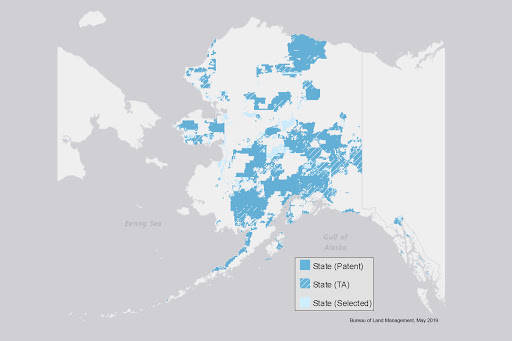
State officials are trying to facilitate the transfer of federal lands to the University of Alaska but where those lands are hasn’t yet been determined. What is known is the lands will be drawn from the state’s allotment of federal lands granted to it under statehood, seen here in this July 30, 2020 Bureau of Land Management map. (Courtesy Image / U.S. Bureau of Land Management)

State officials are trying to facilitate the transfer of federal lands to the University of Alaska but where those lands are hasn’t yet been determined. What is known is the lands will be drawn from the state’s allotment of federal lands granted to it under statehood, seen here in this July 30, 2020 Bureau of Land Management map. (Courtesy Image / U.S. Bureau of Land Management)

Alaska’s elected officials are making a strong push for the federal government to turn over hundreds of thousands of acres to the University of Alaska for economic development, but the exact location of that land is still being determined.

Alaska’s congressional delegation submitted bills on April 15 that would establish a program within the U.S. Department of the Interior to fulfill the state’s land grant obligation. The act would establish the university as a land grant university, “with holdings sufficient to facilitate operation and maintenance of a university system for the State of Alaska.”

That means the university is looking for land to develop for economic use, said Ed Fogels, a private consultant hired by the state to help select the land. Fogels, a former deputy commissioner of the Alaska Department of Natural Resources, told the Empire in an interview that his team has identified 250,000 potential acres for university development, but the process for obtaining the land was a lengthy one.

The university is still owed roughly 360,000 acres promised to it before statehood, according to UA’s Land Grant website. UA owns about 150,700 acres, the website says, 12,000 of which has been designated educational properties like the university campuses themselves and research stations. Since 1987, UA’s land and resource sales have generated $211 million, according to UA.

[University of Alaska looks to a post-pandemic future]

Money generated by the land currently goes into a fund managed by the school’s investment arm, the University of Alaska Foundation, which runs initiatives such as the Alaska Scholars Program, which provides scholarship money to Alaska students.

We don’t have specific lands that we can show the public yet, we’re still trying to work toward that,” Fogels said. “It’s a slow iterative process.”

Fogels said he and his team review state land records and identify land that could potentially be developed for an economic purpose. In Alaska, that typically means resource development. Land selected by Fogels and his team are submitted to DNR, he said, which reviews them and determines if that land has an overwhelming public value.

The primary reason (for the land grants) is to generate revenue,” Fogels said. “Revenues generated on these lands will go to the university.”

According to the UA Land Management report, lands owned by the university generated roughly $6.8 million in Fiscal Year 2020. Lands owned by UA are currently being used to harvest timber, gravel, coal and oil and gas, according to the report.

If the land is approved by DNR, it will have to be formally conveyed to the state by the Department of the Interior, Fogels said. The Alaska delegation’s bill would create a program to facilitate the transfer, and would give the state two years to identify lands to request.

The Alaska State Legislature recently passed a joint statement urging the Congressional delegation, the U.S. Department of the Interior and Gov. Mike Dunleavy to facilitate the transfer of the land. But this is not the first time this bill has been submitted to Congress. The bill submitted by the delegation in mid-April was a duplicate of legislation from past sessions.

The process is long, Fogels said, but the intent is to secure the economic viability of Alaska’s university and make the school less dependent on state revenue.

The university system has faced drastic budget cuts under Dunleavy’s administration, agreeing to reduce its overall budget by $70 million over three years before further losses were caused by the COVID-19 pandemic.

“This isn’t a get rich overnight effort, this is for the long term,” Fogels said. “We want a strong university system in this state. This will ensure the University of Alaska can do its job effectively for 10, 20, 30, 100 years.”

Contact reporter Peter Segall at psegall@juneauempire.com. Follow him on Twitter at @SegallJnuEmpire.

More in News

A diagram presented by Seward City Manager Kat Sorenson during a Kenai Peninsula Borough Assembly meeting on Dec. 2, 2025, shows the expected timeline for the Port of Seward Vessel Shore Power Implementation Project. Screenshot
Seward shore power project moves into preliminary design phase

The project will create jobs, reduce cruise ship emissions and provide a backup power grid.

The U.S. Forest Service Porcupine Campground offers gorgeous views of the Kenai Mountains and Turnagain Arm, as seen here on July 20, 2020, near Hope, Alaska. (Photo by Michael Armstrong/Homer News)
Department of Natural Resources seeks public input on proposed Kenai Peninsula State Forest

DNR is gathering community perspectives during several meetings this week.

David Ross is sworn in as Kenai Police Chief on Tuesday, May 31, 2016 at Kenai City Hall. The Alaska Association of Chiefs of Police named Ross the 2025 Police Chief of the Year, recognizing over two decades of service. Photo by Megan Pacer/Peninsula Clarion
Kenai police chief named 2025 Police Chief of the Year

The Alaska Association of Chiefs of Police recognized David Ross for his more than two decades of leadership.

The cast of Nikiski Middle School’s upcoming performance of “Alice in Wonderland” is pictured on Dec. 2, 2025. The upperclassmen-directed play opens on Friday, with additional showtimes Saturday and next weekend. Photo courtesy of Carla Jenness
Nikiski Middle School debuts student-led “Alice in Wonderland”

The show opens on Friday, with additional showtimes this weekend and next.

On Tuesday, the Kenaitze Indian Tribe unveiled Kahtnu Area Transit, a public transportation service open to the entire Peninsula Borough community. Photo courtesy of Kahtnu Area Transit
Kenaitze Indian Tribe unveils Kahtnu Area Transit

The fixed bus route offers 13 stops between Nikiski and Sterling.

The Kenai Chamber of Commerce and Visitor Center hosts the annual Christmas Comes to Kenai on Nov. 28<ins>, 2025</ins>. The beloved event began over 40 years ago, and this year over 1,000 attendees enjoyed hot chocolate, fireworks, pictures with Santa and shopping. Photo courtesy of the Kenai Chamber of Commerce
 Photo courtesy of the Kenai Chamber of Commerce
The Kenai Chamber of Commerce and Visitor Center hosted the annual Christmas Comes to Kenai on Nov. 28. The beloved event began over 40 years ago, and this year over 1,000 attendees enjoyed hot chocolate, fireworks, pictures with Santa and shopping.
Kicking off a month of holiday festivities

Last weekend’s holiday events, including the annual Christmas Comes to Kenai and the Soldotna Turkey Trot, drew folks from all over the Kenai Peninsula.

Starting Dec. 2, Aleutian Airways will offer roundtrip flights between Anchorage and Unalakleet every Tuesday, Friday and Sunday.
Aleutian Airways to offer roundtrip flights between Anchorage and Unalakleet

Starting Dec. 2, Aleutian Airways will offer three roundtrip flights per week.

The Trump administration’s “Big Beautiful Bill” act requires the Bureau of Ocean Energy management to hold at least six offshore oil and gas lease sales in Alaska between 2026-2028 and 2030-2032. The first of these sales — known as “Big Beautiful Cook Inlet 1,” or BBC1— is scheduled for March 2026. Photo courtesy of the Bureau of Ocean Energy Management
Cook Inletkeeper launches petition against federal government

The organization is calling for transparency in Cook Inlet offshore oil and gas sales.

Winter dining has always carried more weight than the menu might suggest. In the off-season, eating out isn’t just about comfort food or convenience; it’s a way of supporting local businesses as they hold steady through the slower months. Photo credit: Canva.
The ripple effect: How local spending builds stronger communities on the Kenai Peninsula

From cozy cafés to fine-dining bistros, purchases made close to home sustain local jobs and services

Most Read