
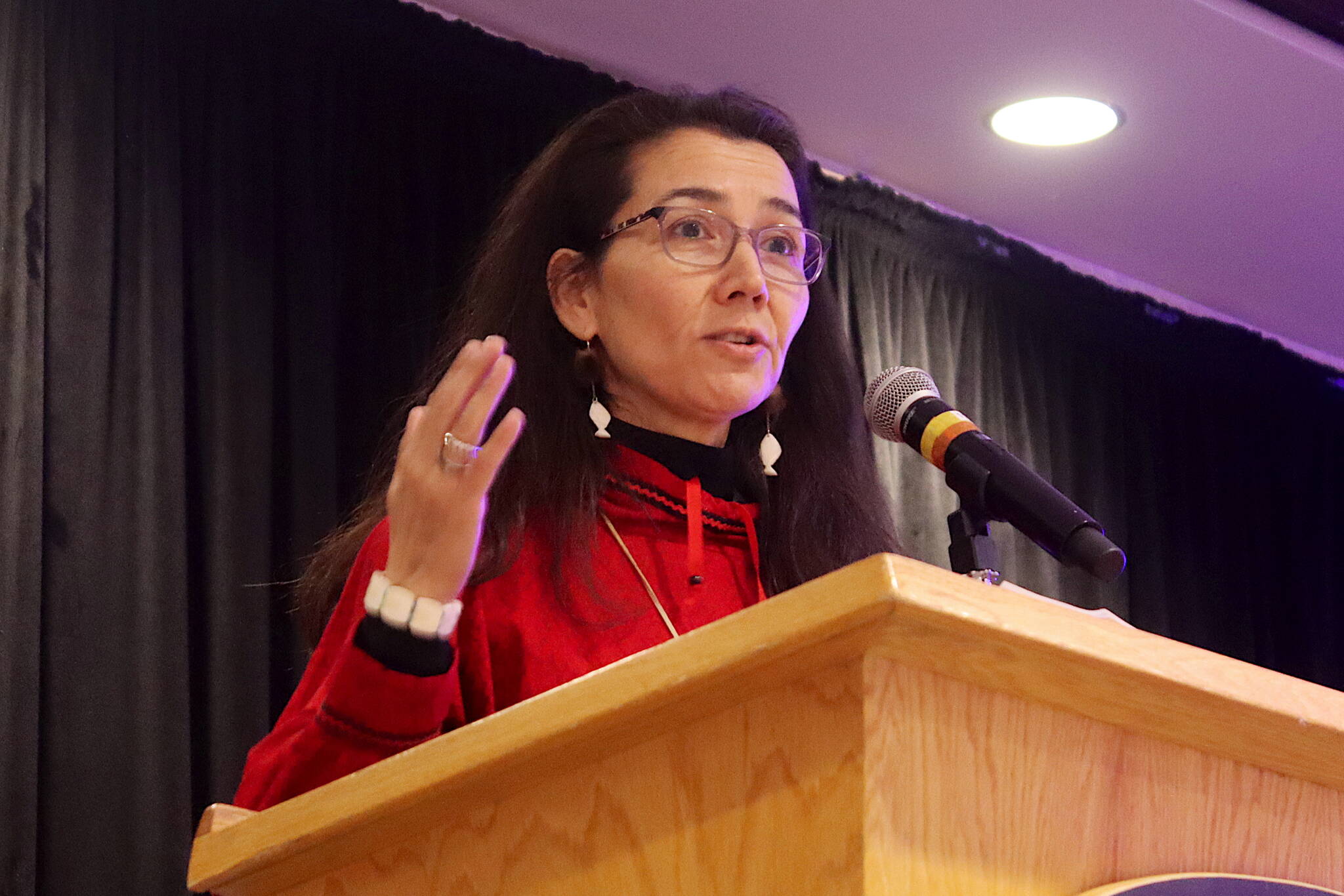
U.S. Rep. Mary Peltola, D-Alaska, held a fish-focused telephone town hall meeting on Thursday, June 20, during which people from across the state voiced concerns related to both state and federal fisheries.
Alaska’s fisheries face numerous challenges, including conflicting perspectives, jurisdictional issues and the need for stronger regulations and policy changes. Speakers emphasized the importance of understanding unique challenges and elevating Alaska voices in Washington, D.C.
Some of the topics discussed included addressing bycatch, dwindling fish populations and nonresident fishing. Other issues discussed were the need for a broader scientific study to assess salmon populations, wasteful fishing practices near hatcheries, concern over hatchery escapement into wild stock streams, and the cultural significance of salmon in Alaska communities.
Peltola started the meeting by introducing herself, her role in Washington and her work with U.S. Sens. Lisa Murkowski and Dan Sullivan.
“Before I even got the job, I made it clear that I’m very pro-fish, that I care deeply about our marine ecosystem and the marine-derived nutrients that our headwaters rely on as well, and have really worked to make this a serious issue and bring it to national attention,” she said.
Those who called into the meeting, identified by first name only, provided both questions to Peltola and general comments.
Callers expressed frustration with what they said were mixed messaging in fisheries management, the lack of understanding among elected officials, and the need for bipartisan work in addressing these issues.
The first question Peltola addressed was her role in bringing Alaska’s fisheries issues to Washington.
“I do feel like the discussions in D.C. don’t have a lot to do with Alaska, and it’s my full-time job — and I take it very seriously — to explain how Alaska is different and why we need carve out exceptions to certain blanket rules that are put in place across the nation, because they don’t work for Alaska,” she said. The primary feature Peltola noted was the size and diversity of species in Alaska compared the smaller East Coast states.
A man from Ketchikan noted concern with listing chinook salmon under the Endangered Species Act and the implications that might have for commercial, sport and subsistence users.
“We need to act to protect our fish in a more concrete way and getting serious about using the tools in our toolbox to make sure that we don’t have a situation where the species is listed as endangered species,” he said.
There were several comments provided on bycatch in general. Peltola referred to a recent piece of legislation introduced called the Bycatch Reduction and Mitigation Act.
H.R. 8508, sponsored by Peltola and two others, authorizes National Oceanic and Atmospheric Administration to reauthorize their Bycatch Reduction and Engineering Program. The bill was referred to the House Committee on Natural Resources in May.
There is also a component of the program that would be administered by the National Fish and Wildlife Foundation.
“This can be used to help fishermen and vessel owners purchase new gear or technology to reduce bycatch with things like camera systems, lice and salmon excluders,” she said.
Many of the comments were directed specifically toward factory trawl ships, the process of bottom trawling, and the impact on salmon.
One man spoke about what he said were inaccuracies in the amount of crab bycatch tallied by NOAA observers.
As an example, he shared an example from Kodiak where many of the boats hire local crew members. He mentioned an incident where a boat caught about 60,000 Tanner crab when they were targeting another species and the skipper simply set the net directly back into the water and kept the crab. The story was available to the community due to local observation.
“Everybody in town knows that, because we probably know more about bycatch through crew members than we do through some observers. So, there’s no way you can figure out how much they’re actually catching,” he said.
A Kenai man asked two questions on behalf of the local setnet organization in regards to the disaster declarations and distributions, citing many specific examples from recent years.
The conversation also touched on foreign trawlers, primarily from China and Russia, and the proximity of access to U.S. federal waters and current monitoring policy.
Peltola addressed this by referring to market and labor conditions.
“One goal is to work with the G7 — the seven countries who have the largest economies — to better understand how unsustainable and inhumane the fish that’s coming out of China and Russia. It’s really creating a market situation where Alaskans can’t compete with our wild caught fish, sustainably harvested and using humane labor to process them.”
At the end of the conversation, Peltola noted that although they took as many comments as possible at the Thursday meeting, people with additional concerns are welcome to contact the representative’s office or visit her website, https://peltola.house.gov/, to submit comments by email.

 E-Wallet Purchase (Add Funds)
 Term Subscription