
Each year, thousands of eager Alaskans flood the north and south Kenai beaches for the personal-use dipnet season with the same goal in mind: catching fish.
The way Alaskans go about achieving that goal, however, varies greatly from group to group. Not all families fish for exactly the same reason, not all participants believe in the same strategies or process, and not all campsites are created equal.
A large portion of campers come from Anchorage and other areas of Alaska. John Collins, of Anchorage, has participated in the dipnet fishery since its inception in 1996. Each year, he said he took notice of other campers and their accommodations, making mental notes for how he wanted to improve his own experience in the future.
“I keep trying to make it more and more comfortable for friends and family,” Collins said. “I used to watch all the people, and I would think, ‘Well, I want to do that, and I want to do that.’ Every year, I try and make it better.”
Along with his family and friends, Collins has become an expert in the art of “glamping,” or glamour camping.
From July 15 through July 20, he and his wife, Tami, slept in a spacious tent with their dog, Sadie, on a large air mattress and cot.
Their tent, a gazebo tent designated for food preparation, two outhouse tents and the other group members’ dwellings made up their base camp situated on a calm section of beach between the Spruce Street entrance and the curve of the Kenai River’s mouth.
The small tent village, affectionately dubbed “The Taj,” stood out easily against the single and two-man tents scattered to either side. Over the years, Collins said his glamping has drawn curiosity from other dipnetters. Since he began bringing his wife along in 2003, everyone on the trip has been well fed.
“I set her up on a lawn chair while I fished,” Collins said. “Her kids were like, ‘Mom went camping?’ And so because it was like 80 degrees and no wind, she’s like, ‘I can do this,’ and then for ten years after that, it would never be the same.”
“I showed up in a little skort thing and a tank top, and it was awesome the whole weekend,” Tami Collins said. “It’s never been that way again.”
Along with his son-in-law, Jeremy Coulson, and family friends Todd and Brandon Kelley, Jill Brown and Chelsee Largo, Collins rises to fish each morning with the tide. The group experienced the most success on Saturday and Sunday, from the seasoned dipnetters to Todd Kelley and his son, Brandon, for whom it was the first season on the Kenai river.
Around the time of the tide’s morning peak, the north beach is a maze of colored jackets poking out from under rubber waders, children, dogs and circling seagulls. Some fishermen struggle to pull on waders or tight rubber wet suits over their clothes. One man reclines on his back, kicking his legs up in the air to remove water, sand, or both from his heavy rubber boots.
Multicolored metal “bonkers” flash in the sun as they are raised high before coming down on the heads of netted fish.
Terra Coulson, Tami Collins’ daughter, explains that the bright blue bonker used by their group once belonged to her dad. She watches as her 5-year-old son Blake, under the direction of his father or grandfather, runs from fish to fish and tries his best to carefully kill them with the fewest, well-aimed “bonks” possible.
Coulson explained that hitting the fish in the right spot takes practice, and the best fishermen can put them out of their misery with a single hit. She said she’s seen others use baseball bats or even their boots, which seems to her to be excessive.
After a few hours of hard work, made harder by larger-than-average waves on Saturday morning, the group retreats to the beach with their spoils to enjoy some of Tami Collins’ cooking — meals that don’t look or taste like they were made on the beach. On Saturday, it was homemade chili over corn bread for dinner. On Sunday, breakfast burritos for lunch.
On several occasions, Tami Collins has been known to give out extra food to hungry passersby on particularly cold and dreary days.
After another stab at the fishery in the afternoon, the group gathers around the fire to enjoy each other’s company, talking of jobs, future aspirations and, of course, the fishing.
Brown and Largo commented on the difficulty of standing steady for long periods of time amid large, powerful waves.
“You use your left shoulder to kind of shore it in, so that when the fish goes in you can twist it to the right,” Brown said. “And then when (the fish) comes, and you twist, and you try to run, it’s really awkward. It’s not a ‘Baywatch’ moment. It was a beached whale moment.”
Despite the difficulties of dipnetting, Brown said there is something about it that draws people back year after year. After graduating from Embry-Riddle Aeronautical University in California next May, she hopes to return to Alaska full-time.
“L.A. has nothing on this place,” she said.
“Alaska has this magnetic way of sucking you in,” Largo added.
One common complaint about the dipnet season is that it has the tendency to leave Kenai’s beaches littered with fish remains and other trash. Dipnetters are supposed to throw fish heads and guts into the water, or transport them to Dumpsters.
“There’s a lot of people from out of town who don’t really respect (the beach),” Jeremy Coulson said. “You know, this is a habitat.”
Coulson and his fellow fishermen took care to throw their unwanted fish remains back into the water over the weekend, if the seagulls didn’t get to them first.
Some people gladly accept the castoffs from other fishermen, like Caitlin Sombatratanakul and her husband, Chad.
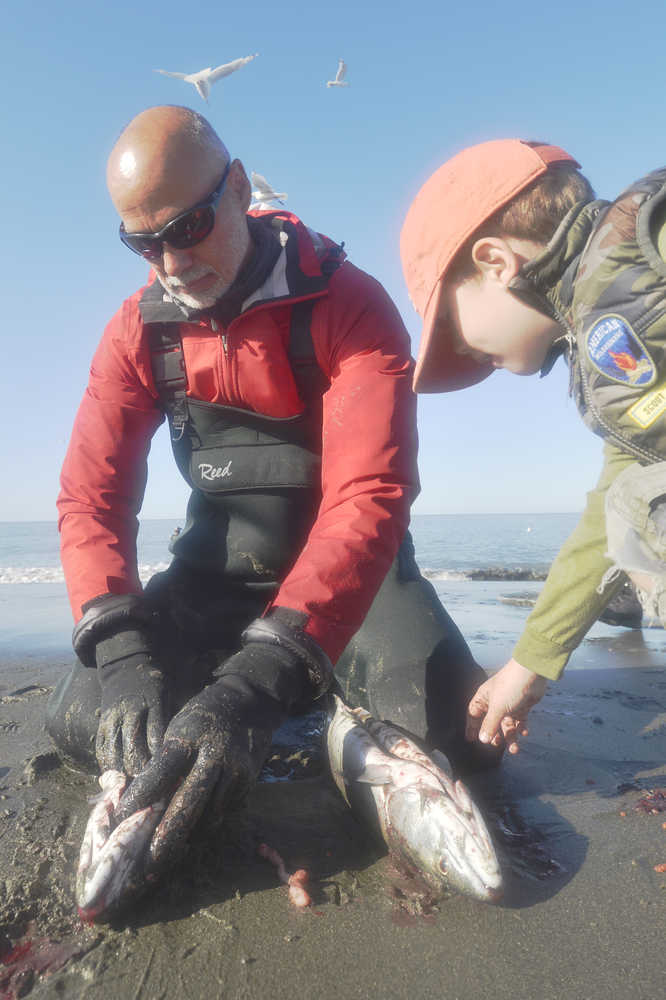
Growing up in a family that attended the dipnet fishery for 20 years, Sombatratanakul said she learned to minimize waste by using as much of the fish as she could. Working in a team with her husband and another fisherman, she prepared and gutted fish after fish during Saturday morning’s high tide.
“As kids we came down here, and it was the assembly line,” Sombatratanakul said. “You always had a job. Whether you were 5 years old and scraping the carcasses with a spoon, or just carrying coolers or getting freshwater, you always had a job. I’m the fillet-er.”
Never taught how to use a fillet knife, Sombatratanakul uses an ulu knife to cut fins, separate the fish’s head and dispose of the guts. Her family fillets the fish back at their main camp, where she says they have a unique way of preserving the parts left unwanted by many other dipnetters.
“We really try to take all the meat,” she said. “You scrape the carcass off and you get this — it’s almost like fish ground beef. Then you can make fish patties with them or fish tacos. You just fry it up and it’s delicious.”
Sombatratanakul also saves the fish bellies, regarded as less desirable by some, to smoke specially, as they make for a more tender meat. She has a friend who goes so far as to pickle the fish bones as well.
Collins is also interested in utilizing as much of his fish as possible. After hearing that salmon livers have historically been regarded as sacred because of the large amounts of Vitamin D they contain, he became determined to benefit from them.
“When I learned that, the first thing I did is … I cut out the liver and took a big bite of it,” Collins. “That was just awful. So I told Chelsee about it, and she said, ‘Let’s fry some up.’”
Throughout the dipnet season, some families participate to bond, and others attend mainly for subsistence reasons. Many groups are somewhere in between. Bill Diel, of Anchorage, said he enjoys spending time with his wife, daughter and dog while he dipnets, but that his family also relies on the season for a year’s supply of fish. By Saturday, his family had 36 to bring home for smoking, freezing and canning.
“The majority of the fish have been from today,” Diel said. “We have a commercial vacuum packer. We vacuum pack (the fish) right there on the spot.”
It’s not only the preparation of fish that differs from group to group, but the fishing strategies as well. Dipnetters traded opinions throughout the weekend about whether the fish were more plentiful at the river’s mouth or farther north where the waves came straight on. They debated their movements during the incoming tide compared to the outgoing. Speculations flew regarding the differences between the north beach and the south. Only one conclusion was reached unanimously; each year seems slower than the last.
By 11 p.m., dipnetting is closed for the night. Tired fishers trudge back across the beach from the river’s mouth to their tents, dipnets balanced on their shoulders and coolers filled with varying amounts of fish dragging behind them, drawing lines in the sand. By midnight, the only sounds are the wind as it rustles tent flaps, the scattered laughter floating from campfire to campfire and the rumble of a tractor as it smooths the sand for the next day’s onslaught of activity.
Reach Megan Pacer at megan.pacer@peninsulaclarion.com.
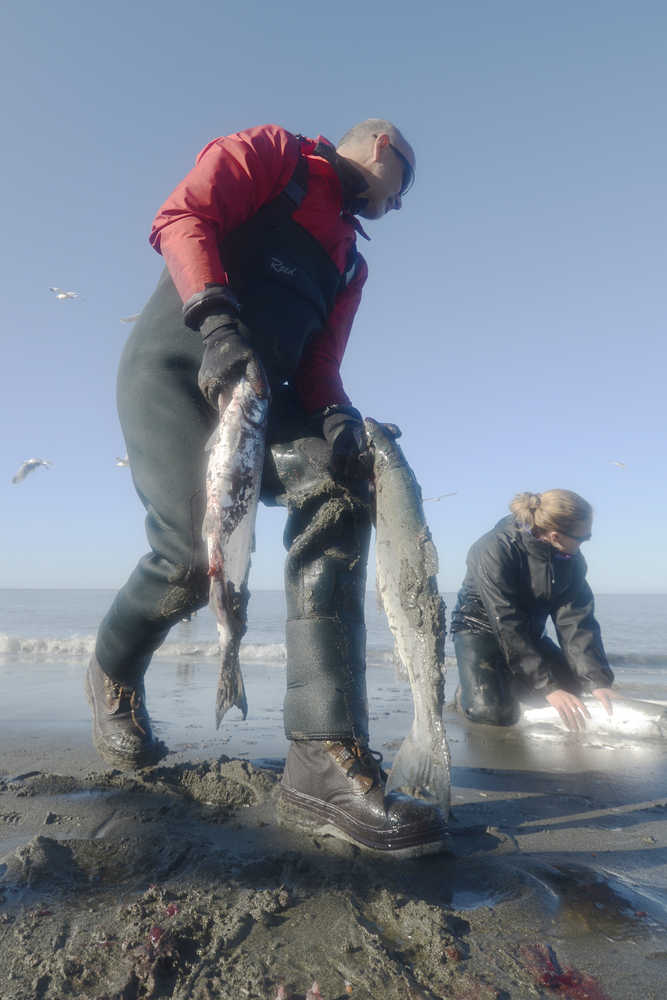
Ben Boettger/Peninsula Clarion John Collins (left) looks over a catch by Chelsee Largo (right) as he prepares to clean gutted salmon in the waters of Kenai’s north beach on Sunday July 19.
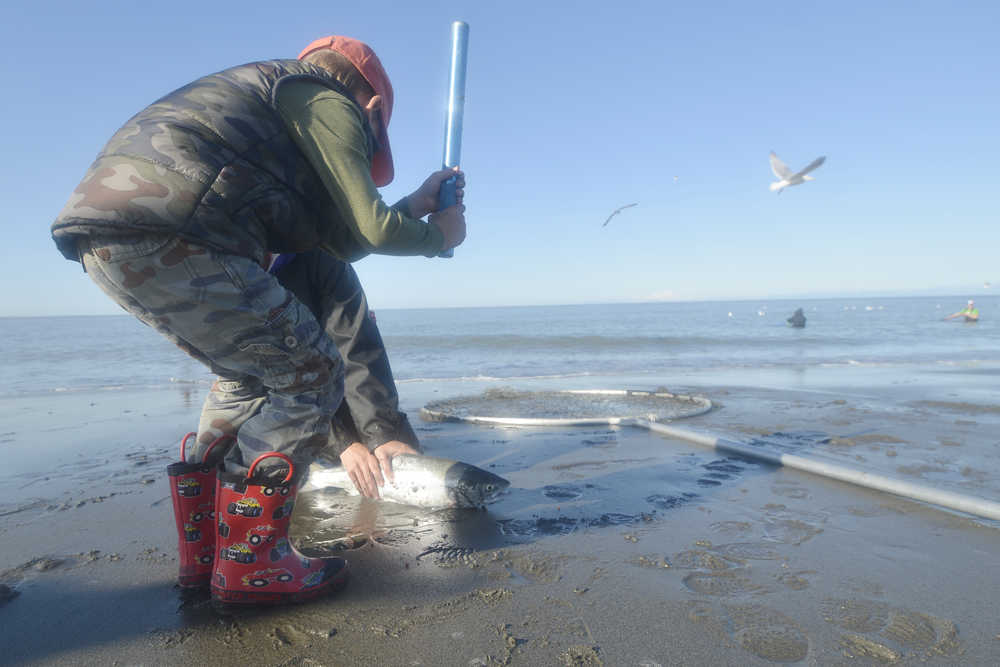
Ben Boettger/Peninsula Clarion Five-year-old Blake Coulson prepares to hit a fish caught by Chelsee Largo at Kenai’s north beach on Sunday, July 19.
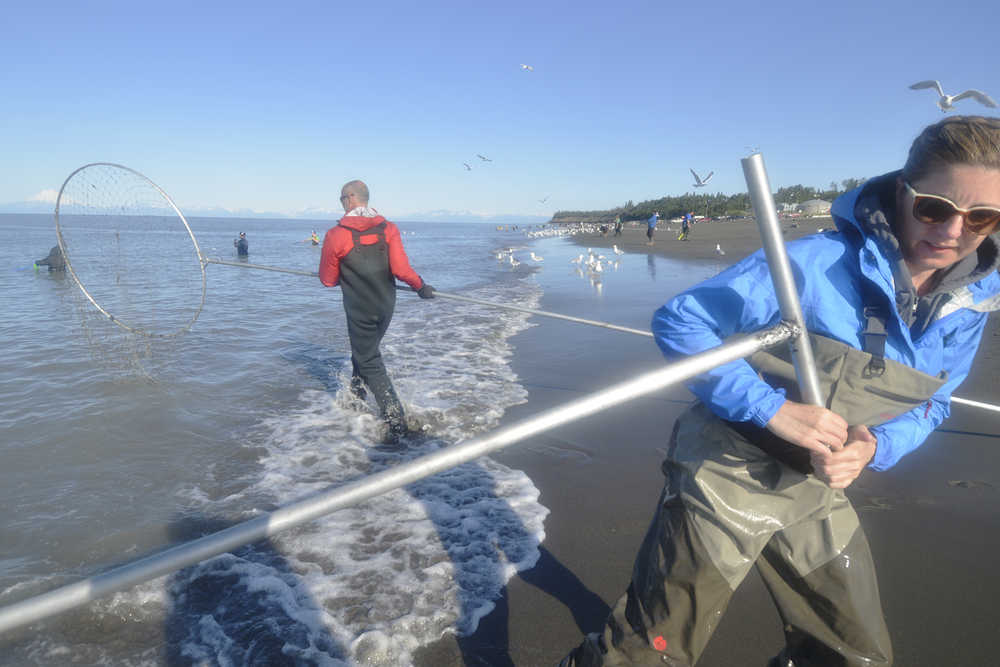
Ben Boettger/Peninsula Clarion Jill Brown (foreground) hauls in a fish while John Collins (background) returns to the water of Kenai’s north beach on Sunday, July 19.
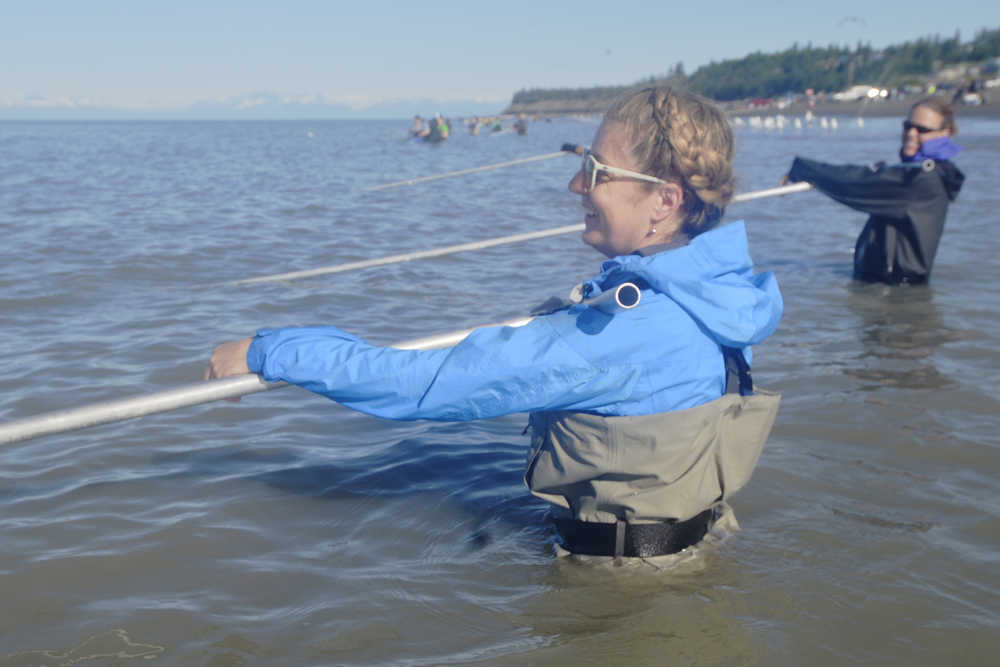
Ben Boettger/Peninsula Clarion Jill Brown (foreground) dipnets alongside Chelsee Largo (background) on Kenai’s north beach on Sunday July 19.
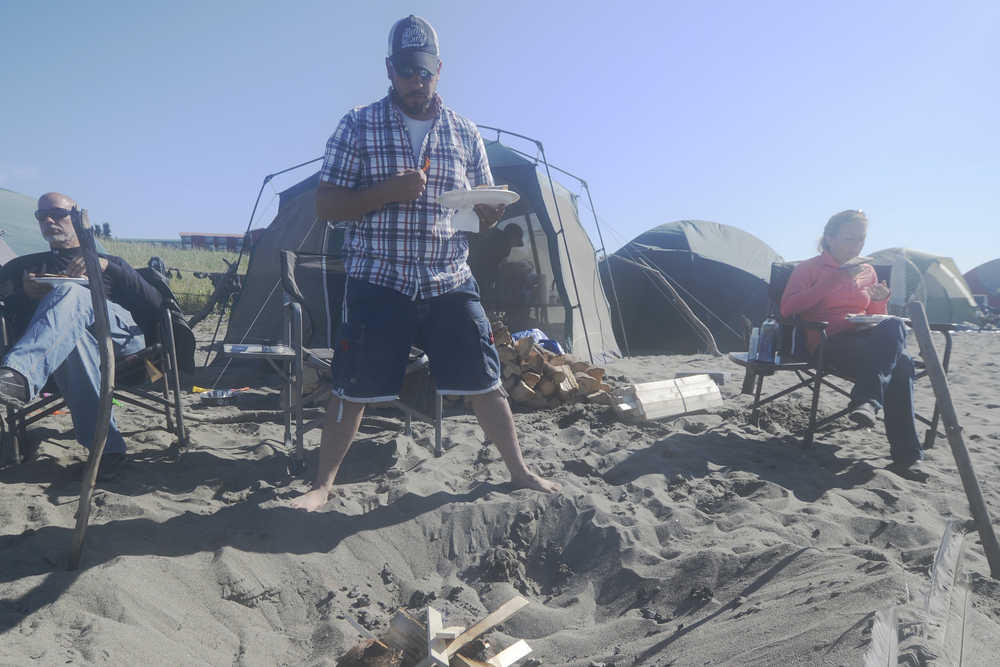
Ben Boettger/Peninsula Clarion Dipnetters John Collins (left), Jeremy Coulson (center,) and Chelsee Largo (right) eat a brunch of bacon and eggs at their encampment on Kenai’s north beach on Sunday, July 19.
