
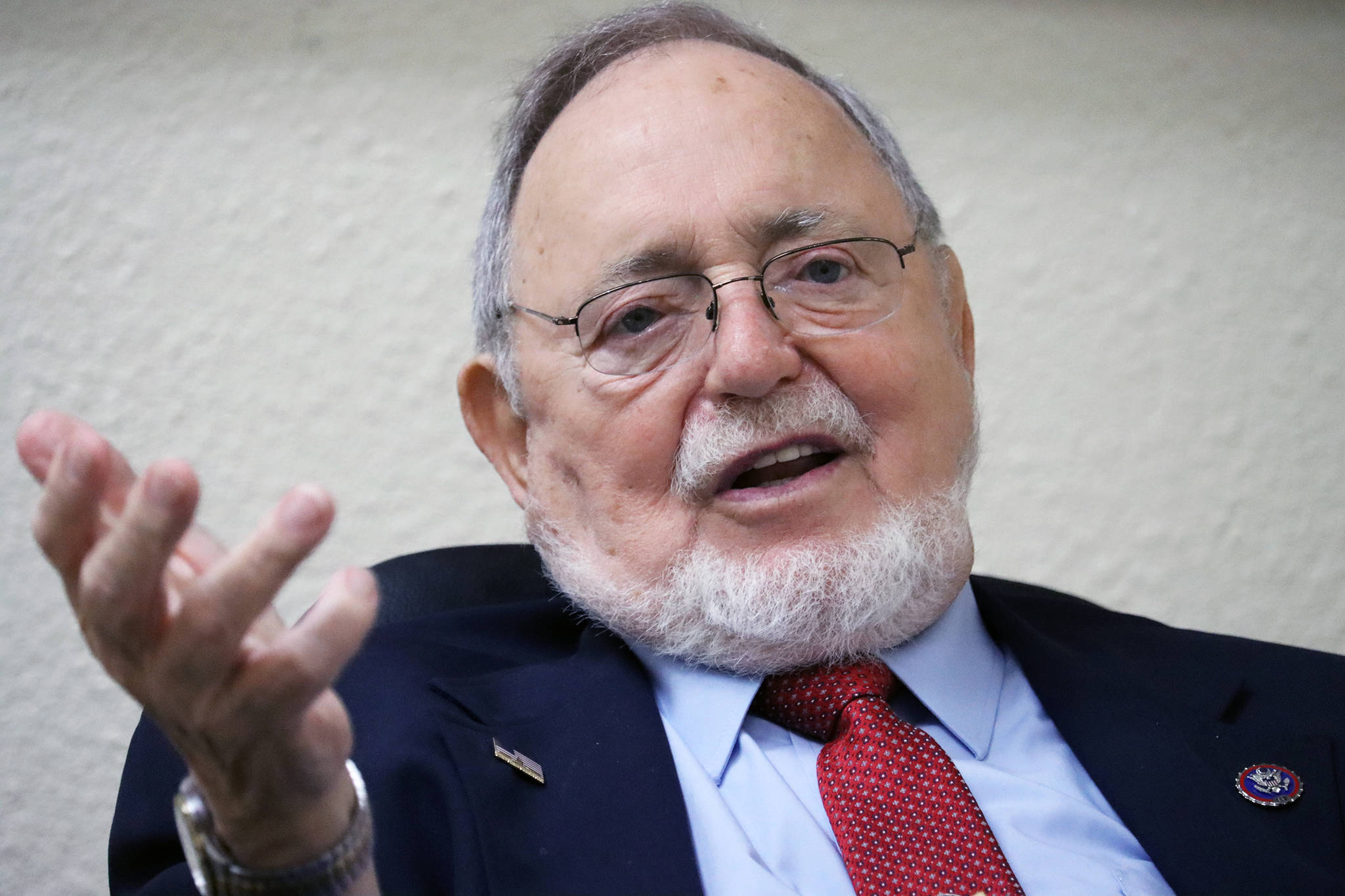
Up for reelection soon for his potential 26th term, Alaska’s lone representative to the U.S. House of Representatives, Don Young is among the all-time longest-serving congressmen, serving as the sole representative of Alaska for nearly 20% of the United States’ existence.
In an interview with the Juneau Empire on Thursday, Young said he welcomed competition in the race to represent Alaska, but that he would put up a fight and believes he is uniquely up to the task.
“This state is a very diversified state and a lot of Alaskans don’t understand that. This state’s so big that it takes somebody like myself that gained knowledge, that had knowledge, to represent the state,” Young said of his decision to seek reelection. “I’ve done good at that.”
Here are a few other takeaways from the open-ended, 45-minute conversation.
Tourism returns to the Southeast
Young, along with Sens. Lisa Murkowski and Dan Sullivan, R-Alaska, was crucial in passing the Alaska Tourism Restoration Act several weeks ago, granting large-deck, foreign-flagged cruise ships an exception this year from a requirement to stop in another country while going between U.S. ports.
“I will be happier when I see ships lined up at the harbor,” Young said. “It may not happen this year as far as lined up, but we are hoping it’ll improve next year.”
The Alaska delegation shepherded the bill through the House and the Senate after the Canadian government announced it would not allow cruise ships to stop in its harbors, which would strangle 2021’s nascent cruise season in its cradle.
“I’m still very irritated with the Canadians,” Young said. “Why should we let another country dictate to us whether we can move through our own waters?”
Similarly, a Florida lawsuit filed by Gov. Ron DeSantis against the Center for Disease Control and Prevention could also kill the cruise season before it even leaves the pier.
“I am not real happy with the CDC, but I think we can handle that,” Young said.
Young discussed the possibility of making Metlakatla a port that would fulfill the requirements of the Passenger Vessel Services Act, with its reserve status as the Metlakatla Indian Community.
“The only good thing about this intellectually is that a lot of people realized you can’t live on tourism,” Young said. “Tourism is only successful when you have surplus money and you don’t have any interruptions.”
Infrastructure
Young talked about President Joe Biden’s proposed infrastructure bill and the necessity of financing the huge cost of fixing America’s infrastructure.
“We have a tremendous shortage of good highways, which are necessary if you’re gonna use trucks,” Young said. “When they’re stuck or stalled because of a traffic jam or breakdown of a bridge or anything else they’re losing money.”
Without the ability to finance the infrastructure repair and maintenance, Young said, Biden’s bill won’t get off the ground. Young proposed a number of ideas, including a mileage-based user fee for drivers, charging for miles of road driven. He said he does support increased investment in infrastructure, but there must be a funding mechanism.
“The challenge we have right now is no one wants to finance it and we can’t borrow any more,” Young said. “I’m for the infrastructure bill, and I want to actually have a user fee.”
Young argued against having things such as lead pipe removal, child care, and veteran’s health care as part of the $2 trillion infrastructure bill currently in Congress, saying they should be separate bills if they’re worthy cases. For example, a users fee, such as mileage-based, increase in the gas tax, or a registration would help to pay for widespread infrastructure improvements.
“I’ll spread it out so it won’t be a big jolt,” Young said. “In 10 years time, we’ll have enough money to pave our roads and build our bridges.”
Young also talked about the necessity for improvements to power generation, capacity and storage.
“I tell every young kid that comes into my office that wants to be a physicist or something, ‘Develop a battery that’s oriented like lithium-ion.’ That’s a metal-based battery,’” Young said.
Young also spoke about the improvements that would be required if the U.S. were to establish high-speed rails in the country, including dedicated tracks.
Arctic security
As the Arctic thaws, the Coast Guard and Department of Defense are rapidly increasing their presence in Alaska. The Department of Defense recently announced the creation of Ted Stevens Center for Arctic Security Studies, a center for Arctic strategic thought.
“When I took office, we had two Coast Guard stations, Ketchikan and Juneau,” Young said. “Now, we have the biggest Coast Guard (district), I think, in the country.”
“I’m very supportive of the icebreakers, but that’s not the answer,” Young said. “We need other vessels and we need stations. I look at this climate change — and it is changing — and you’re going to have a different challenge of transportation by vessels.”
Young said that it’s good that the Department of Defense is warming to opportunity.
“It’s good, because the Defense Department finally recognized the importance of the Arctic globe,” Young said. “We really have not studied the Arctic. Even the other countries haven’t.”
Young praised the Arctic for the strategic and economic wealth locked in the melting ice, and called for unity among the Arctic countries in using those resources for the good of the international community.
Young also supported an expanded role for the University of Alaska in Arctic research.
“You take the crown of this globe, the Arctic Circle — above the Arctic Circle, the total future of this world lies, and everything we have to consume, is there,” Young said. “It’s been locked up for millions of years. How do we do it fairly, and protect it as we should?”
Young also described difficulties in basing in the high Arctic, with its lack of good deepwater ports.
“You don’t have that many good deepwater harbors,” Young said. “You have some good harbors in the Southeast, but that’s the tail of the dog.”
Contact reporter Michael S. Lockett at 757-621-1197 or mlockett@juneauempire.com.
