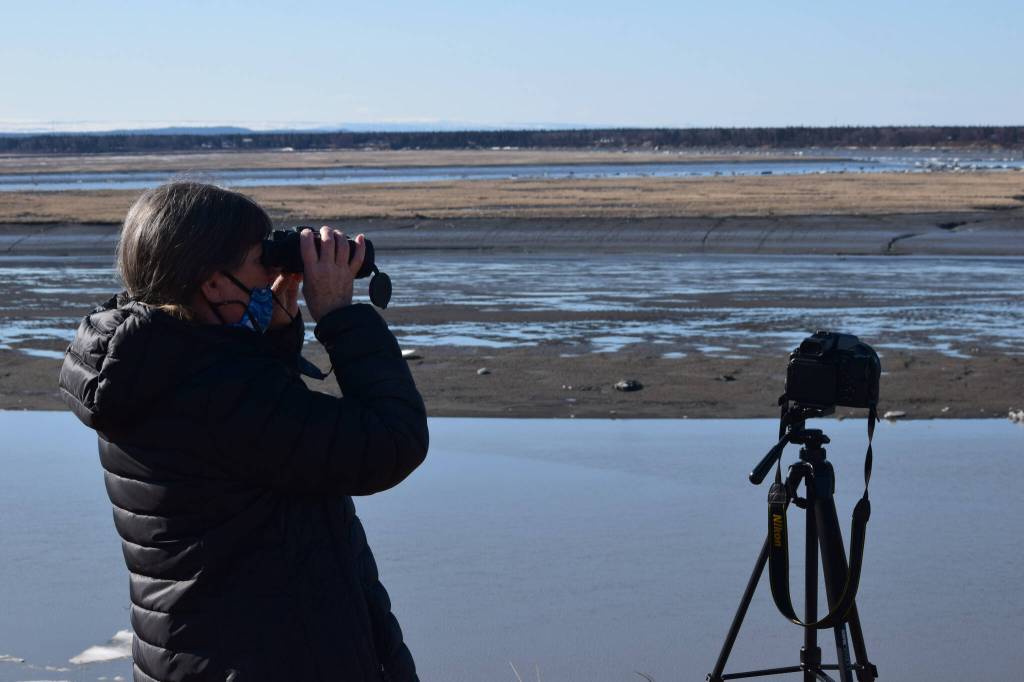
Teresa Becher watches as beluga whales swim up the Kenai River on Saturday, April 24, 2021. She and her volunteer team monitor belugas in the Cook Inlet. (Camille Botello/Peninsula Clarion file)

Teresa Becher watches as beluga whales swim up the Kenai River on Saturday, April 24, 2021. She and her volunteer team monitor belugas in the Cook Inlet. (Camille Botello/Peninsula Clarion file)

Ship noise may impact endangered Cook Inlet belugas, study finds

Cook Inlet sees traffic and noise from commercial shipping, the international airport, military operations and oil and gas exploration

The “vital” vocal communications of the endangered population of Cook Inlet belugas may be masked by ship noise in its core critical habitat. That’s according to a study by the Journal of the Acoustical Society of America, published in November and featured by the National Oceanic and Atmospheric Administration on Monday.

According to NOAA Fisheries, belugas are “highly social and vocal marine mammals” who “use acoustics to find prey, navigate their environment, avoid predators, and maintain group cohesion.” The study, which NOAA says was a collaborative effort between their own Alaska Fisheries Science Center, the University of Washington and the State Department of Fish and Game, sought to “document the complex vocal repertoire” of the population.

The completed study, “Communication in Cook Inlet beluga whales: Describing the vocal repertoire and masking of calls by commercial ship noise” was published on Nov. 30 and authored by Arial Brewer, Manuel Castellote, Amy Van Cise, Tom Gage and Andrew Berdahl.

Brewer says in the NOAA feature that Cook Inlet sees traffic and noise from commercial shipping, the international airport, military operations and oil and gas exploration.

”All of that human-caused noise means the belugas may not hear critical communications from each other, such as predator alarm calls or a mother calling to her calf,” Brewer says in the feature.

She goes on to say that Cook Inlet belugas may be “particularly vulnerable” to noise because of how turbid — or cloudy — Cook Inlet is. The waters of Cook Inlet, made turbid by glacial runoff, are “like chocolate milk,” Brewer says.

The study was conducted by analyzing recordings produced by passive acoustic recorders mounted in Cook Inlet as part of the Cook Inlet Beluga Acoustics Program. The NOAA feature says the scientists analyzed recordings from multiple seasons generated at the Susitna River and at Trading Bay.

The group listened for beluga vocalizations and classified them into three groups. They used a process called rarefaction to “assess the richness and completeness of a beluga vocal repertoire,” which NOAA says has never been done for a beluga population before.

The constructed vocal repertoire can be used, Brewer says in the feature, do expand understanding of habitat size and behavior in the population.

Of the 41 calls documented in the study, 18 have not been documented in any other population of beluga whales, which speaks to the “long-term geographic and genetic isolation” of the population, Brewer says.

The calls defined in the study were also tested for masking — when the ability to detect and recognize a sound is degraded by the presence of another sound. The sound frequency of the Cook Inlet beluga calls were tested against the sound of commercial ship noise through “the most important area of their habitat.”

All seven of “the most commonly used call types” were partially masked by commercial ships within 17 kilometers of the study — and they were completely masked when the ships were at their closest.

Taking the average number of ships that use the Port of Alaska each year, NOAA says that an average of eight to 10 ships pass each week. Each of those passages “could mask” beluga communication for an average of nearly two hours.

“This means beluga communication in the Susitna delta could be subject to masking for approximately 29-37 hours a week,” the feature reads.

To read the full feature by NOAA Fisheries, visit fisheries.noaa.gov and search for “vocal repertoire of Cook Inlet Beluga”

Reach reporter Jake Dye at jacob.dye@peninsulaclarion.com.

More in News

Goldenview Middle School student Luciana Liu's winning poster entry for the 2024 Alaska Radon Poster Contest. Photo provided by the Alaska Department of Natural Resources
Students invited to compete in statewide radon poster contest

The deadline to submit poster entries is Dec. 19.

The industrial area of Nikiski, featuring a refinery and currently mothballed LNG and fertilizer plants, was selected by the producer-led consortium of the Alaska LNG Project before the state took over in 2017. (Photo/File/AJOC)
The industrial area of Nikiski, featuring a refinery and currently mothballed LNG and fertilizer plants, was selected by the producer-led consortium of the Alaska LNG Project before the state took over in 2017. (File photo)
Harvest Midstream announces Kenai LNG terminal acquisition

The company is now seeking engagement from global LNG suppliers and potential offtake customers, a Nov. 11 press release says.

The aurora borealis is seen from Mendenhall Lake in Juneau on Nov. 12, 2025. A series of solar flares caused unusually bright displays of the northern lights across Alaska Tuesday and Wednesday nights. (Chloe Anderson/Peninsula Clarion)
Out of the Office: Aurora’s performance was worth the wait

A series of solar flares caused an unusually bright display of the northern lights Wednesday night.

The KBBI Public Radio office and studio is on Kachemak Way, as seen in this photo taken July 2, 2019, in Homer, Alaska. (Photo by Michael Armstrong/Homer News)
Kenai Peninsula public radio receives grant funding

The Alaska Community Foundation fund recently awarded $2.9 million in grants to public media stations statewide, including in Homer and Kenai.

Low clouds hang over Cook Inlet north of Anchor Point on Oct. 23, 2025. The Trump administration is planning an oil and gas lease sale in federal territory of the inlet. It is set to be the first of at six Cook Inlet lease sales that Congress has mandated by held between now and 2032. (Photo by Yereth Rosen/Alaska Beacon)
Trump administration sets terms for upcoming oil and gas lease sale in Alaska’s Cook Inlet

The ‘Big Beautiful Cook Inlet Oil and Gas Lease Sale,’ scheduled for March, would follow a series of federal and state inlet lease sales that drew little industry interest.

Volunteers gather around a captured salmon during one of Cook Inletkeeper’s Mapping Salmon Habitat Solution field days in August<ins> 2025</ins>. Every year, Cook Inletkeeper creates programs designed to get community members involved with mapping salmon habitat.
Cook Inletkeeper program promotes community engagement

Backyard Salmonscapes aims to map undocumented salmon habitat with the help of volunteers.

Central Peninsula Hospital is seen on June 24, 2018 in Soldotna, Alaska. (Ben Boettger/Peninsula Clarion)
Central Peninsula Hospital names new CEO

Angela Hinnegan will replace Shaun Keef as CEO following Keef’s retirement in January.

Grant Aviation’s Cessna 208B EX Grand Caravan is pictured at the Kenai Municipal Airport in Kenai, Alaska, on Monday, March 4, 2024. (Jake Dye/Peninsula Clarion)
Federal mandate orders Grant Aviation to cut flights

Grant Aviation will cut 10% of its flights between Kenai and Anchorage by Nov. 14.

The logo for the Kenai Peninsula Borough School District is displayed inside the George A. Navarre Borough Admin Building on Thursday, July 22, 2021 in Soldotna, Alaska. (Ashlyn O’Hara/Peninsula Clarion)
Board of Education moves to increase school meal prices

In January, the cost of adult meals and elementary student lunches will increase.

Most Read