
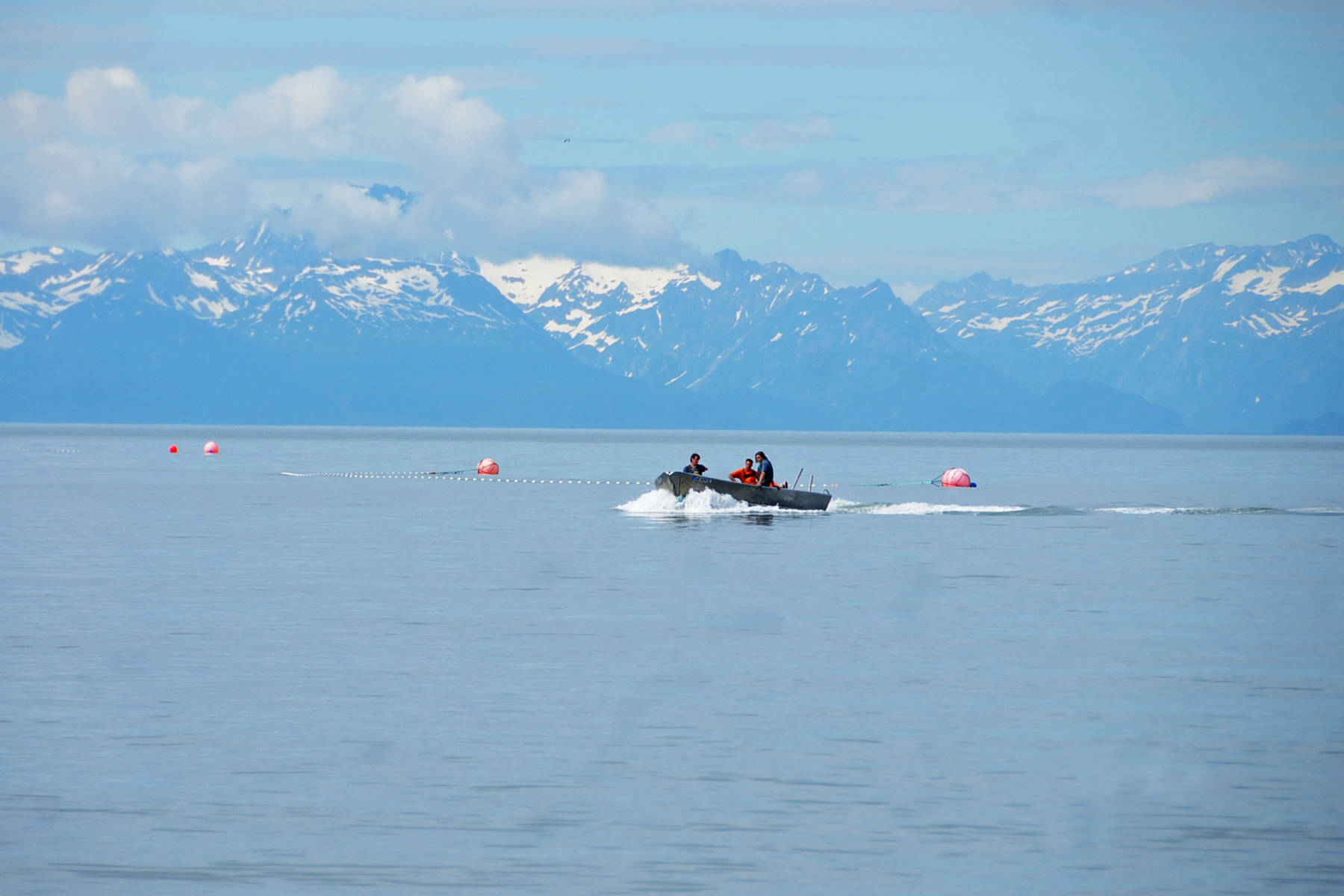
With low king salmon counts in the Kenai River and restrictions tightened on most fisheries in the area, scrutiny is tightening on the commercial set gillnet fishery still harvesting kings.
Setnetters on the east side of Cook Inlet are allowed by their permits to harvest kings, but with the inriver sportfishery restricted to catch-and-release only and the personal-use dipnet fishery prohibited from harvesting kings, sportfishermen have expressed frustration that the setnetters are still allowed to fish and harvest kings. The Kenai River Professional Guide Association has repeatedly called for setnetting closures to allow more king salmon to enter the river, objecting to the Alaska Department of Fish and Game issuing emergency orders to open them.
As of Friday, 4,878 large king salmon had passed Fish and Game’s sonar on the Kenai River. In 2017, Fish and Game converted to counting only king salmon larger than 75 centimeters from mid-eye to tail fork toward escapement and excluding smaller king salmon. When the Board of Fisheries approved the new counting goal in 2017, the escapement number was adjusted down to reflect that not all kings would be counted anymore.
The official numbers for the commercial east side setnet fishery state that fishermen have harvested 1,428 king salmon as of July 14. However, only about 148–192 of those are Kenai River large kings, according to estimates from Fish and Game provided to the Clarion. More accurate analysis will be available post-season when a genetic analysis is done.
Setnetters want to make sure everyone knows the difference. On Monday, the Kenai Peninsula Fishermen’s Association — a Soldotna-based nonprofit representing east side setnetters — issued a press release July 16 saying the Kenai River Sportfishing Association is spreading an incorrect number about the king salmon harvest.
The press release specifically identified two news reports in which Kenai River Sportfishing Association Executive Director Ricky Gease said setnetters had harvested 1,700 king salmon as of July 13. In a July 13 public letter to Gov. Bill Walker, Kenai River Sportfishing Association Chairman Bill Eckhardt wrote that commercial fishermen had harvested 1,700 kings and setnetters had harvested “more than 1- times the number of large-size king salmon than have sport anglers.”
That number isn’t accurate, the group said in its release.
“Mr. Gease’s statements are false, worse such disregard for the truth only fuels the ongoing Cook Inlet fish wars at a time when all user groups should be seeking solutions to provide prudent and equitable access, while maintaining healthy salmon stocks,” the release states. “KPFA supports the Alaska Department of Fish and Game’s science-based management rather than the attack-dog, community-dividing actions that have become the hallmark of the Kenai River Sportfishing Association.”
The group asked Fish and Game to publicly release the number of large king salmon caught in setnets. Kenai Peninsula Fishermen’s Association President Andy Hall said the confusion between the total harvest and the number of large king salmon was one of the setnetters’ concerns when Fish and Game transitioned to the large-king goal.
When Fish and Game restricted the Kenai River sportfishery to catch-and-release only for kings, the setnet fishery felt the impact too — they can only fish for 24 hours maximum per week if the sportfishery is restricted to catch-and-release, per the management plan.
Most of the kings caught in the setnet harvest have been smaller kings, less than 34 inches, which is part of why the Kenai River Sportfishing Association supported the transition to the large-king goal, Gease said — they want to see more large kings in the escapement, supporting more eggs and possibly genetics for larger fish.
Gease said the Kenai River Sportfishing Association supported Fish and Game’s decision to restrict the harvest of kings to help boost escapement. As of July 13, projections show the Kenai River run won’t meet the minimum escapement without harvest restrictions.
“Hopefully the numbers will slide back up — maybe they will, maybe they won’t,” Gease said.
Setnetters in the Kasilof section and North Kalifornsky Beach fished Saturday with nets within 600 feet of the mean high tide mark, targeting primarily Kasilof River-bound sockeye, and Fish and Game announced another 12-hour opener Sunday in the Kasilof Section within 60 feet of the mean high tide mark.
Reach Elizabeth Earl at eearl@peninsulaclarion.com.
