
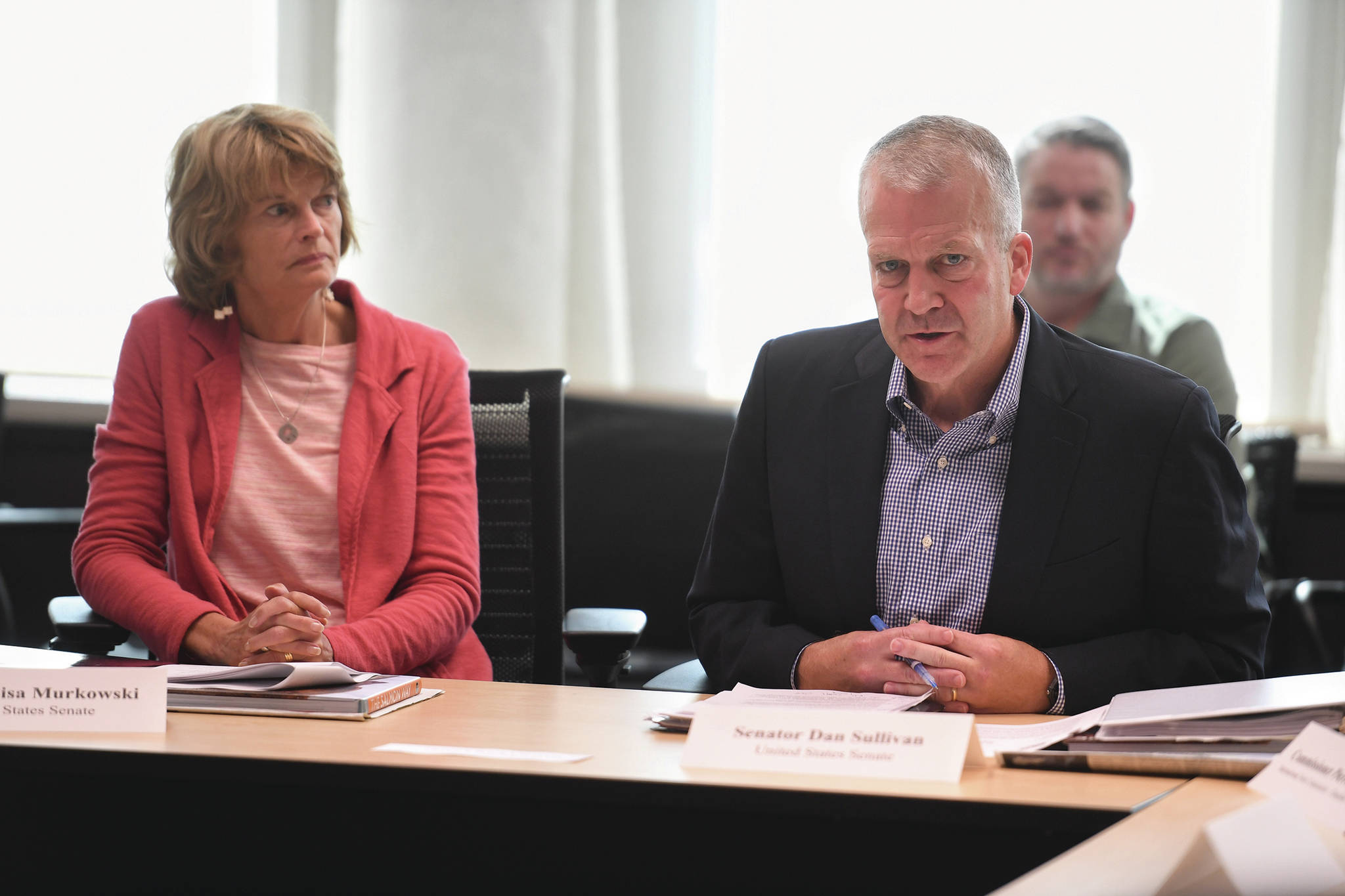
In town hall audioconferences held the past two weeks on the COVID-19 pandemic, Alaska’s U.S. senators have been listening to concerns and trying to help citizens get relief through the $2 trillion Coronavirus Aid, Relief and Economic Security, or CARES Act.
Sen. Lisa Murkowski and Sen. Dan Sullivan have held the dial-in audioconferences on April 2 and April 9 to give people an opportunity to understand how Congress has responded to the pandemic and how it can help them. The April 2 conference aimed to explain the act and how laid-off workers and small business owners can get help from the impact of the pandemic. This week, they heard about issues people have been having and acknowledged the challenge of rolling out a massive aid effort.
“There are going to be snafus,” Sullivan said at the April 9 audioconference. “We are going to work with you around the clock.”
“We have experienced issues and problems,” Murkowski said. “I think we’re going to hear from lots of folks with frustrations about the payroll protection program.”
Murkowski referred to a provision of the CARES Act that helps out small businesses and employees. Small businesses with fewer than 500 employees who get federally guaranteed loans and keep up their payroll can get up to eight weeks of payments. That act was the third phase of laws addressing the impacts of the pandemic, following two other acts to provide $8.3 billion in supplemental payments for responding to the pandemic and a second bill that bolstered the response, including paying for COVID-19 testing and securing family and medical leave.
The CARES act also boosts unemployment benefits, with an additional 13 weeks above what state laws provide. It adds $600 to the weekly compensation states provide. Murkowski noted the act doesn’t just apply to salaried employees, but also to the self-employed, independent contractors and people who are sick, caring for a sick family member, under a community quarantine or self-quarantined.
Most people at the call-in on April 9 had questions about those two provisions. A gravel-pit operator in Juneau, Jim Sydney, asked how as a self-employed, owner-run business he could get the payroll loans. Murkowski said he actually could get unemployment compensation.
“For those of you who are self-employed, independent contractors, you apply tomorrow on the 10th,” she said.
Sullivan said small businesses also can apply for economic injury disaster loans and request an advance of $10,000.
“Even if you don’t get the loan, it is essentially a grant to small businesses,” he said.
One glitch applicants have found is that they have to apply through the State of Alaska unemployment program, and that’s not quite in step with the federal program.
“What we’re hearing and seeing is the updated system of the state hasn’t caught up with them on expanded regulations and eligibility we put in the federal law,” Sullivan said.
“They’re working to put this in place,” Murkowski added. “It’s just taking a bit longer. It’s not unique to Alaska.”
Gavin Hudson of Metlakatka said he understood the CARES Act didn’t apply to gambling enterprises. The Southeast Alaska community has some gaming operations. Sullivan said he would check into that.
Murkowski said the point of the CARES Act was to get assistance out quickly.
“I was going to say ‘immediately,’ but we all know it’s hard to get things immediately through the federal government,” she said.
Jim Rowe, president of Bering Air out of Nome, asked about COVID-19 testing kits. He said he’d like to buy the Abbott machines and 5,000 test kits to make sure his pilots, mechanics and workers aren’t infected. He’s already done things like separate parts of his workforce so if someone tests positive not everyone will have to be isolated.
“So many of us recognize it is this testing that is going to allow us to get back to work safely,” Murkowski said.
One test that could help is an antibody test, one that determines if someone had been infected with COVID-19 unknowingly and might be immune. Some people who get the virus don’t show major symptoms and might not think they had the disease. Murkowski said public health officials hope to hear about antibody tests soon.
“We want to flood the zone — flood the zone,” she said of antibody testing.
One Homer caller, Brenda Adams, had a practical question: How can people who have been in the Lower 48 get through Canada if they want to drive home? On March 21, Canada closed the Canada-U.S. border for 30 days for non-essential travel, including tourism and recreation.
Murkowski said Alaskans returning home should be able to drive through Canada.
“We have been working on not only the Canada travel issue, but all those stranded in other countries,” she said. “The effort in the State Department to bring back folks has been extraordinary.”
Sullivan said one issue is that Canada implemented a mandatory 14-day quarantine for people entering the country.
“We can reach out with Homeland Security and the Canadians to make sure Alaskans can get home,” he said.
Another question came up about how cities could get assistance in the anticipation that they will lose revenues from sales taxes due to a rough tourist season. Could cities get relief for previously planned projects? Murkowski said part of the CARES Act is to help local government, but she didn’t know if expenditures budgeted before the pandemic would be covered.
“We’re seeking to get greater definition from the secretary (of the treasury) as allowance of these expenditures,” she said.
That raised a good point, Sullivan said. The CARES Act is for economic stabilization, but what comes next?
“This entire CARES Act is kind of a tourniquet, a cushion to get us through these difficult times,” he said at the April 2 audioconference.
At the April 9 meeting, he said America needs to look forward to the next phase.
“Phase 4 in my view should be focused on turbocharging our state and our nation’s economy,” Sullivan said “The way we should be doing that, I think, is an intensive infrastructure program.”
Congress members are talking about building and repairing highways, ports, harbors and bridges, he said.
“Together we will get on the other side of this,” Murkowski said of the pandemic. “Alaskans are strong. We are being mightily tested — mightily tested. … Working together, showing kindness to each other, appreciating where we are in this process, is important.”
Reach Michael Armstrong at marmstrong@homernews.com.
