
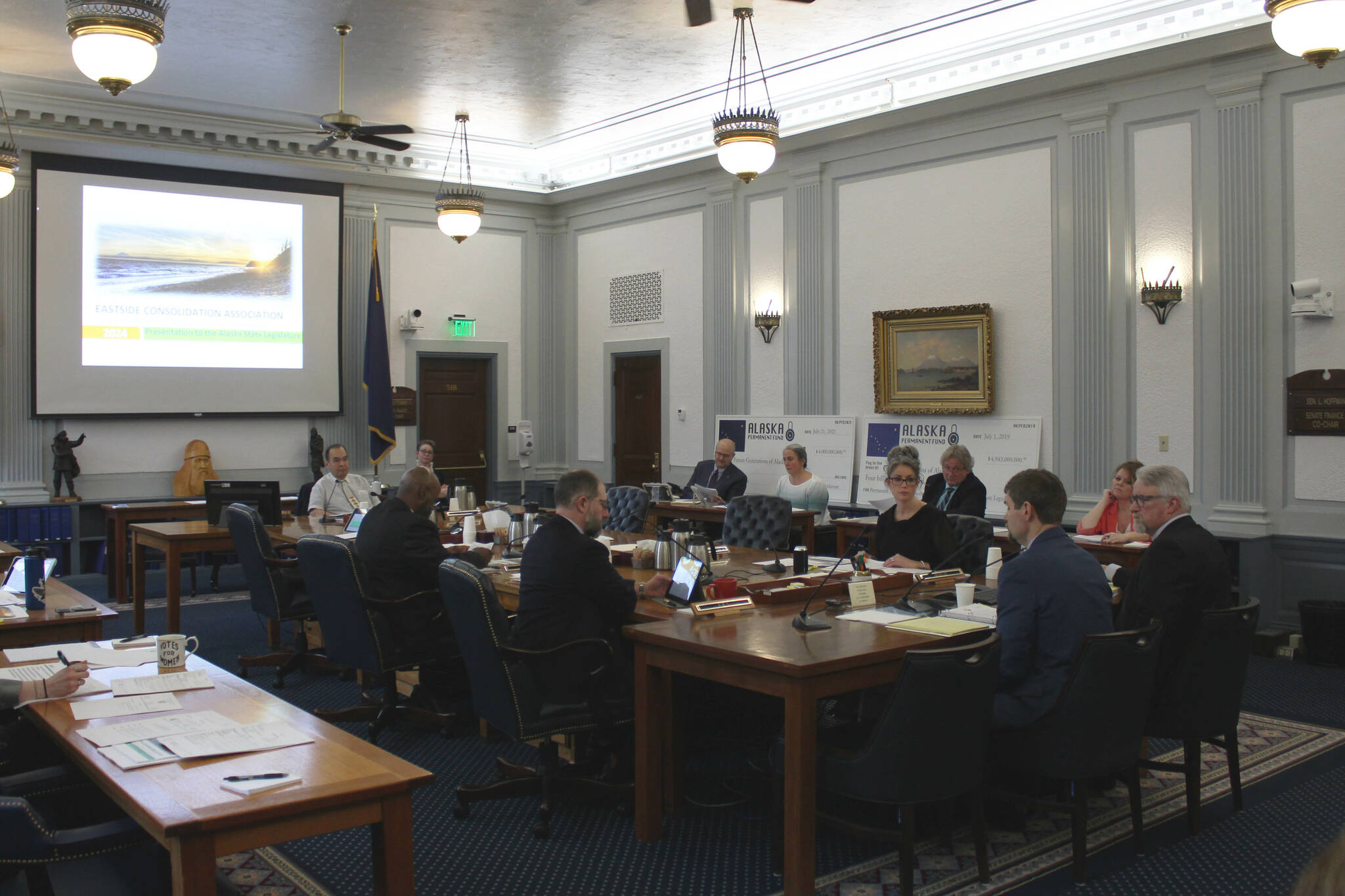
JUNEAU – A Senate committee on Monday considered legislation that would give Cook Inlet’s east side setnet fishermen the opportunity to retire their fishing permits through a volunteer, lottery-style buyback program. The bill, which still needs to pass in both the Alaska House and Senate in the next 12 weeks, would create the program, but not fund the buyouts. That money would need to come from outside groups.
The bill, S.B. 82, is named the East Side of Cook Inlet Set Net Fleet Reduction Act and is sponsored by Sen. Jesse Bjorkman, R-Nikiski. The bill aims to make Cook Inlet’s east side setnet fishery more economically viable and to reduce tensions between fishery user groups by reducing the amount of fishing gear in the water and giving permit holders an opportunity to exit the fishery.
If passed, the legislation would put before eligible east side setnet fishery permit holders the question of whether a buy-back lottery program should be held. If approved, permit holders could apply to participate in the lottery, through which 200 permits would be selected and retired. Retirement of the permit would close that permit’s associated waters to commercial fishing.
Of the 736 fishing permits in Cook Inlet, 440 were registered to the east side in 2022. Fishermen may fish three nets per permit held, meaning 1,320 nets are currently permitted on the east side of Cook Inlet.
The bill was long championed by former Sen. Peter Micciche — lawmakers have considered some version of the bill every year for the last seven — who touted the measure as the project of collaboration between fishery user groups. A survey of more than half of all east side setnet fishery permit holders conducted by Micciche in 2021 found that 92.4% of respondents said they support a voluntary fleet reduction program.
If the bill passes, the state would be on the hook for the $108,000 needed to set up and administer the program. That’s roughly 0.2% of the estimated $52 million needed to actually buy out the proposed 200 permits at $260,000 each, which would not be funded through the bill.
Rather, Bjorkman and others have touted as among the bill’s strengths that the money used for buyouts would come from existing relief programs and nongovernmental agencies, rather than from the state. He provided economically distressed fisheries grants, such as those offered by the National Oceanic and Atmospheric Administration, as an example.
“This permit buyback is not to be funded by state general fund dollars,” Bjorkman said. “It will not require the state to fund the dollars used to purchase these permits. These permits will be purchased by federals grants that are designed for economically distressed fisheries.”
The $260,000 amount per-permit buyout amount is meant to be equal to the average earnings of a setnet permit per year over the past 10 years after expenses. After paying taxes, fisherman could exit the fishery with around $200,000.
Bjorkman fielded questions during Monday’s committee meeting from Sen. Bert Stedman, who was skeptical of the legislation. Among his concerns were why the east side setnet fishery should be uniquely targeted by the program when there are other state fisheries struggling and whether a lottery would open the buyback process up to financial speculation.
“We’ve got numerous fisheries along the coasts of, frankly, Dixon Entrance (south of Ketchikan) clear to Nome that are in trouble,” Stedman said. “So is this going to be a model for buybacks that we’re going to face up and down the coast? What precedents are we potentially setting here with this buyback versus the other fisheries?”
Bjorkman said the economic blow to Cook Inlet’s east side setnet fishery has been handed down through broad regulations by the Alaska Department of Fish and Game.
“Right now, we have an economic benefit from our setnet fishery of zero,” Bjorkman said. “I would like that number to be substantially more than zero and I believe that this model of legislation provides for an avenue to do that.”
Further, the opportunity for that type of financial abuse doesn’t exist because the bill requires lottery participants to have held a fishing permit since at least Jan. 1, 2020, Bjorkman said.
“That closes the door to speculation,” Bjorkman said. “You have to have held a permit and fished the permit in order to be eligible for the program.”
Glenn Haight is a commissioner of the Alaska Commercial Fisheries Entry Commission — the agency that would be responsible for administering the lottery program described in S.B. 82. He told senators Monday that the program wouldn’t require much legwork and that the bill clearly describes what he and his employees would be expected to do.
“I think the timeline is quick, but it’s something we can do,” Haight said. “Just as it relates to our work, it’s pretty simple.”
Haight said there’s also precedent for the type of buyouts described by the bill, which he said has always been part of the Limited Entry Act. As envisioned, the Commercial Fisheries Entry Commission would issue a certain number of permits, then study what the optimal number of permits would be for that fishery and then see if too many permits had been issued.
“If (the commission) got the number wrong — perhaps too many permits — it would go back and establish a buyback,” he said.
Haight pointed to buyouts in Alaska’s recent history as examples. One was for Southeast Alaska’s purse seine salmon fishery, as part of which Congress approved an up to $23.5 million loan to pay for a “fishing capacity reduction program.” In another, Congress authorized up to $100 million for the Bering Sea and Aleutian Islands King and Tanner crab fisheries.
Joining Bjorkman during Monday’s hearing was Ken Coleman, a longtime east side setnet fisherman who is also vice president of the Kenai Peninsula Fisherman’s Association. Coleman told senators that he was also speaking on behalf of the Eastside Consolidation Association, a nonprofit group created to promote the consolidation of the east side setnet fishery through fleet reduction.
Coleman said his goal in presenting the committee and in supporting the bill is to try and advance a program that can help the “very distressed economic condition” that he said setnetters are in.
“Fighting to remain viable, we continue to try to find creative and solution-oriented ways to make sure that our fishermen have the opportunity for economic viability,” Coleman said. “Obviously, there’s not a guarantee and we understand that.”
More than a dozen people called in to testify on the bill Monday, in addition to those who were invited to give testimony and represented stakeholder groups. The vast majority said they support a voluntary gear reduction program like the one described in S.B. 82. Not everyone agrees that a buyout was the best way to provide relief, though. Many who oppose the legislation say a big problem facing the east side setnet fishery — how the fishery is managed — is not addressed by the bill.
Coleman said Tuesday that supporters know that the bill won’t guarantee more fishing time for setnetters, or buyouts for permit holders. The problems facing the fishery, though, are existential, he said, and nearly all surveyed permit holders support the type of relief proposed in the bill.
“We can’t split this 440 ways anymore,” he said, referring to the east side fishing permits.
S.B. 82 must clear both the House and Senate before the end of session on May 15 to cross the legislative finish line.
More information about S.B. 82 can be found on the Alaska Legislature’s website at akleg.gov.
Reach reporter Ashlyn O’Hara at ashlyn.ohara@peninsulaclarion.com.
This reporting from the State Capitol was made possible by the Alaska Center for Excellence in Journalism’s Legislative Reporter Exchange. Alaska news outlets, please contact Erin Thompson at editor@peninsulaclarion.com to republish this story.
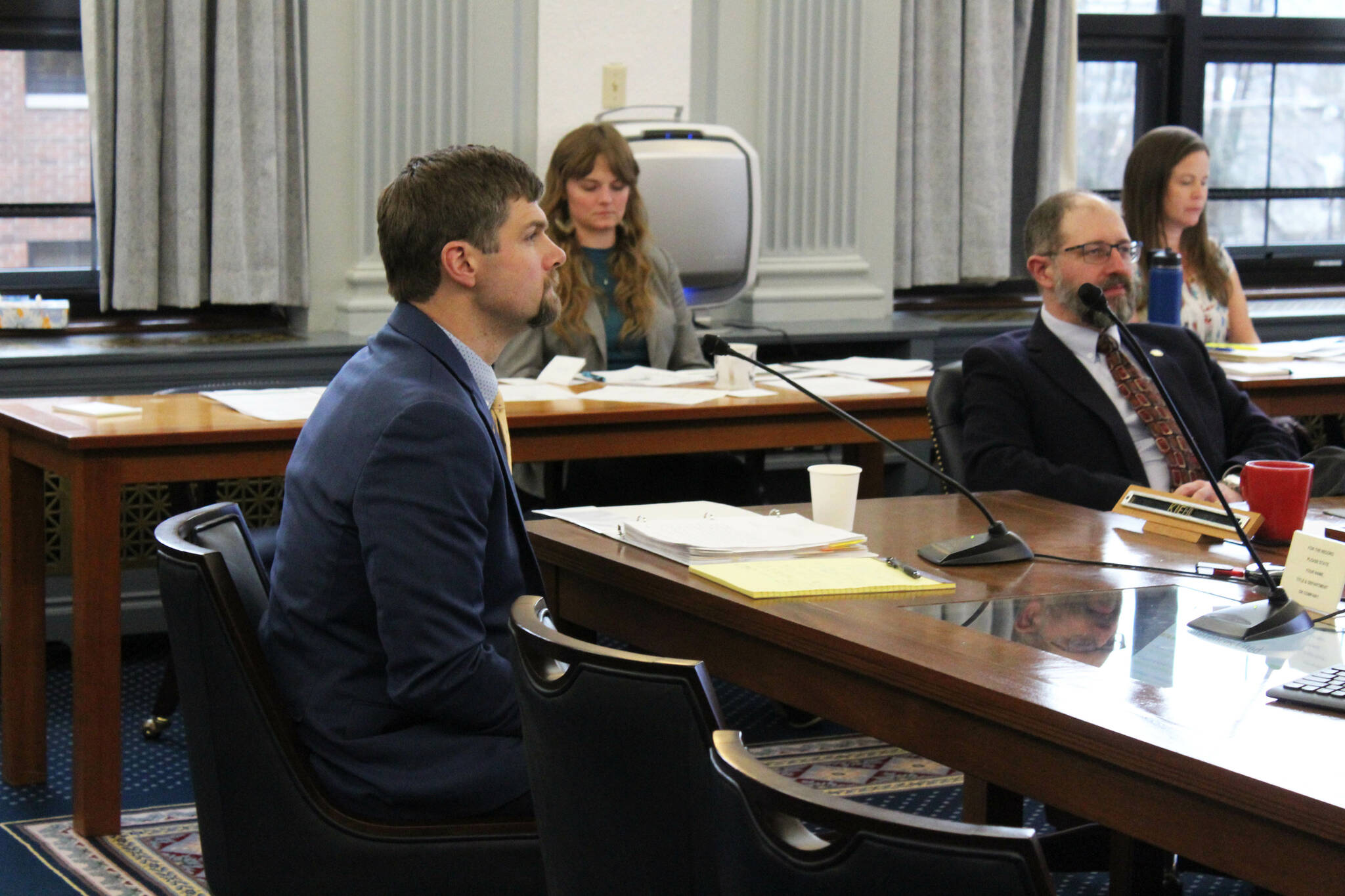
Sen. Jesse Bjorkman, R-Nikiski, presents information on a bill establishing a voluntary buyback program for Cook Inlet’s east side setnet fishery on Monday, Feb. 19, 2024, in Juneau, Alaska. (Ashlyn O’Hara/Peninsula Clarion)
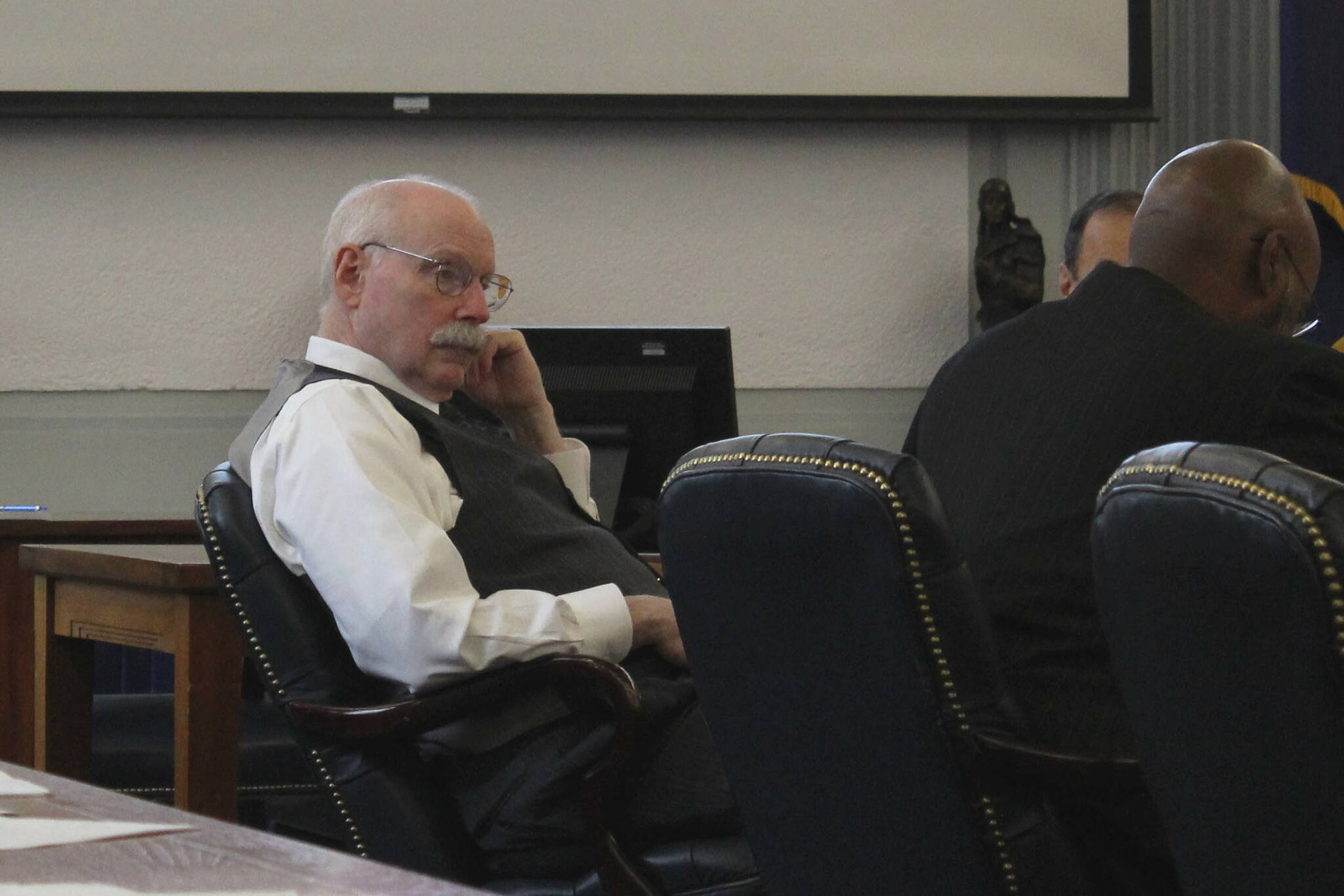
Sen. Bert Stedman, R-Sitka, asks questions about a bill establishing a voluntary buyback program for east side setnet fishery permits during a Senate Finance Committee meeting on Monday, Feb. 19, 2024, in Juneau, Alaska. (Ashlyn O’Hara/Peninsula Clarion)
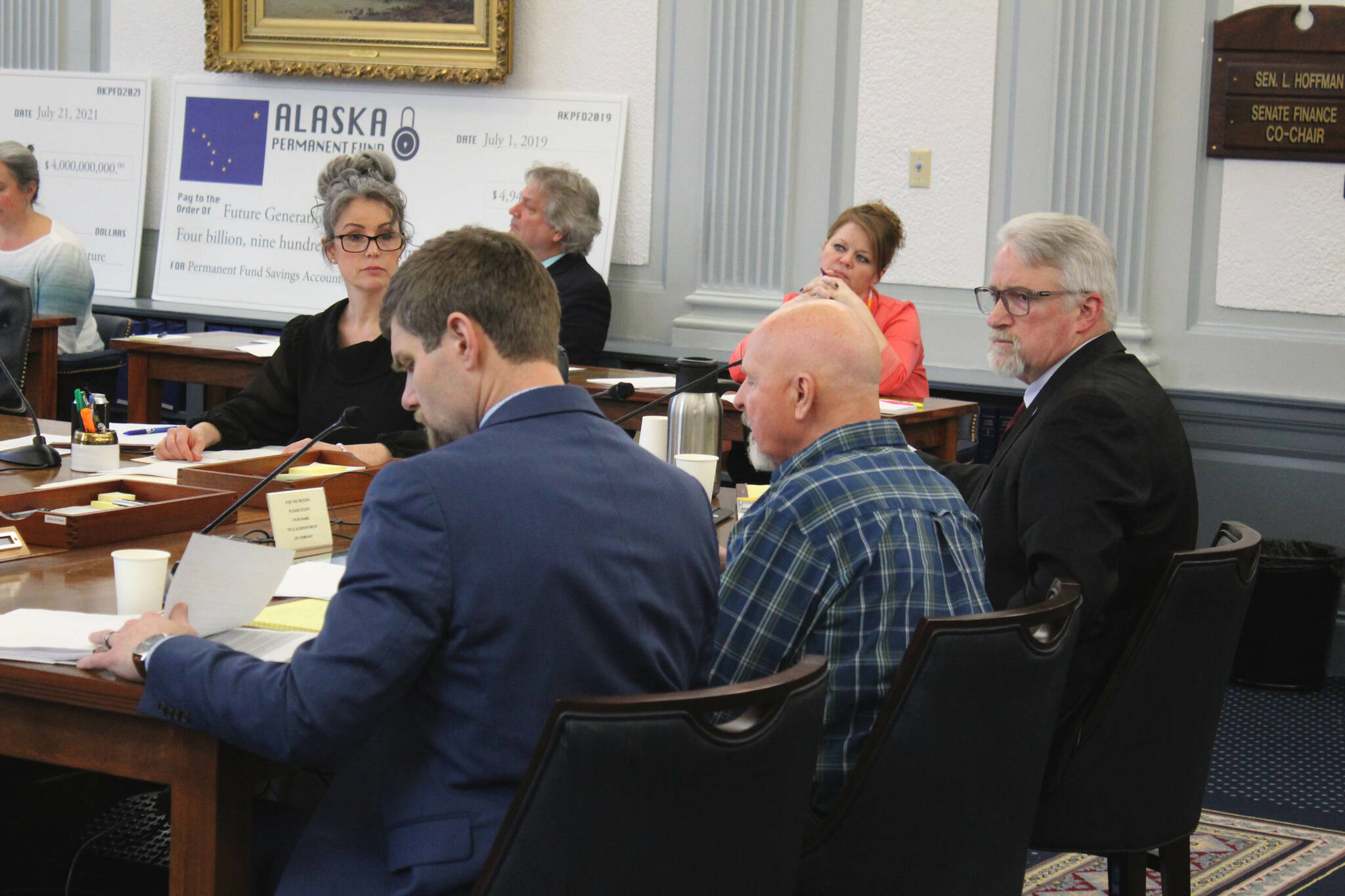
From left, Sen. Jesse Bjorkman, R-Nikiski, east side setnetter Ken Coleman and Konrad Jackson present information about a bill establishing a voluntary buyback program for east side setnet fishery permits during a Senate Finance Committee meeting on Monday, Feb. 19, 2024, in Juneau, Alaska. (Ashlyn O’Hara/Peninsula Clarion)
