
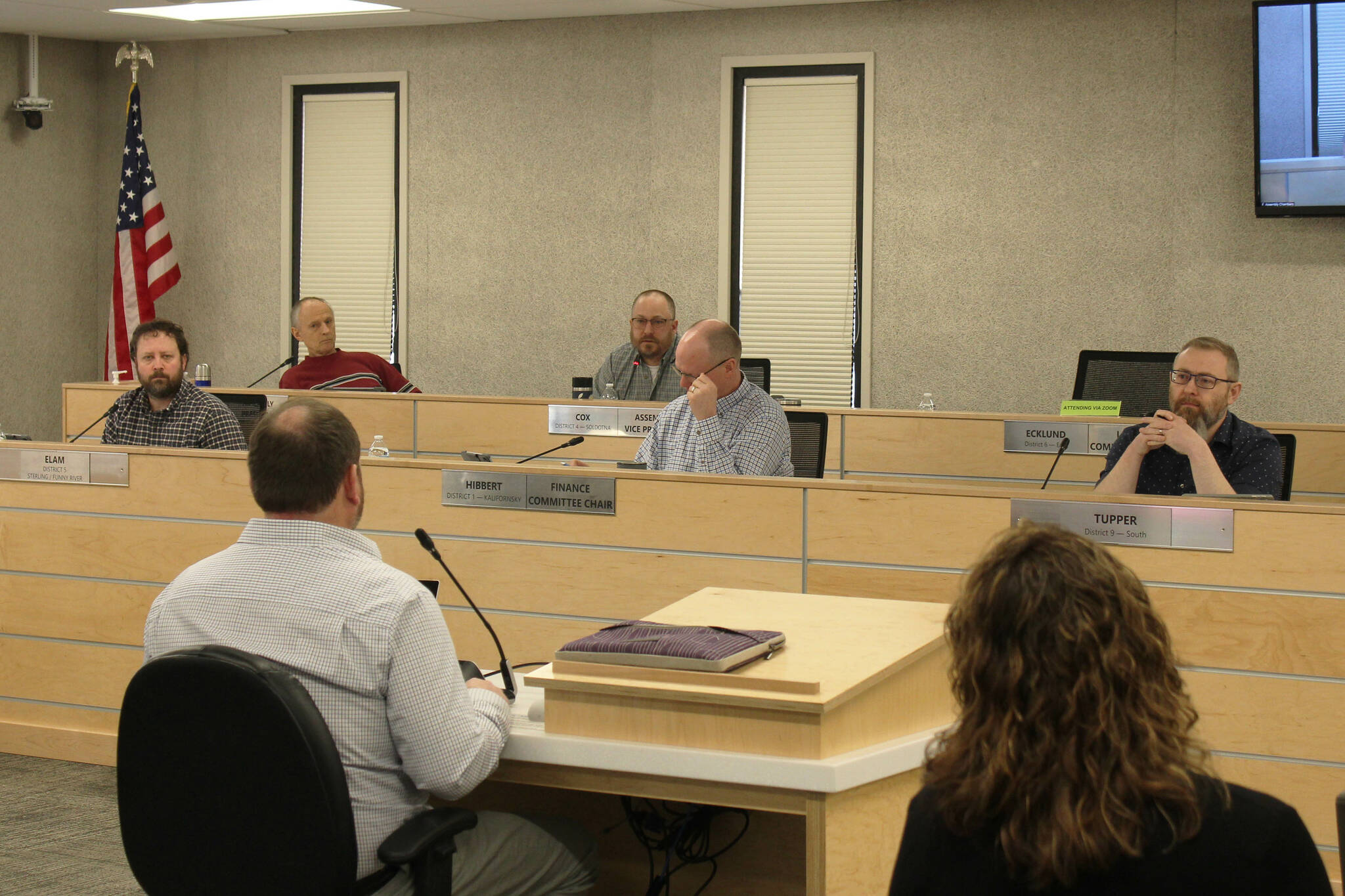
Administrators from the Kenai Peninsula Borough School District convened with the Kenai Peninsula Borough Assembly for a work session Tuesday to present the district’s needs for the upcoming fiscal year. KPBSD, which is forecasting a $13.1 million budget deficit, has requested to be fully funded by the borough this fiscal year at around $54.8 million.
That’s about $2.2 million more than the amount of money the borough gave the school district last year. Because the assessed value of the Kenai Peninsula Borough by the State of Alaska increased, the amount of money the borough is allowed to contribute to the school district increased. All of the money the borough earns through sales tax already goes to funding borough schools.
Assembly member Richard Derkevorkian, who represents Kenai, said Tuesday that any money needed that exceeds what the borough can provide through sales tax revenue will come from borough property tax revenue.
“If we fund to the $54 million cap, today it looks like we’d be covering $7 or $8 million from property taxes in the borough,” Derkevorkian said. “So if the state were to give them more money, that burden could go down on borough property owners.”
Looking to the state
Of the roughly $135 million in general fund revenue KPBSD expects to bring in during fiscal year 2024, about $79 million — about 59% — comes from the State of Alaska. A borough contribution of $54.8 million would account for about 40.6% of KPBSD’s general fund revenue for the upcoming fiscal year.
A priority of KPBSD in recent months has been encouraging people to lobby the Alaska Legislature for increases to the amount of money school districts receive per student. The current amount, $5,930, hasn’t changed since fiscal year 2017, but will increase to $5,960 for the upcoming fiscal year.
KPBSD Finance Director Elizabeth Hayes said Tuesday that every $100 increase to the base student allocation provides $1.7 million more to the school district, based on projected enrollment numbers. A $1,000 increase as proposed in Senate Bill 52 would, therefore, increase state funding for KPBSD by $17 million. A $1,250 increase as proposed in House Bill 65 would increase district funding by nearly $20 million.
If no increase to the base student allocation is approved this legislative session, Hayes said KPBSD will be in a worse position next year.
“If we were not to get any increase to the BSA, and we’ve cut $3.8 million this year, we’d have to look at cutting another $6.5 million next year just to stay at the level we are today,” Hayes said.
Cuts ahead
The district has used some of its federal COVID-19 relief funds to support its general fund, Hayes said, but those one-time monies are going away at the end of the current fiscal year. The district’s second round of federal funding, for example, was used to save 74.3 certified staff positions and 14 non-certified positions.
Hayes reiterated Tuesday that the school board wants to keep fiscal year 2024 budget cuts as far away from the classroom as possible to ensure the district could keep as many existing staff, whose contracts are approved at the beginning of the year. District support staff, such as pool managers and theater technicians, are under a different type of contract called a personnel action form.
“As we learn our funding sources, the board will make a decision on which items on the cut list to bring back into our schools,” Hayes told assembly members.
Hayes has been directed by the board of education to move forward with cuts described in a list submitted for consideration by the board’s finance committee. Using $6.4 million in leftover COVID-19 relief funds, one-third of the district’s savings account — about $821,000 — and an additional $3.3 million in cuts, Hayes said the district will be able to present a balanced budget to the assembly.
The additional budget cuts include:
Increasing the student-to-teacher ratio by three students at Homer High, Kenai Central High, Nikiski Middle/High and Soldotna High schools
Increasing the student-to-teacher ratio by two students at some district middle schools
Eliminating pool managers at Susan B. English, Skyview Middle, Ninilchik, Kenai Central High, Homer High, Seward High and Soldotna High school
Eliminating theater technicians at Homer High School, Seward High School and schools on the central peninsula
Eliminating student success liaisons and athletic directors
Cutting school supplies by 10%
Cutting extra curricular travel funds, safety equipment and hockey ice
When asked whether KPBSD was considering closing any schools to save money, KPBSD Superintendent Clayton Holland said that the process of closing schools is long and one that doesn’t always result in significant cost savings. Still, Holland said current financial circumstances mean it hasn’t entirely been ruled out.
“If we stay on the same financial trajectory, I think everything’s on the table, again, including school closures, but I’d have to also defer to the board,” Holland said. “ … I think everything’s on the table if things don’t change.”
Boosting enrollment
Kenai Peninsula Borough Mayor Peter Micciche, who has previously said he supports funding the school district to the cap, said the district and the borough should prioritize bringing back to the district peninsula students enrolled in a non-KPBSD home-school program. Hayes told the Clarion last month that there are more than 1,400 school-age children on the Kenai peninsula who attend a home-school program that is not Connections.
If all the school-age Kenai Peninsula Borough students currently enrolled in a non-KPBSD home-school program decided to enroll in Connections for next school year, the amount of money KPBSD receives from the State of Alaska would increase by about $7.7 million for the upcoming fiscal year, Hayes said.
Micciche suggested a survey be sent out to parents whose children are enrolled in a non-KPBSD home-school program and floated the idea of creating a borough working group to address the issue.
“(I’m) just wondering what that process looks like for an all-hands-on-deck approach to understand why those parents are choosing to go elsewhere and what we can do to bring a relatively high proportion of them back to Connections right here in our own district,” Micciche said.
Assembly members on Tuesday passed a resolution requesting a “meaningful increase” to the base student allocation as a way to “bridge the fiscal gap” caused by a historic lack of adjustments for inflation. Copies of the resolution will be sent to multiple state legislative groups, including the peninsula lawmakers, the House and Senate education committee and Gov. Mike Dunleavy, among others.
“Requiring the Kenai Peninsula Borough to continually increase local contributions to keep pace with rising costs (results) in decreased spending on other essential programs,” the resolution says.
Tuesday’s full work session between KPBSD and the Kenai Peninsula Borough Assembly can be streamed on the borough’s website at kpb.legistar.us.
Reach reporter Ashlyn O’Hara at ashlyn.ohara@peninsulaclarion.com.
