
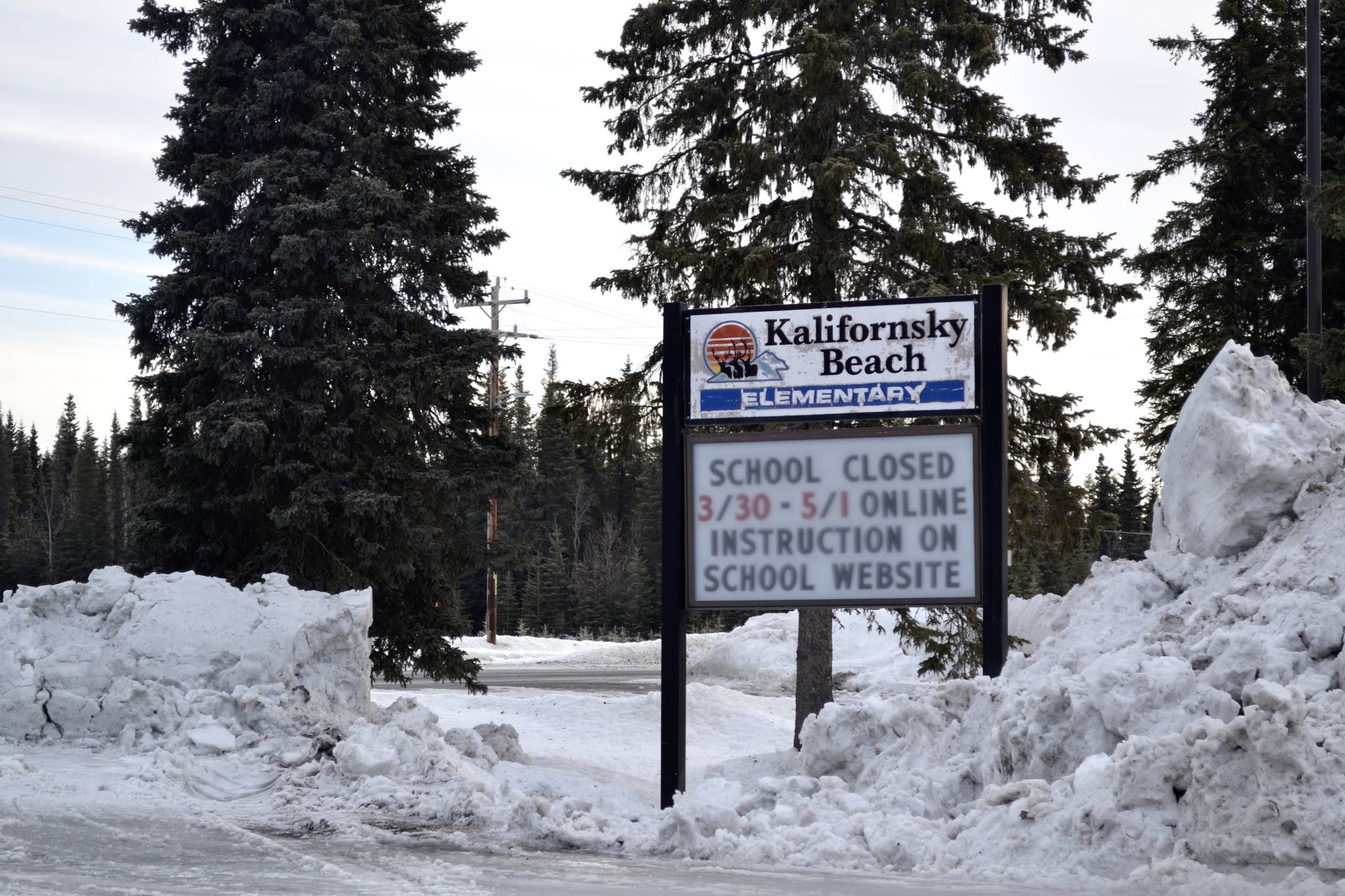
The first day of school for Kenai Peninsula students is poised to be Aug. 24, as the Kenai Peninsula Borough School District finalizes its mitigation plan for returning students to hallways both physical and virtual in the fall.
The KPBSD School Board will vote on whether to set the first day of school for Aug. 24 at their upcoming meeting on Monday.
Pegge Erkeneff, director of Communications, Community and Government Relations for the school district, said this delayed start date is meant to give teachers and staff more of the time they’ll need to prepare their classrooms and lessons for students.
“We can do the right thing in the wrong way, or we can do the right thing in the right way,” she said.
Also at their Monday meeting, the board will vote on whether to approve the “COVID-19 Smart Start” plan the district has put together. The Alaska Department of Education and Early Development (DEED) has mandated that each school district in the state submit a COVID-19 mitigation plan for the 2020-21 school year by July 31.
If approved by the school board, the plan will be available for the public to review on the school district’s webpage specifically for Smart Start. You can read the current version of the plan here: https://go.boarddocs.com/ak/kpbsd/Board.nsf/files/BRC2LW029A82/$file/KPBSD%202020%20Smart%20Start%20Plan.pdf.
Additional documents related to the Smart Start plan, like the districtwide calendar, alternate calendars for certain schools and end of year surveys, are available to be read on the district’s BoardDocs website, at https://go.boarddocs.com/ak/kpbsd/Board.nsf/goto?open&id=BR9W298348A2.
The last guidelines related to schools given out by the Department of Health and Social Services had to do with conducting graduation ceremonies and how to handle sports and other school activities. Since then, DEED has stepped in to guide state school districts in their plans for the start of classes in the fall. Erkeneff said school districts were notified by DEED that this summer would be spent putting together the Smart Start plans.
Rather than give out statewide guidelines for starting school, DEED has asked each individual school district to come up with its own plan tailored to its student population.
“They gave a lot of local control over designing what that will look like,” Erkeneff said.
While the final Smart Start plan needs to be submitted to DEED by July 31, Erkeneff stressed that it will be subject to updates and changes as the landscape of the COVID-19 pandemic in Alaska changes. Erkeneff said she doesn’t anticipate massive or major changes to the document unless there’s a major change in the way schools need to calculate risk levels when it comes to the virus.
The Smart Start plan is organized by category, including things like cleaning and safety, assessment and grading, classroom design, staff leave protocols, transportation and more. For each category, the district has set up protocols for how that aspect of school will be handled under three given risk levels: low risk, medium risk and high risk.
For example, under a low-risk scenario, school buildings will be open and have physical barriers for office staff, floor markings to keep people 6 feet apart, and volunteers and visitors will be limited to parents and guardians. Under a medium-risk scenario, school building occupancy may be adjusted or reduced to allow for more physical distancing. In a high-risk scenario, school buildings will be closed and teaching will be moved back to a completely virtual mode. This means every classroom will be both physical and virtual, with teachers needing to provide both in-person and remote instruction.
When it comes to the cleaning and sanitizing section of the plan, protocols are the same for both the low-risk and medium-risk scenarios. They include extra sanitizing of desk and common or high-touch areas, and having students clean their own desks and personal items. If a student or staff members is diagnosed with COVID-19, the school in question may be closed for extra sanitizing. The options of a two-hour delay start or early release is also included.
In a high-risk situation, a school would be closed. Under the cleaning section of the plan, it says that “if a building is closed for 72 hours or more, no extra cleaning is needed.”
Erkeneff stressed that the purchasing of cleaning supplies and personal protective equipment should not fall to teachers.
“Teachers will not be expected at all to spend their own money to sanitize their classrooms,” she said.
The district plans to foot the bill for those supplies, Erkeneff said, and is currently working toward ordering them. There are a few categories where the supplies are not yet up to the necessary levels, she said, and the district is still in need of certain supplies.
Another important fact for parents to be aware of, Erkeneff said, is that they will have the choice of whether to send their children to brick and mortar school buildings, or opt to continue their education remotely this fall. The district, and teachers, will have a better idea of how many students to expect back in schools by August, after hearing from parents and their preferences, Erkeneff said. If it turns out more parents want to keep their kids at home, the district could look at something like designating a few more teachers specifically to remote learning, she said.
Erkeneff said what the district really needs in order to be able to open safely in August is personal responsibility from peninsula families now. An uptick in community spread of the virus would further delay plans to reopen, she said.
The district is working directly with the DHSS to learn how to assess risk levels when it comes to COVID-19 in communities, Erkeneff said. The district is also working with representatives from the Centers for Disease Control and Prevention and the state Section of Epidemiology.
The two main goals of the district heading into the fall are safety and continuity of education, Erkeneff said. She acknowledged that, after schools turned on a dime this spring to make all learning virtual, there’s going to be some heavy lifting and big asks of staff this year. She said there will likely be evaluation to determine “what gaps do we need to fill?”
Something Erkeneff said the district needs directly from parents is up-to-date phone numbers and email addresses. Much like the district sends out alerts during dangerous weather events and other emergencies, the district is going to need accurate contact information for each student this year in order to immediately contact parents if there is a change in risk level after school starts, she said.
There were 20 district representatives who participated in drafting the Smart Start plan. They included the presidents of both associations that represent teachers and other staff. The representatives from the southern peninsula were Paul Banks Elementary School Principal Eric Pederson, representing elementary schools, and Homer Middle School Principal Kari Dendurent, representing middle schools and athletics.
Parents can read more information about the Smart Start plan, school activities during COVID-19, and more by going to the main page of the district’s website.
Reach Megan Pacer at mpacer@homernews.com.
